Liu John, Buckley Heather, Ho Kendall, Hubinette Maria, Abdalkhani Arman, Holmes Cheryl, Nathoo Nawaaz
Faculty of Medicine, University of British Columbia, British Columbia, Canada.
Can Med Educ J. 2021 Dec 29;12(6):28-34. doi: 10.36834/cmej.71373. eCollection 2021 Dec.
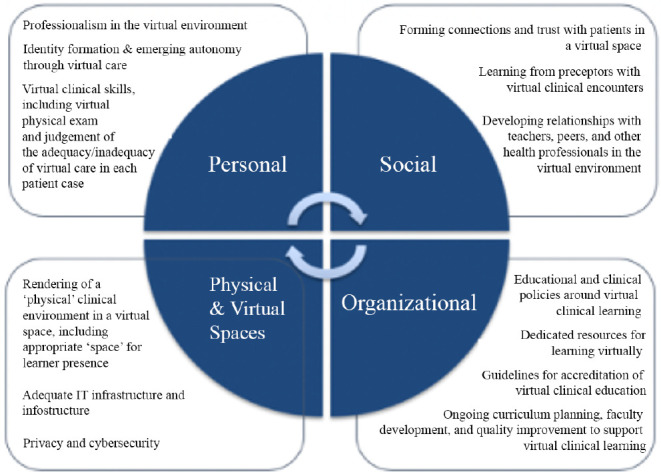
The way in which health care is delivered has rapidly changed since the onset of the COVID-19 pandemic, with a rapid increase in virtual delivery of clinical care. As a result, the learning environment (LE) in health professions education, which has traditionally been situated in the bricks-and-mortar clinical context, now also requires attention to the virtual space. As a frequently examined topic in the health professions literature, the LE is a critical component in the development and training of future healthcare professionals. Based on a published conceptual framework for the LE from Gruppen et al. in 2019, a conceptual framework for how the LE can manifest through virtual care space is presented here. The four components of personal, social, organizational, physical/virtual spaces are explored, with a discussion of how they can be integrated into virtual care. The authors provide suggestions that health professions educators can consider when adapting their LE to the virtual environment and highlight aspects of its integration that require further research and investigation.
自新冠疫情爆发以来,医疗保健的提供方式迅速改变,临床护理的虚拟提供急剧增加。因此,健康职业教育中的学习环境(LE),传统上位于实体临床环境中,现在也需要关注虚拟空间。作为健康职业文献中经常探讨的主题,学习环境是未来医疗保健专业人员发展和培训的关键组成部分。基于Gruppen等人在2019年发表的学习环境概念框架,本文提出了一个关于学习环境如何通过虚拟护理空间体现的概念框架。探讨了个人、社会、组织、物理/虚拟空间这四个组成部分,并讨论了它们如何融入虚拟护理。作者提供了健康职业教育工作者在将其学习环境适应虚拟环境时可以考虑的建议,并强调了其整合中需要进一步研究和调查的方面。