Synn Chun-Bong, Kim Sung Eun, Lee Hee Kyu, Kim Min-Hwan, Kim Jae Hwan, Lee Ji Min, Jo Ha Ni, Lee Wongeun, Kim Dong Kwon, Byeon Youngseon, Kim Young Seob, Yun Mi Ran, Park Chae-Won, Yun Jiyeon, Lim Sangbin, Heo Seong Gu, Yang San-Duk, Lee Eun Ji, Lee Seul, Choi Hunmi, Lee You Won, Cho Jae Seok, Kim Do Hee, Park Sungho, Kim Jung-Ho, Choi Yewon, Lee Sung Sook, Ahn Beung-Chul, Kim Chang Gon, Lim Sun Min, Hong Min Hee, Kim Hye Ryun, Pyo Kyoung-Ho, Cho Byoung Chul
Department of Medical Science College of Medicine Yonsei University Seoul Korea.
Brain Korea 21 PLUS Project for Medical Science Yonsei University College of Medicine Seoul Korea.
Clin Transl Immunology. 2021 Dec 29;11(1):e1364. doi: 10.1002/cti2.1364. eCollection 2022.
AXL-mediated activation of aberrant tyrosine kinase drives various oncogenic processes and facilitates an immunosuppressive microenvironment. We evaluated the anti-tumor and anti-metastatic activities of SKI-G-801, a small-molecule inhibitor of AXL, alone and in combination with anti-PD-1 therapy.
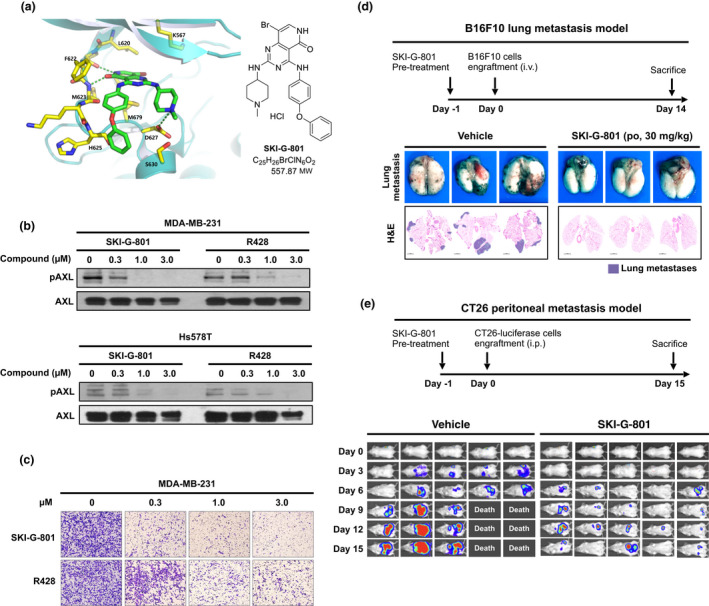
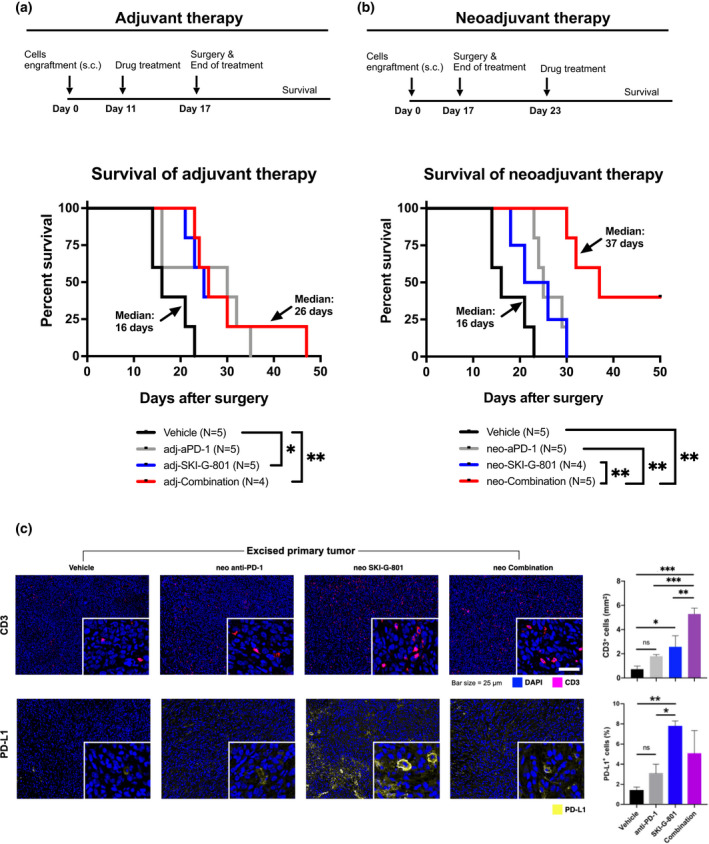
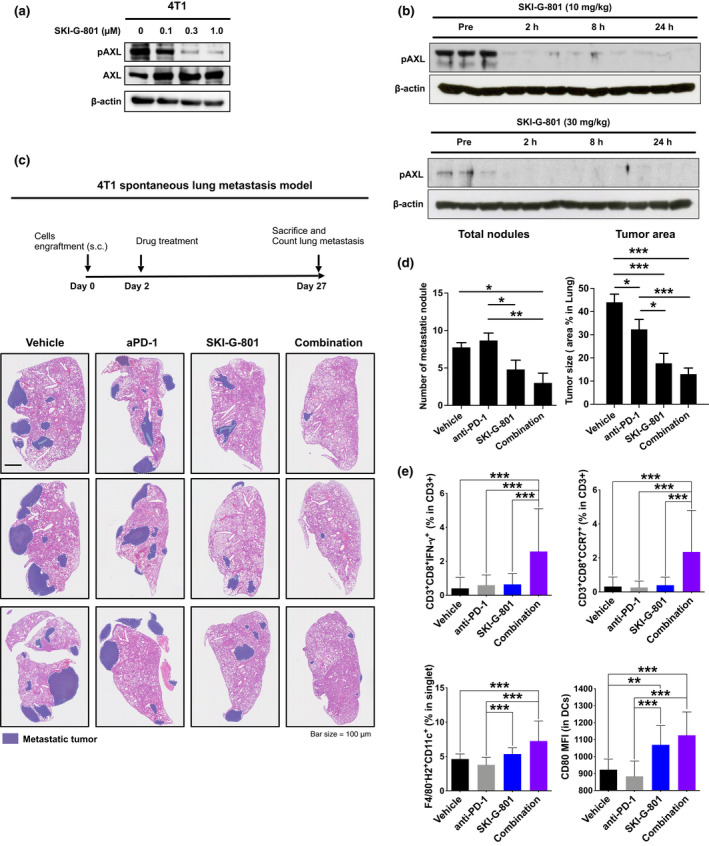
pAXL inhibition by SKI-G-801 was performed in both human and mouse cancer cell lines. Immunocompetent mouse models of tumor were established to measure anti-metastatic potential of SKI-G-801. Furthermore, SKI-G-801, anti-PD-1 or their combination was administered as an adjuvant or neoadjuvant in the 4T1 tumor model to assess their potential for clinical application.
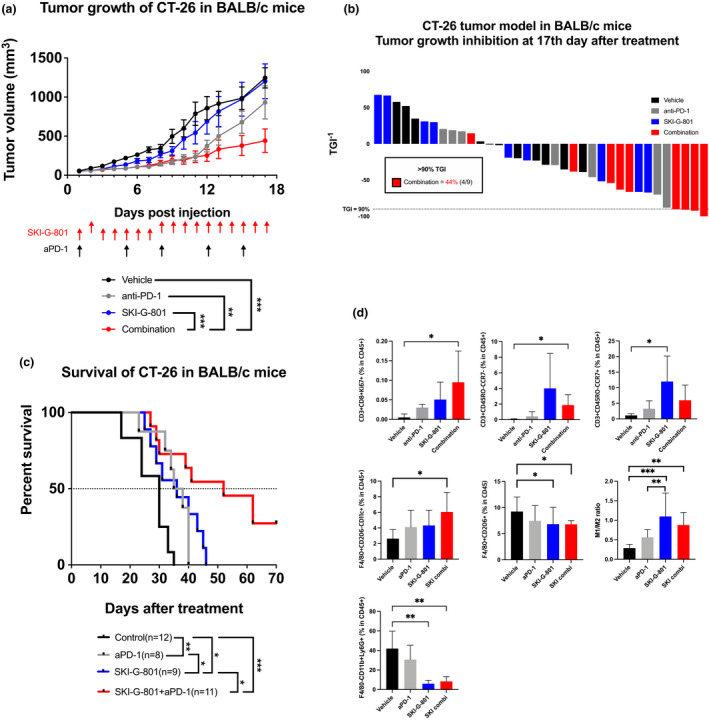
SKI-G-801 robustly inhibited pAXL expression in various cell lines. SKI-G-801 alone or in combination with anti-PD-1 potently inhibited metastasis in B16F10 melanoma, CT26 colon and 4T1 breast models. SKI-G-801 inhibited the growth of B16F10 and 4T1 tumor-bearing mice but not immune-deficient mice. An antibody depletion assay revealed that CD8 T cells significantly contributed to SKI-G-801-mediated survival. Anti-PD-1 and combination group were observed the increased CD8Ki67 and effector T cells and M1 macrophage and decreased M2 macrophage, and granulocytic myeloid-derived suppressor cell (G-MDSC) compared to the control group. The neoadjuvant combination of SKI-G-801 and anti-PD-1 therapy achieved superior survival benefits by inducing more profound T-cell responses in the 4T1 syngeneic mouse model.
SKI-G-801 significantly suppressed tumor metastasis and growth by enhancing anti-tumor immune responses. Our results suggest that SKI-G-801 has the potential to overcome anti-PD-1 therapy resistance and allow more patients to benefit from anti-PD-1 therapy.
AXL介导的异常酪氨酸激酶激活驱动多种致癌过程,并促进免疫抑制微环境的形成。我们评估了AXL小分子抑制剂SKI-G-801单独使用以及与抗PD-1疗法联合使用时的抗肿瘤和抗转移活性。
在人源和小鼠癌细胞系中进行SKI-G-801对pAXL的抑制实验。建立具有免疫活性的小鼠肿瘤模型以测定SKI-G-801的抗转移潜力。此外,在4T1肿瘤模型中,将SKI-G-801、抗PD-1或它们的组合作为辅助剂或新辅助剂给药,以评估它们在临床应用中的潜力。
SKI-G-801在多种细胞系中强烈抑制pAXL表达。SKI-G-801单独使用或与抗PD-1联合使用,在B16F10黑色素瘤、CT26结肠癌和4T1乳腺癌模型中均能有效抑制转移。SKI-G-801抑制B16F10和4T1荷瘤小鼠的生长,但对免疫缺陷小鼠无效。抗体清除实验表明,CD8 T细胞对SKI-G-801介导的生存有显著贡献。与对照组相比,抗PD-1组和联合治疗组的CD8Ki67、效应T细胞、M1巨噬细胞增加,M2巨噬细胞和粒细胞来源的髓系抑制细胞(G-MDSC)减少。在4T1同基因小鼠模型中,SKI-G-801与抗PD-1疗法的新辅助联合通过诱导更强烈的T细胞反应,实现了更好的生存获益。
SKI-G-801通过增强抗肿瘤免疫反应显著抑制肿瘤转移和生长。我们的结果表明,SKI-G-801有潜力克服抗PD-1疗法耐药性,使更多患者从抗PD-1疗法中获益。