National Center for Cancer Immune Therapy, Department of Oncology, University Hospital Herlev, Borgmester Ib Juuls Vej 25C, Copenhagen, Denmark.
Inflammation and Cancer Group, Department of Immunology and Microbiology, University of Copenhagen, Copenhagen, Denmark.
Cancer Immunol Immunother. 2020 Feb;69(2):237-244. doi: 10.1007/s00262-019-02421-w. Epub 2019 Oct 29.
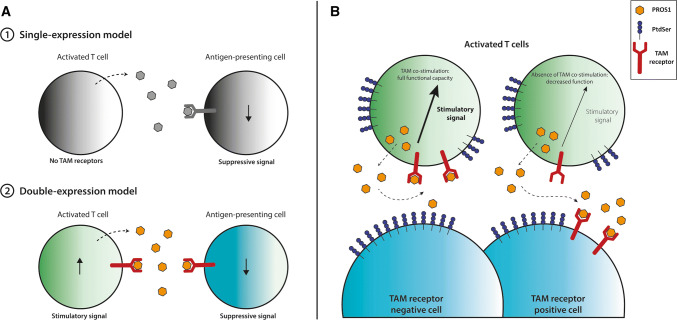
The TAM receptors-TYRO3, AXL, MERTK-are pleiotropically expressed receptors in both healthy and diseased tissue. A complex of the ligands Protein S (PROS1) or Growth Arrest-Specific 6 (GAS6) with apoptotic phosphatidylserine activates the TAM receptors. Hence, this receptor family is essential for the efferocytosis of apoptotic material by antigen-presenting cells. In addition, TAM receptors are expressed by virtually all cells of the tumor microenvironment. They are also potent oncogenes, frequently overexpressed in cancer and involved in survival and therapy resistance. Due to their pro-oncogenic and immune-inhibitory traits, TAM receptors have emerged as promising targets for cancer therapy. Recently, TAM receptors have been described to function as costimulatory molecules on human T cells. TAM receptors' ambivalent functions on many different cell types therefore make therapeutic targeting not straight-forward. In this review we summarize our current knowledge of the function of TAM receptors in the tumor microenvironment. We place particular focus on TAM receptors and the recently unraveled role of MERTK in activated T cells and potential consequences for anti-tumor immunity.
TAM 受体(TYRO3、AXL、MERTK)是在健康组织和病变组织中均有表达的多功能受体。配体蛋白 S(PROS1)或生长停滞特异性基因 6(GAS6)与凋亡磷脂酰丝氨酸形成复合物,可激活 TAM 受体。因此,该受体家族对于抗原呈递细胞吞噬凋亡物质至关重要。此外,TAM 受体几乎存在于肿瘤微环境中的所有细胞中。它们还是强效致癌基因,在癌症中常过度表达,并参与存活和治疗抵抗。由于其致癌和免疫抑制特性,TAM 受体已成为癌症治疗的有前途的靶点。最近,TAM 受体被描述为人类 T 细胞上的共刺激分子。因此,TAM 受体在许多不同类型的细胞上的双重功能使得治疗靶向变得不那么直接。在这篇综述中,我们总结了目前关于 TAM 受体在肿瘤微环境中的功能的知识。我们特别关注 TAM 受体以及最近发现的 MERTK 在激活的 T 细胞中的作用及其对抗肿瘤免疫的潜在影响。