Institute for Evidence-Based Healthcare (IEBH), Health Science and Medicine, Bond University, Gold Coast, QLD, Australia.
Front Public Health. 2021 Dec 22;9:725877. doi: 10.3389/fpubh.2021.725877. eCollection 2021.
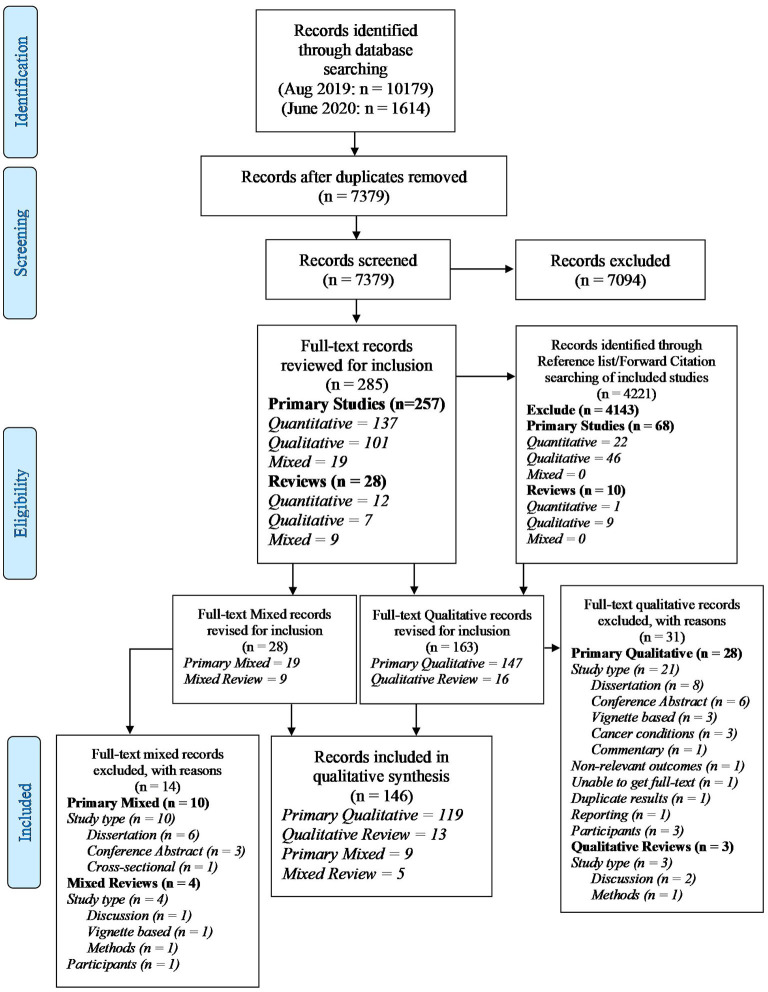
To develop a thematic framework for the range of consequences arising from a diagnostic label from an individual, family/caregiver, healthcare professional, and community perspective. Systematic scoping review of qualitative studies. We searched PubMed, Embase, PsycINFO, Cochrane, and CINAHL for primary studies and syntheses of primary studies that explore the consequences of labelling non-cancer diagnoses. Reference lists of included studies were screened, and forward citation searches undertaken. We included peer reviewed publications describing the perceived consequences for individuals labelled with a non-cancer diagnostic label from four perspectives: that of the individual, their family/caregiver, healthcare professional and/or community members. We excluded studies using hypothetical scenarios. Data extraction used a three-staged process: one third was used to develop a preliminary framework, the next third for framework validation, and the final third coded if thematic saturation was not achieved. Author themes and supporting quotes were extracted, and analysed from the perspective of individual, family/caregiver, healthcare professional, or community member. After deduplication, searches identified 7,379 unique articles. Following screening, 146 articles, consisting of 128 primary studies and 18 reviews, were included. The developed framework consisted of five overarching themes relevant to the four perspectives: (e.g., positive/negative psychological impact, social- and self-identity, stigma), (e.g., increased, decreased, relationship changes, professional interactions), (e.g., action and uncertainty), (e.g., beneficial or detrimental modifications), and . Perspectives of individuals were most frequently reported. This review developed and validated a framework of five domains of consequences following diagnostic labelling. Further research is required to test the external validity and acceptability of the framework for individuals and their family/caregiver, healthcare professionals, and community.
从个体、家庭/照顾者、医疗保健专业人员和社区的角度出发,制定一个用于描述诊断标签所产生的一系列后果的主题框架。对定性研究进行系统的范围综述。我们在 PubMed、Embase、PsycINFO、Cochrane 和 CINAHL 中搜索了探索非癌症诊断标签后果的原始研究和原始研究综合。筛选了纳入研究的参考文献列表,并进行了前瞻性引文搜索。我们纳入了描述个体、家庭/照顾者、医疗保健专业人员和/或社区成员从四个角度看待非癌症诊断标签后果的同行评议出版物。我们排除了使用假设情景的研究。数据提取使用了三阶段过程:三分之一用于开发初步框架,三分之一用于框架验证,最后三分之一用于在未达到主题饱和时进行编码。从个体、家庭/照顾者、医疗保健专业人员或社区成员的角度提取了作者主题和支持性引述,并进行了分析。经过去重后,搜索共确定了 7379 篇独特的文章。经过筛选,有 146 篇文章被纳入,包括 128 篇原始研究和 18 篇综述。所开发的框架包括与四个角度相关的五个总体主题:(例如,积极/消极的心理影响、社会和自我认同、污名)、(例如,增加、减少、关系变化、专业互动)、(例如,行动和不确定性)、(例如,有益或有害的修改)和。个体的观点被报道得最多。本综述制定并验证了一个用于诊断标签后后果的五个领域的框架。需要进一步研究来测试该框架对个人及其家庭/照顾者、医疗保健专业人员和社区的外部有效性和可接受性。