Zhang Lianglu, Dong Lanlan, Lu Changming, Huang Wenxian, Yang Cuiping, Wang Qian, Wang Qian, Lei Ruixue, Sun Rui, Wan Kangkang, Li Tingting, Sun Fan, Gan Tian, Lin Jun, Yin Lei
Department of Biochemistry, College of Life Sciences, Wuhan University, Wuhan, China.
Wuhan Ammunition Life-tech Company, Ltd., Wuhan, China.
Front Mol Biosci. 2021 Dec 22;8:706754. doi: 10.3389/fmolb.2021.706754. eCollection 2021.
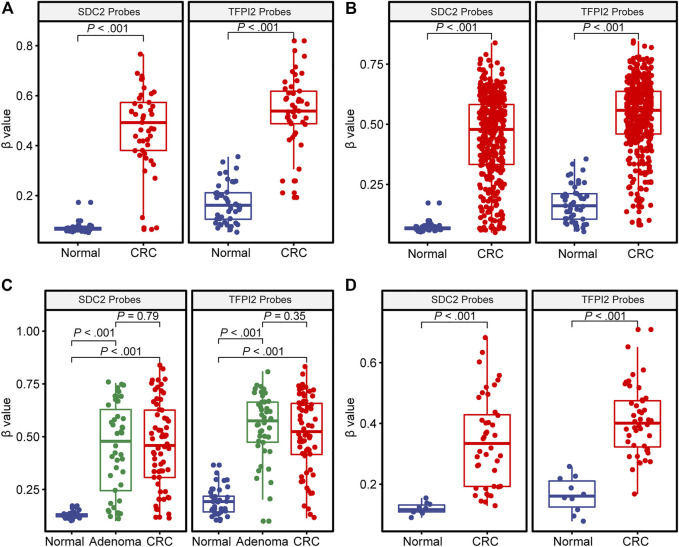
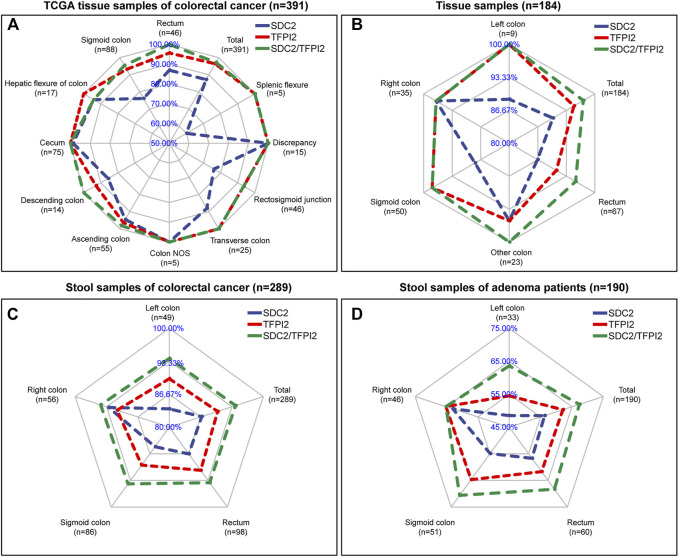
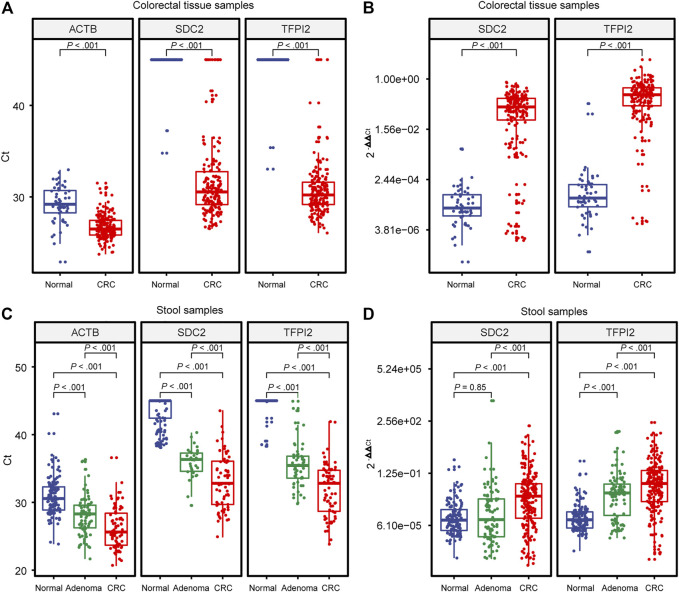
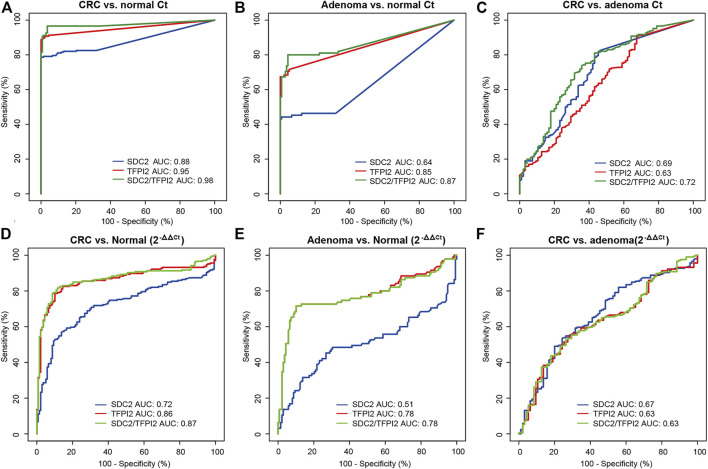
methylation is a feasible biomarker for colorectal cancer detection. Its specificity for colorectal cancer is higher than 90%, but the sensitivity is normally lower than 90%. This study aims to improve the sensitivity of detection through finding a high positive target from the false-negative samples of detection based on analysis of the bowel subsite difference in methylation. Hypermethylated was identified in hypomethylated colorectal cancer samples retrieved from TCGA database with the methylation level lower than 0.2. The methylation-specific PCR assay was developed and then evaluated using tissue samples (184 cancer and 54 healthy control samples) and stool samples (289 cancer, 190 adenoma, and 217 healthy control samples). was hypermethylated in most hypomethylated colorectal cancer samples. When the /-combined PCR assay was performed in stool specimens, the AUC value of cancer vs. control was 0.98, with the specificity of 96.40% and sensitivity of 96.60%, and the AUC value of adenoma vs. control was 0.87, with the specificity of 95.70% and the sensitivity of 80.00%. The improvement in sensitivity was the most momentous in the left colon. As the detection index, the Ct value was better in improving the sensitivity of detection than the methylation level based on the 2 value. can improve the sensitivity of methylation-specific detection of colorectal tumorous lesions while maintaining high specificity, in particular reducing the missed detection of left colon cancer and adenoma.
甲基化是一种用于结直肠癌检测的可行生物标志物。其对结直肠癌的特异性高于90%,但敏感性通常低于90%。本研究旨在通过基于甲基化的肠段亚部位差异分析,从检测的假阴性样本中找到高阳性靶点,以提高检测的敏感性。在从TCGA数据库检索到的甲基化水平低于0.2的低甲基化结直肠癌样本中鉴定出高甲基化的[具体基因名称未给出]。开发了甲基化特异性PCR检测方法,然后使用组织样本(184例癌症样本和54例健康对照样本)和粪便样本(289例癌症样本、190例腺瘤样本和217例健康对照样本)进行评估。在大多数低甲基化结直肠癌样本中[具体基因名称未给出]呈高甲基化。当在粪便标本中进行[具体基因名称未给出]/[具体基因名称未给出]联合PCR检测时,癌症与对照的AUC值为0.98,特异性为96.40%,敏感性为96.60%,腺瘤与对照的AUC值为0.87,特异性为95.70%,敏感性为80.00%。在左半结肠,敏感性的提高最为显著。作为检测指标,基于2值,Ct值在提高检测敏感性方面比甲基化水平更好。[具体基因名称未给出]可以提高结直肠肿瘤性病变甲基化特异性检测的敏感性,同时保持高特异性,特别是减少左半结肠癌和腺瘤的漏检。