Mitoma Hiroshi, Honnorat Jerome, Yamaguchi Kazuhiko, Manto Mario
Department of Medical Education, Tokyo Medical University, Tokyo, Japan.
French Reference Center on Paraneoplastic Neurological Syndromes, Hospices Civils de Lyon, Hôpital Neurologique, 69677, Bron, France.
Mol Biomed. 2021 Jan 10;2(1):2. doi: 10.1186/s43556-020-00024-x.
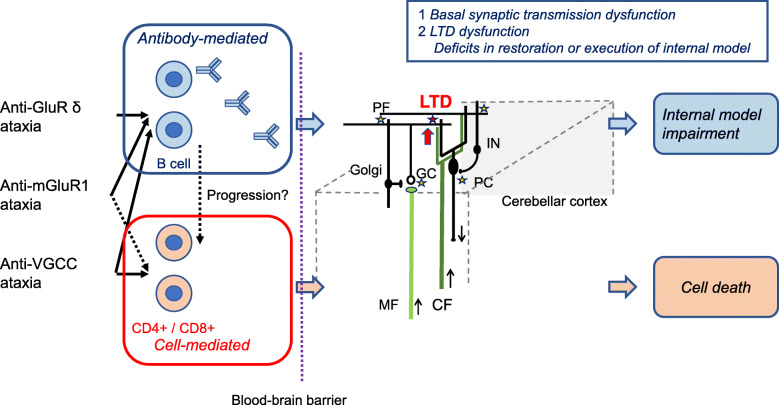
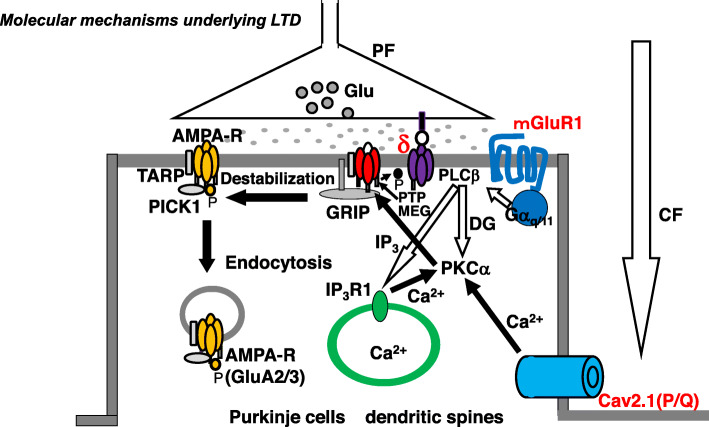
There is general agreement that auto-antibodies against ion channels and synaptic machinery proteins can induce limbic encephalitis. In immune-mediated cerebellar ataxias (IMCAs), various synaptic proteins, such as GAD65, voltage-gated Ca channel (VGCC), metabotropic glutamate receptor type 1 (mGluR1), and glutamate receptor delta (GluR delta) are auto-immune targets. Among them, the pathophysiological mechanisms underlying anti-VGCC, anti-mGluR1, and anti-GluR delta antibodies remain unclear. Despite divergent auto-immune and clinical profiles, these subtypes show common clinical features of good prognosis with no or mild cerebellar atrophy in non-paraneoplastic syndrome. The favorable prognosis reflects functional cerebellar disorders without neuronal death. Interestingly, these autoantigens are all involved in molecular cascades for induction of long-term depression (LTD) of synaptic transmissions between parallel fibers (PFs) and Purkinje cells (PCs), a crucial mechanism of synaptic plasticity in the cerebellum. We suggest that anti-VGCC, anti-mGluR1, and anti-GluR delta Abs-associated cerebellar ataxias share one common pathophysiological mechanism: a deregulation in PF-PC LTD, which results in impairment of restoration or maintenance of the internal model and triggers cerebellar ataxias. The novel concept of LTDpathies could lead to improvements in clinical management and treatment of cerebellar patients who show these antibodies.
人们普遍认为,针对离子通道和突触机制蛋白的自身抗体可诱发边缘性脑炎。在免疫介导的小脑性共济失调(IMCA)中,多种突触蛋白,如GAD65、电压门控钙通道(VGCC)、代谢型谷氨酸受体1(mGluR1)和谷氨酸受体δ(GluRδ)是自身免疫靶点。其中,抗VGCC、抗mGluR1和抗GluRδ抗体的病理生理机制仍不清楚。尽管自身免疫和临床特征各异,但这些亚型在非副肿瘤综合征中表现出共同的临床特征,即预后良好,小脑萎缩无或轻微。良好的预后反映了小脑功能障碍但无神经元死亡。有趣的是,这些自身抗原均参与平行纤维(PF)与浦肯野细胞(PC)之间突触传递的长时程抑制(LTD)诱导的分子级联反应,这是小脑突触可塑性的关键机制。我们认为,抗VGCC、抗mGluR1和抗GluRδ抗体相关的小脑性共济失调具有一个共同的病理生理机制:PF-PC LTD失调,导致内部模型恢复或维持受损,引发小脑性共济失调。LTD病的新概念可能会改善对出现这些抗体的小脑疾病患者的临床管理和治疗。