Geppert Julia, Walth Alina A, Terrón Expósito Raúl, Kaltenecker Doris, Morigny Pauline, Machado Juliano, Becker Maike, Simoes Estefania, Lima Joanna D C C, Daniel Carolin, Berriel Diaz Mauricio, Herzig Stephan, Seelaender Marilia, Rohm Maria
Institute for Diabetes and Cancer, Helmholtz Center Munich, 85764 Neuherberg, Germany.
Joint Heidelberg-IDC Translational Diabetes Program, Inner Medicine 1, Heidelberg University Hospital, 69120 Heidelberg, Germany.
Cancers (Basel). 2021 Dec 24;14(1):90. doi: 10.3390/cancers14010090.
Cancer is primarily a disease of high age in humans, yet most mouse studies on cancer cachexia are conducted using young adolescent mice. Given that metabolism and muscle function change with age, we hypothesized that aging may affect cachexia progression in mouse models.
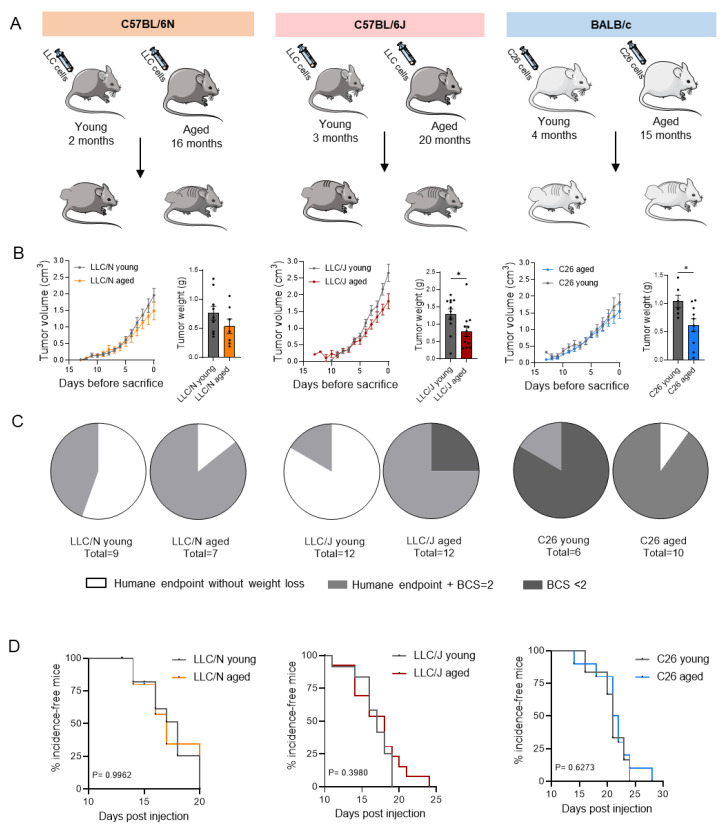
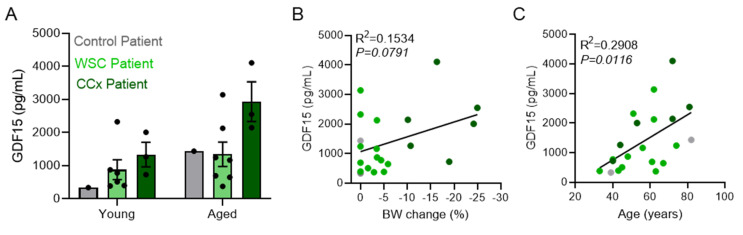
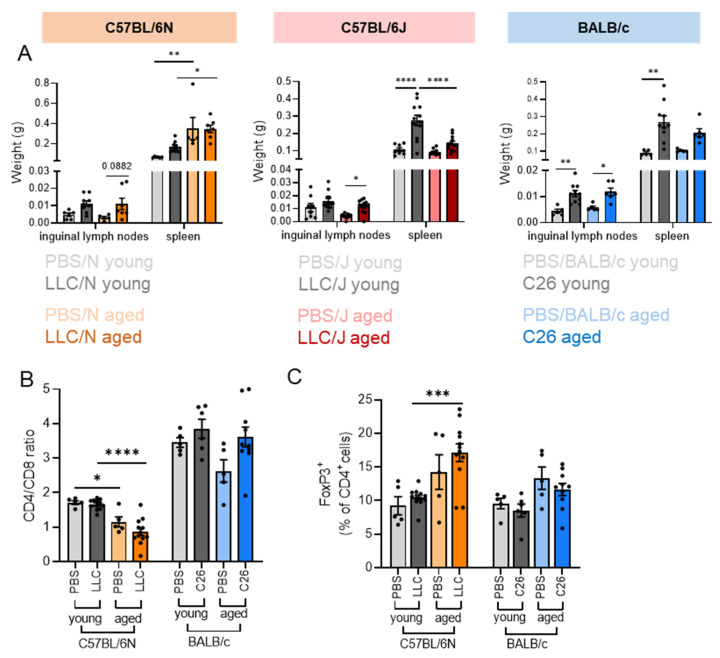
We compare tumor and cachexia development in young and old mice of three different strains (C57BL/6J, C57BL/6N, BALB/c) and with two different tumor cell lines (Lewis Lung Cancer, Colon26). Tumor size, body and organ weights, fiber cross-sectional area, circulating cachexia biomarkers, and molecular markers of muscle atrophy and adipose tissue wasting are shown. We correlate inflammatory markers and body weight dependent on age in patients with cancer.
We note fundamental differences between mouse strains. Aging aggravates weight loss in LLC-injected C57BL/6J mice, drives it in C57BL/6N mice, and does not influence weight loss in C26-injected BALB/c mice. Glucose tolerance is unchanged in cachectic young and old mice. The stress marker GDF15 is elevated in cachectic BALB/c mice independent of age and increased in old C57BL/6N and J mice. Inflammatory markers correlate significantly with weight loss only in young mice and patients.
Aging affects cachexia development and progression in mice in a strain-dependent manner and influences the inflammatory profile in both mice and patients. Age is an important factor to consider for future cachexia studies.
癌症主要是一种发生于老年人群的疾病,但大多数关于癌症恶病质的小鼠研究是使用年轻的青春期小鼠进行的。鉴于新陈代谢和肌肉功能会随年龄变化,我们推测衰老可能会影响小鼠模型中恶病质的进展。
我们比较了三种不同品系(C57BL/6J、C57BL/6N、BALB/c)的年轻和老年小鼠以及两种不同肿瘤细胞系(Lewis肺癌、结肠26)的肿瘤和恶病质发展情况。展示了肿瘤大小、体重和器官重量、纤维横截面积、循环恶病质生物标志物以及肌肉萎缩和脂肪组织消耗的分子标志物。我们将癌症患者中炎症标志物与依赖年龄的体重进行了关联分析。
我们注意到小鼠品系之间存在根本差异。衰老加剧了注射LLC的C57BL/6J小鼠的体重减轻,在C57BL/6N小鼠中导致体重减轻,而对注射C26的BALB/c小鼠的体重减轻没有影响。恶病质的年轻和老年小鼠的葡萄糖耐量没有变化。应激标志物GDF15在恶病质的BALB/c小鼠中与年龄无关而升高,在老年C57BL/6N和J小鼠中增加。炎症标志物仅在年轻小鼠和患者中与体重减轻显著相关。
衰老以品系依赖的方式影响小鼠恶病质的发展和进展,并影响小鼠和患者的炎症特征。年龄是未来恶病质研究中需要考虑的一个重要因素。