Böhme Matthias, Kayser Sabine
Medical Clinic and Policlinic I, Hematology and Cellular Therapy, University Hospital Leipzig, 04103 Leipzig, Germany.
NCT Trial Center, National Center of Tumor Diseases, German Cancer Research Center (DKFZ), 69120 Heidelberg, Germany.
Cancers (Basel). 2021 Dec 27;14(1):105. doi: 10.3390/cancers14010105.
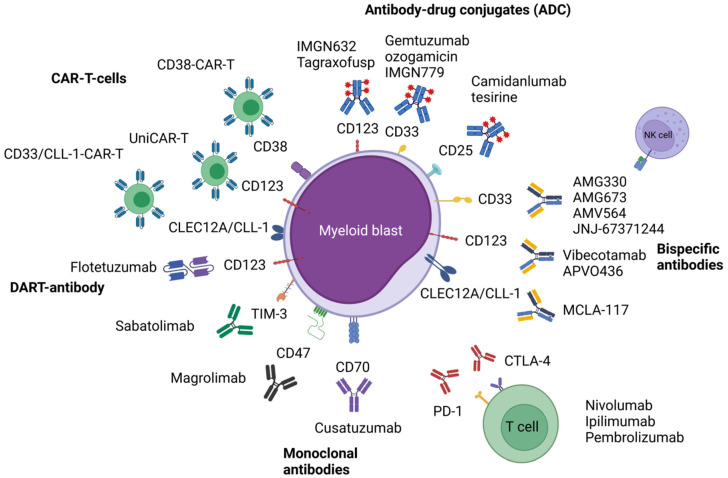
The development and design of immune-based strategies have become an increasingly important topic during the last few years in acute myeloid leukemia (AML), based on successful immunotherapies in solid cancer. The spectrum ranges from antibody drug conjugates, immune checkpoint inhibitors blocking programmed cell death protein 1 (PD1), cytotoxic T lymphocyte antigen 4 (CTLA4) or T cell immunoglobulin and mucin domain containing-3 (TIM3), to T-cell based monoclonal and bispecific T-cell engager antibodies, chimeric antigen receptor-T-cell (CAR-T) approaches and leukemia vaccines. Currently, there are many substances in development and multiple phase I/II studies are ongoing. These trials will help us to deepen our understanding of the pathogenesis of AML and facilitate the best immunotherapeutic strategy in AML. We discuss here the mode of action of immune-based therapies and provide an overview of the available data.
基于实体癌免疫疗法的成功,在过去几年中,基于免疫的策略的开发与设计已成为急性髓系白血病(AML)领域中一个日益重要的话题。其范围涵盖抗体药物偶联物、阻断程序性细胞死亡蛋白1(PD1)、细胞毒性T淋巴细胞相关抗原4(CTLA4)或含T细胞免疫球蛋白和粘蛋白结构域3(TIM3)的免疫检查点抑制剂,到基于T细胞的单克隆和双特异性T细胞衔接抗体、嵌合抗原受体T细胞(CAR-T)方法以及白血病疫苗。目前,有许多药物正在研发中,多项I/II期研究正在进行。这些试验将有助于我们加深对AML发病机制的理解,并推动AML最佳免疫治疗策略的发展。我们在此讨论基于免疫疗法的作用模式,并概述现有数据。