Sturm Niklas, Ettrich Thomas J, Perkhofer Lukas
Department of Internal Medicine I, University Hospital Ulm, Albert-Einstein-Allee 23, 89081 Ulm, Germany.
Cancers (Basel). 2022 Jan 3;14(1):217. doi: 10.3390/cancers14010217.
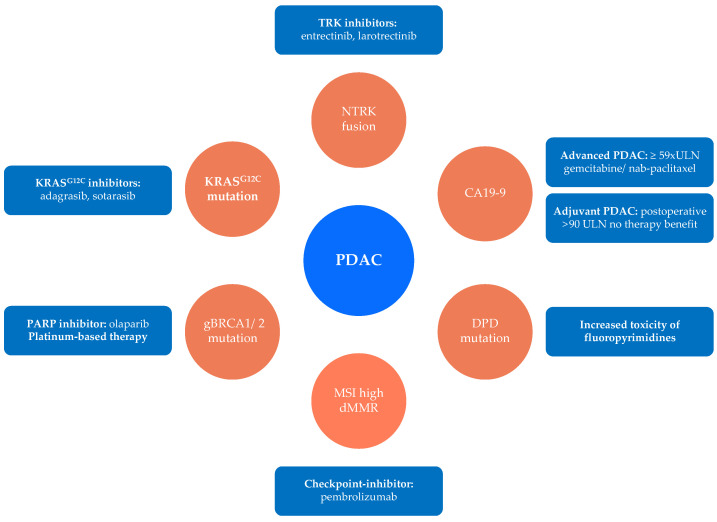
Pancreatic ductal adenocarcinoma (PDAC) is still difficult to treat due to insufficient methods for early diagnosis and prediction of therapy response. Furthermore, surveillance after curatively intended surgery lacks adequate methods for timely detection of recurrence. Therefore, several molecules have been analyzed as predictors of recurrence or early detection of PDAC. Enhanced understanding of molecular tumorigenesis and treatment response triggered the identification of novel biomarkers as predictors for response to conventional chemotherapy or targeted therapy. In conclusion, progress has been made especially in the prediction of therapy response with biomarkers. The use of molecules for early detection and recurrence of PDAC is still at an early stage, but there are promising approaches in noninvasive biomarkers, composite panels and scores that can already ameliorate the current clinical practice. The present review summarizes the current state of research on biomarkers for diagnosis and therapy of pancreatic cancer.
由于早期诊断和治疗反应预测方法不足,胰腺导管腺癌(PDAC)的治疗仍然困难。此外,根治性手术后的监测缺乏及时检测复发的适当方法。因此,已经分析了几种分子作为PDAC复发或早期检测的预测指标。对分子肿瘤发生和治疗反应的深入了解促使人们识别出新型生物标志物,作为对传统化疗或靶向治疗反应的预测指标。总之,尤其是在利用生物标志物预测治疗反应方面已经取得了进展。用于PDAC早期检测和复发的分子应用仍处于早期阶段,但在非侵入性生物标志物、综合检测板和评分方面有一些有前景的方法,已经可以改善当前的临床实践。本综述总结了胰腺癌诊断和治疗生物标志物的当前研究现状。