Ermolaev Vadim V, Arkhipova Daria M, Miluykov Vasili A, Lyubina Anna P, Amerhanova Syumbelya K, Kulik Natalia V, Voloshina Alexandra D, Ananikov Valentine P
Arbuzov Institute of Organic and Physical Chemistry, FRC Kazan Scientific Center, Russian Academy of Sciences, Arbuzov str., 8, Kazan 420088, Russia.
N.D. Zelinsky Institute of Organic Chemistry, Russian Academy of Sciences, Leninsky Prospect, 47, Moscow 119991, Russia.
Int J Mol Sci. 2021 Dec 22;23(1):86. doi: 10.3390/ijms23010086.
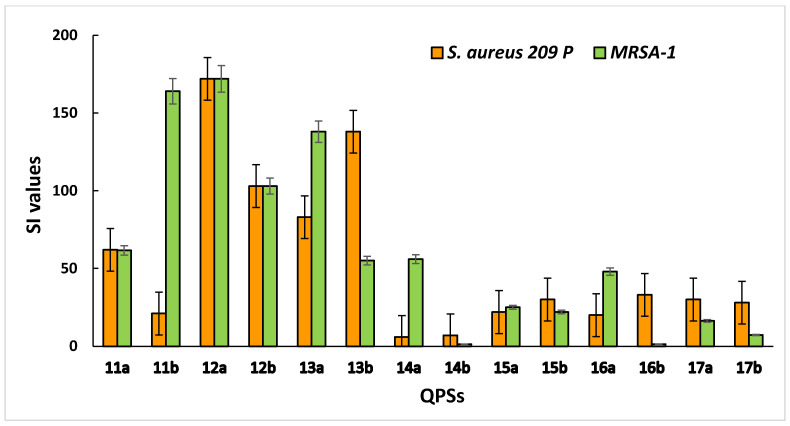
Structure-activity relationships are important for the design of biocides and sanitizers. During the spread of resistant strains of pathogenic microbes, insights into the correlation between structure and activity become especially significant. The most commonly used biocides are nitrogen-containing compounds; the phosphorus-containing ones have been studied to a lesser extent. In the present study, a broad range of sterically hindered quaternary phosphonium salts (QPSs) based on tri--butylphosphine was tested for their activity against Gram-positive (, ) and Gram-negative (, ) bacteria and fungi (, var. gypseum). The cation structure was confirmed to determine their biological activity. A number of QPSs not only exhibit high activity against both Gram-positive and -negative bacteria but also possess antifungal properties. Additionally, the hemolytic and cytotoxic properties of QPSs were determined using blood and a normal liver cell line, respectively. The results show that tri--butyl(-dodecyl)phosphonium and tri--butyl(-tridecyl)phosphonium bromides exhibit both low cytotoxicity against normal human cells and high antimicrobial activity against bacteria, including methicillin-resistant strains (). The mechanism of QPS action on microbes is discussed. Due to their high selectivity for pathogens, sterically hindered QPSs could serve as effective tunable biocides.
构效关系对于杀菌剂和消毒剂的设计很重要。在致病性微生物耐药菌株传播期间,深入了解结构与活性之间的相关性变得尤为重要。最常用的杀菌剂是含氮化合物;含磷化合物的研究较少。在本研究中,测试了一系列基于三丁基膦的空间位阻季鏻盐(QPSs)对革兰氏阳性菌( , )、革兰氏阴性菌( , )和真菌( , 变种石膏样毛癣菌)的活性。确定阳离子结构以确定其生物活性。许多QPSs不仅对革兰氏阳性菌和阴性菌都表现出高活性,而且还具有抗真菌特性。此外,分别使用血液和正常肝细胞系测定了QPSs的溶血和细胞毒性特性。结果表明,三丁基(十二烷基)鏻溴化物和三丁基(十三烷基)鏻溴化物对正常人类细胞均表现出低细胞毒性,对包括耐甲氧西林菌株( )在内的细菌具有高抗菌活性。讨论了QPSs对微生物的作用机制。由于其对病原体具有高选择性,空间位阻QPSs可作为有效的可调谐杀菌剂。