International Collaborative Centre on Big Science Plan for Purinergic Signalling, Chengdu University of TCM, Chengdu 610075, China.
School of Acupunct3ure and Tuina, Chengdu University of TCM, Chengdu 610075, China.
Int J Mol Sci. 2021 Dec 26;23(1):232. doi: 10.3390/ijms23010232.
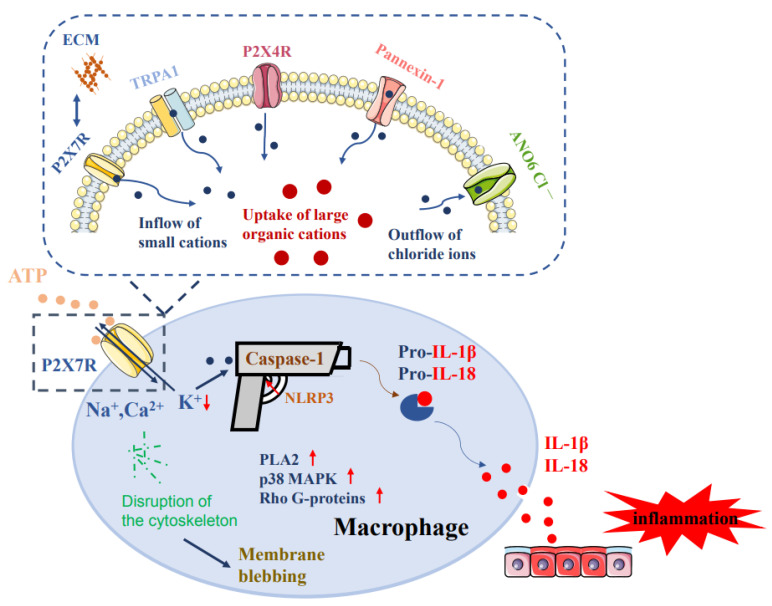
Macrophages are mononuclear phagocytes which derive either from blood-borne monocytes or reside as resident macrophages in peripheral (Kupffer cells of the liver, marginal zone macrophages of the spleen, alveolar macrophages of the lung) and central tissue (microglia). They occur as M1 (pro-inflammatory; classic) or M2 (anti-inflammatory; alternatively activated) phenotypes. Macrophages possess P2X7 receptors (Rs) which respond to high concentrations of extracellular ATP under pathological conditions by allowing the non-selective fluxes of cations (Na, Ca, K). Activation of P2X7Rs by still higher concentrations of ATP, especially after repetitive agonist application, leads to the opening of membrane pores permeable to ~900 Da molecules. For this effect an interaction of the P2X7R with a range of other membrane channels (e.g., P2X4R, transient receptor potential A1 [TRPA1], pannexin-1 hemichannel, ANO6 chloride channel) is required. Macrophage-localized P2X7Rs have to be co-activated with the lipopolysaccharide-sensitive toll-like receptor 4 (TLR4) in order to induce the formation of the inflammasome 3 (NLRP3), which then activates the pro-interleukin-1β (pro-IL-1β)-degrading caspase-1 to lead to IL-1β release. Moreover, inflammatory diseases (e.g., rheumatoid arthritis, Crohn's disease, sepsis, etc.) are generated downstream of the P2X7R-induced upregulation of intracellular second messengers (e.g., phospholipase A2, p38 mitogen-activated kinase, and rho G proteins). In conclusion, P2X7Rs at macrophages appear to be important targets to preserve immune homeostasis with possible therapeutic consequences.
巨噬细胞是单核吞噬细胞,来源于血液中的单核细胞或作为常驻巨噬细胞存在于外周组织(肝脏的枯否细胞、脾脏的边缘区巨噬细胞、肺的肺泡巨噬细胞)和中枢组织(小神经胶质细胞)中。它们表现为 M1(促炎;经典)或 M2(抗炎;替代激活)表型。巨噬细胞具有 P2X7 受体(Rs),在病理条件下,这些受体对细胞外 ATP 的高浓度作出反应,允许阳离子(Na+、Ca2+、K+)非选择性流动。更高浓度的 ATP,特别是在重复激动剂应用后,激活 P2X7Rs,导致对~900 Da 分子可渗透的膜孔的开放。对于这种效应,P2X7R 与一系列其他膜通道(例如 P2X4R、瞬时受体电位 A1 [TRPA1]、连接蛋白-1 半通道、ANO6 氯离子通道)相互作用是必需的。为了诱导炎症小体 3(NLRP3)的形成,需要在巨噬细胞定位的 P2X7R 与脂多糖敏感的 Toll 样受体 4(TLR4)共同激活,然后激活前白细胞介素-1β(pro-IL-1β)-降解半胱天冬酶-1 导致 IL-1β 的释放。此外,炎症性疾病(例如类风湿关节炎、克罗恩病、败血症等)是在 P2X7R 诱导的细胞内第二信使(例如磷脂酶 A2、p38 丝裂原激活激酶和 rho G 蛋白)上调的下游产生的。总之,巨噬细胞上的 P2X7R 似乎是维持免疫稳态的重要靶点,可能具有治疗意义。