CNM Team, Centre National de la Recherche Scientifique, CAMB UMR 7199, Faculté de Pharmacie, Université de Strasbourg, 67401 Illkirch, France.
Institute for Advanced Studies (USIAS), University of Strasbourg, 67000 Strasbourg, France.
Int J Mol Sci. 2021 Jun 18;22(12):6542. doi: 10.3390/ijms22126542.
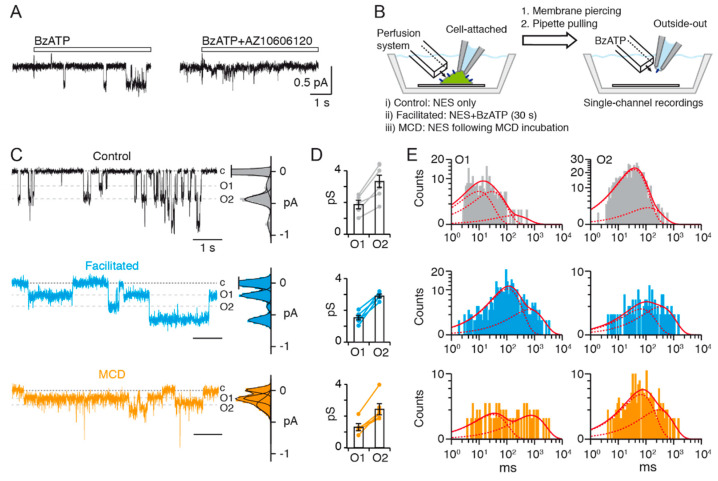
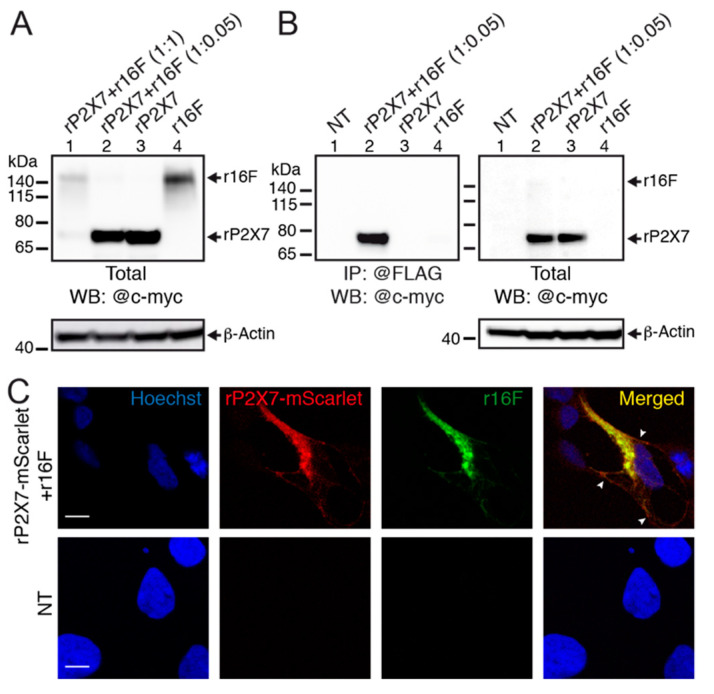
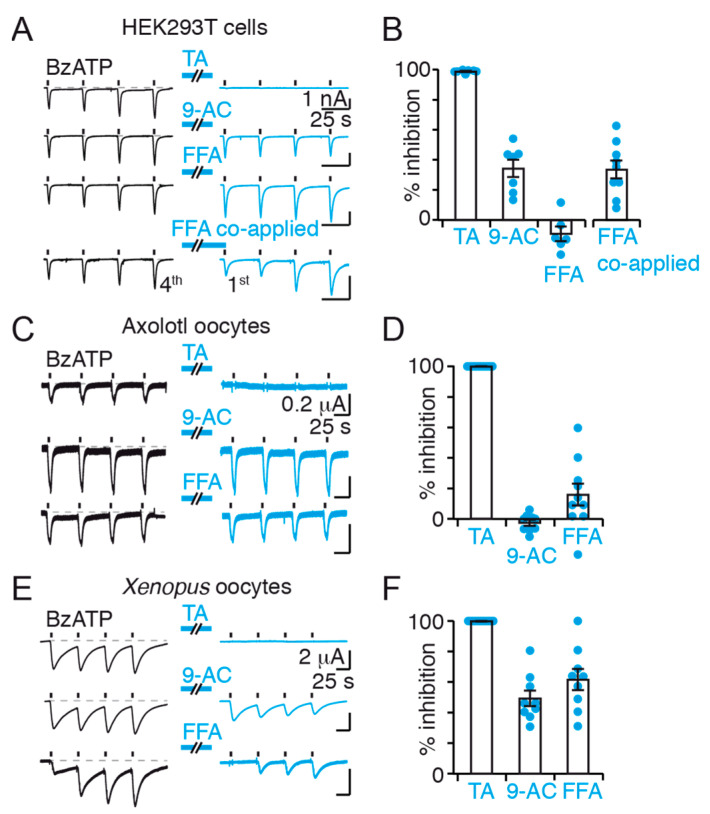
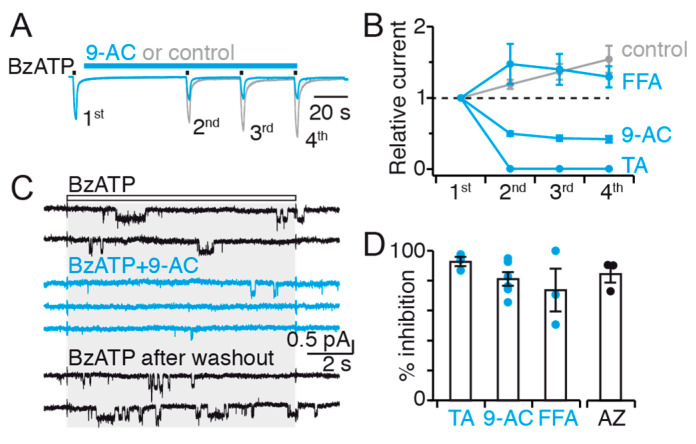
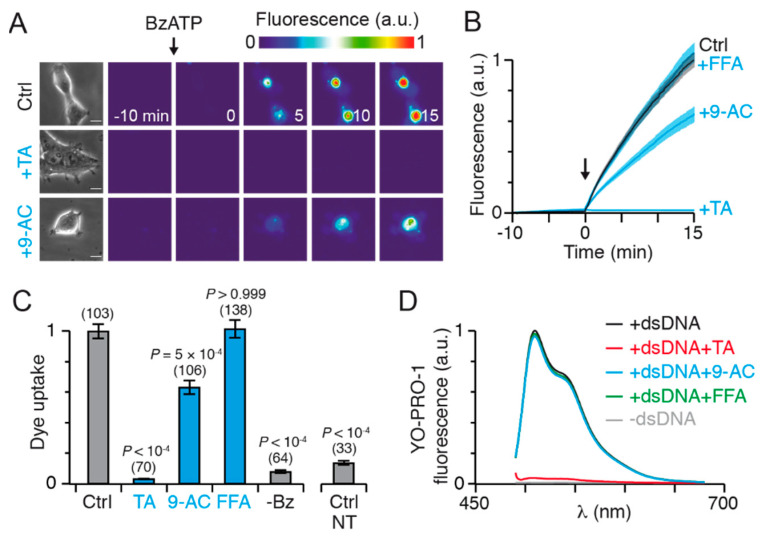
P2X7 receptors (P2X7) are cationic channels involved in many diseases. Following their activation by extracellular ATP, distinct signaling pathways are triggered, which lead to various physiological responses such as the secretion of pro-inflammatory cytokines or the modulation of cell death. P2X7 also exhibit unique behaviors, such as "macropore" formation, which corresponds to enhanced large molecule cell membrane permeability and current facilitation, which is caused by prolonged activation. These two phenomena have often been confounded but, thus far, no clear mechanisms have been resolved. Here, by combining different approaches including whole-cell and single-channel recordings, pharmacological and biochemical assays, CRISPR/Cas9 technology and cell imaging, we provide evidence that current facilitation and macropore formation involve functional complexes comprised of P2X7 and TMEM16, a family of Ca-activated ion channel/scramblases. We found that current facilitation results in an increase of functional complex-embedded P2X7 open probability, a result that is recapitulated by plasma membrane cholesterol depletion. We further show that macropore formation entails two distinct large molecule permeation components, one of which requires functional complexes featuring TMEM16F subtype, the other likely being direct permeation through the P2X7 pore itself. Such functional complexes can be considered to represent a regulatory hub that may orchestrate distinct P2X7 functionalities.
P2X7 受体(P2X7)是参与多种疾病的阳离子通道。在细胞外 ATP 激活后,会触发不同的信号通路,导致各种生理反应,如促炎细胞因子的分泌或细胞死亡的调节。P2X7 还表现出独特的行为,如“大孔”形成,这对应于增强的大分子细胞膜通透性和电流易化,这是由延长激活引起的。这两种现象经常被混淆,但迄今为止,还没有明确的机制得到解决。在这里,我们通过结合全细胞和单通道记录、药理学和生化测定、CRISPR/Cas9 技术和细胞成像等不同方法,提供了证据表明,电流易化和大孔形成涉及由 P2X7 和 TMEM16 组成的功能性复合物,TMEM16 是一类钙激活的离子通道/翻转酶。我们发现,电流易化导致功能性复合物中嵌入的 P2X7 开放概率增加,这一结果可以通过质膜胆固醇耗竭来重现。我们进一步表明,大孔形成需要两个不同的大分子渗透成分,其中一个需要具有 TMEM16F 亚型的功能性复合物,另一个可能是直接通过 P2X7 孔本身渗透。这种功能性复合物可以被认为是一个调节枢纽,可能协调不同的 P2X7 功能。