
基于上转换纳米粒子的荧光免疫分析用于热加工肉类中 2-氨基-3-甲基咪唑[4,5-f]喹啉(IQ)的灵敏检测。
Upconversion Nanoparticles-Based Fluorescence Immunoassay for the Sensitive Detection of 2-Amino-3-methylimidazo [4,5-f] Quinoline (IQ) in Heat Processed Meat.
机构信息
State Key Laboratory of Food Nutrition and Safety, College of Food Science and Engineering, Tianjin University of Science and Technology, Tianjin 300457, China.
Tianjin Key Laboratory of Food Science and Health, School of Medicine, Nankai University, Tianjin 300071, China.
出版信息
Sensors (Basel). 2021 Dec 21;22(1):8. doi: 10.3390/s22010008.
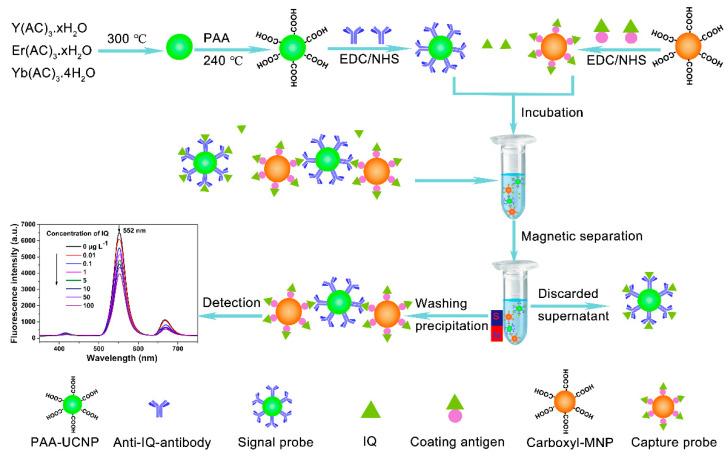
A competitive fluorescence immunoassay for the quantitative detection of 2-amino-3-methylimidazo [4,5-f] quinoline (IQ) in pan-fried meat patties was developed, using magnetic nanoparticles coupled with coating antigen as the capture probe and anti-IQ antibody coupled with NaYF: Yb, Er upconversion nanoparticles as the signal probe. Under optimal conditionals, the wide detection range for IQ in phosphate buffer saline is from 0.01 to 100 μg·L (R = 0.991) with a detection limit of 0.007 μg·L. This proposed method has been applied to detect IQ in two different types of pan-fried meat patties at varying frying times, and the IQ content in chicken patties and fish patties are 2.11-3.47 μg·kg and 1.35-2.85 μg·kg, respectively. These results are consistent with that of the ultraperformance liquid chromatography-tandem mass spectrometry. In summary, this method can serve as a sensitive and specific test tool for the determination of IQ in processed meat.
建立了一种竞争性荧光免疫分析法,用于定量检测煎肉饼中的 2-氨基-3-甲基咪唑并[4,5-f]喹啉(IQ)。该方法使用磁性纳米粒子偶联包被抗原作为捕获探针,抗 IQ 抗体偶联 NaYF:Yb,Er 上转换纳米粒子作为信号探针。在最佳条件下,该方法在磷酸盐缓冲液中的检测范围为 0.01-100 μg·L(R = 0.991),检测限为 0.007 μg·L。该方法已应用于不同煎炸时间的两种不同类型煎肉饼中 IQ 的检测,鸡肉饼和鱼肉饼中 IQ 的含量分别为 2.11-3.47 μg·kg 和 1.35-2.85 μg·kg,与超高效液相色谱-串联质谱法的结果一致。总之,该方法可作为一种用于检测加工肉类中 IQ 的灵敏、特异的检测工具。




 Zotero 插件