Qiu Shi, An Pengcheng, Kang Kai, Hu Jun, Han Ting, Rauterberg Matthias
Department of Design, Shanghai Jiao Tong University, Shanghai 200240, China.
Department of Industrial Design, Eindhoven University of Technology, 5600MB Eindhoven, The Netherlands.
Sensors (Basel). 2021 Dec 23;22(1):82. doi: 10.3390/s22010082.
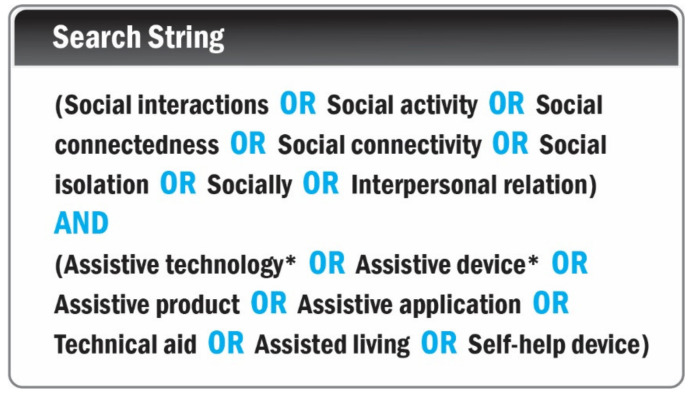
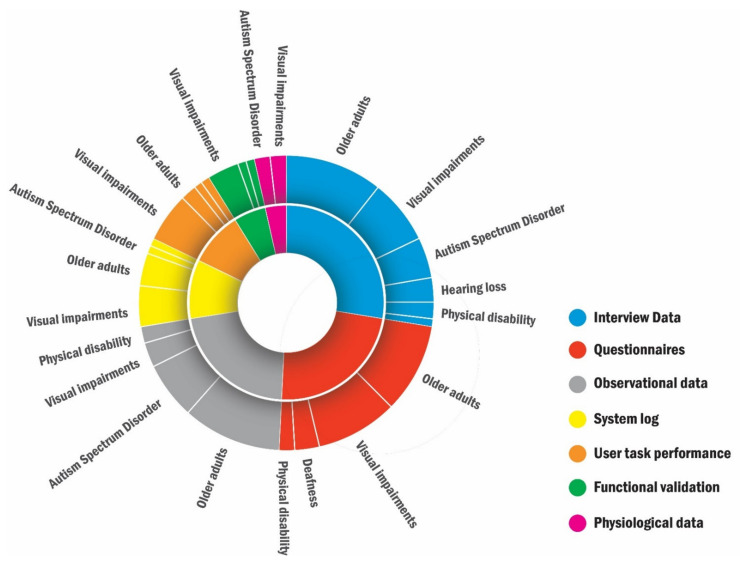
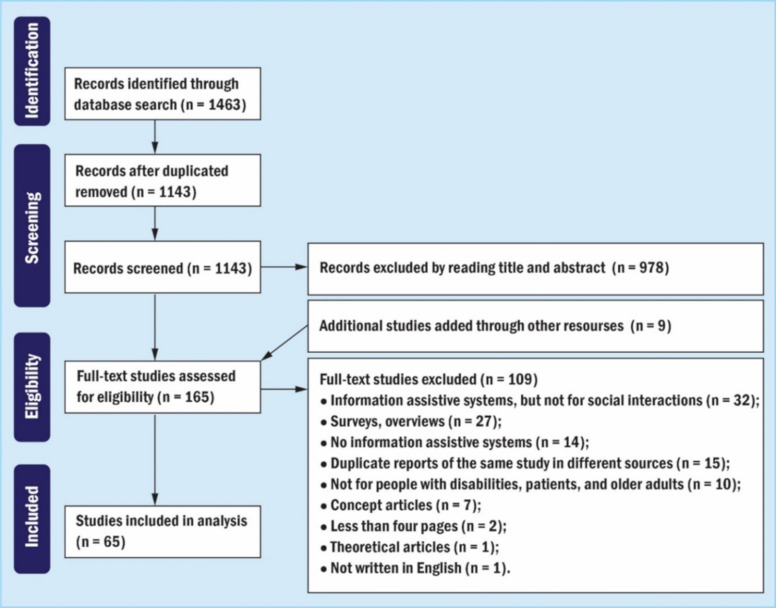
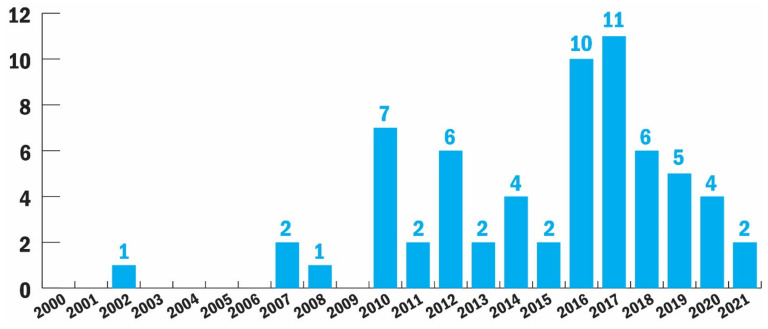
Social interactions significantly impact the quality of life for people with special needs (e.g., older adults with dementia and children with autism). They may suffer loneliness and social isolation more often than people without disabilities. There is a growing demand for technologies to satisfy the social needs of such user groups. However, evaluating these systems can be challenging due to the extra difficulty of gathering data from people with special needs (e.g., communication barriers involving older adults with dementia and children with autism). Thus, in this systematic review, we focus on studying data gathering methods for evaluating socially assistive systems (SAS). Six academic databases (i.e., Scopus, Web of Science, ACM, Science Direct, PubMed, and IEEE Xplore) were searched, covering articles published from January 2000 to July 2021. A total of 65 articles met the inclusion criteria for this systematic review. The results showed that existing SASs most often targeted people with visual impairments, older adults, and children with autism. For instance, a common type of SASs aimed to help blind people perceive social signals (e.g., facial expressions). SASs were most commonly assessed with interviews, questionnaires, and observation data. Around half of the interview studies only involved target users, while the other half also included secondary users or stakeholders. Questionnaires were mostly used with older adults and people with visual impairments to measure their social interaction, emotional state, and system usability. A great majority of observational studies were carried out with users in special age groups, especially older adults and children with autism. We thereby contribute an overview of how different data gathering methods were used with various target users of SASs. Relevant insights are extracted to inform future development and research.
社交互动对有特殊需求的人群(如患有痴呆症的老年人和自闭症儿童)的生活质量有重大影响。他们可能比无残疾的人更容易遭受孤独和社会隔离。满足此类用户群体社交需求的技术需求日益增长。然而,评估这些系统可能具有挑战性,因为从有特殊需求的人群(如患有痴呆症的老年人和自闭症儿童存在沟通障碍)收集数据格外困难。因此,在本系统综述中,我们专注于研究用于评估社会辅助系统(SAS)的数据收集方法。我们检索了六个学术数据库(即Scopus、Web of Science、ACM、ScienceDirect、PubMed和IEEE Xplore),涵盖2000年1月至2021年7月发表的文章。共有65篇文章符合本系统综述的纳入标准。结果表明,现有的社会辅助系统最常针对视力障碍者、老年人和自闭症儿童。例如,一种常见的社会辅助系统旨在帮助盲人感知社交信号(如面部表情)。社会辅助系统最常通过访谈、问卷调查和观察数据进行评估。大约一半的访谈研究仅涉及目标用户,而另一半还包括次要用户或利益相关者。问卷调查主要用于老年人和视力障碍者,以测量他们的社交互动、情绪状态和系统可用性。绝大多数观察性研究是针对特殊年龄组的用户进行的,尤其是老年人和自闭症儿童。因此,我们概述了不同的数据收集方法如何应用于社会辅助系统的各类目标用户。提取了相关见解,为未来的发展和研究提供参考。