Department of Healthy Life Expectancy, Graduate School of Medicine Juntendo University, Tokyo 113-0034, Japan.
School of Nursing, Tokyo Women's Medical University, Tokyo 162-8666, Japan.
Int J Environ Res Public Health. 2021 Dec 30;19(1):394. doi: 10.3390/ijerph19010394.
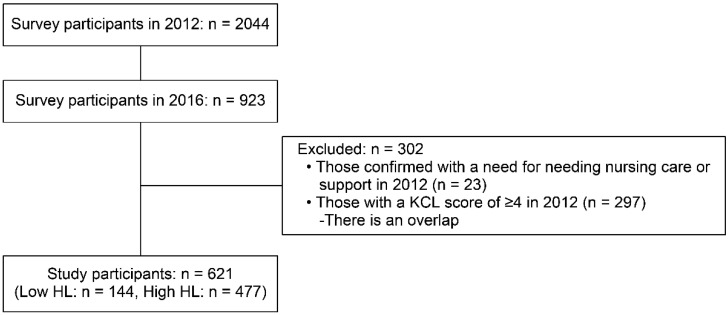
Health literacy (HL) promotes healthy lifestyle behaviors among older adults, and its relationship with frailty remains unclear. This study examined whether HL is a predictor of frailty progression among community-dwelling older adults. Data from two surveys conducted in 2012 and 2016 involving older residents (mean age, 71.6 ± 4.6 years) of Kashiwa City, Chiba Prefecture, Japan were used. Only healthy individuals without frailty and cognitive impairments participated in the 2012 assessment, where the Kihon Checklist (KCL), HL, and other variables were assessed. Logistic and multiple logistic analyses were used to assess the effects of HL and other factors on frailty between the 'high HL' vs. 'low HL' groups in 2012 and between the 'robust' vs. 'frailty-progressing' groups in 2016. Of the 621 robust participants, 154 (25.4%) had progression of frailty in 2016, which was significantly associated with advanced age, higher KCL score, lower HL, poor mental health, and lack of social support. Furthermore, low HL was a predictor of frailty progression. Low HL may be associated with frailty progression. The obtained results suggest that increased health literacy should be effective in preventing frailty for community-dwelling older residents.
健康素养(HL)可促进老年人的健康生活方式行为,但它与衰弱的关系尚不清楚。本研究旨在探讨 HL 是否是社区居住的老年人衰弱进展的预测因素。本研究使用了 2012 年和 2016 年在日本千叶县柏市对老年居民(平均年龄 71.6±4.6 岁)进行的两次调查的数据。只有没有衰弱和认知障碍的健康个体参加了 2012 年的评估,在该评估中评估了 Kihon Checklist(KCL)、HL 和其他变量。使用逻辑和多项逻辑分析评估了 2012 年 HL 和其他因素对“高 HL”与“低 HL”组之间衰弱的影响,以及 2016 年“健壮”与“衰弱进展”组之间的影响。在 621 名健壮参与者中,有 154 名(25.4%)在 2016 年出现衰弱进展,这与年龄较大、较高的 KCL 评分、较低的 HL、心理健康状况较差和缺乏社会支持显著相关。此外,低 HL 是衰弱进展的预测因素。低 HL 可能与衰弱进展有关。研究结果表明,提高健康素养对于预防社区居住的老年人衰弱可能是有效的。