The Key Laboratory of the Digestive System Tumors of Gansu Province, Tumor Center, Lanzhou University Second Hospital, Lanzhou 730000, China.
The Second Clinical Medical College, Lanzhou University, Lanzhou 730000, China.
Molecules. 2021 Dec 27;27(1):137. doi: 10.3390/molecules27010137.
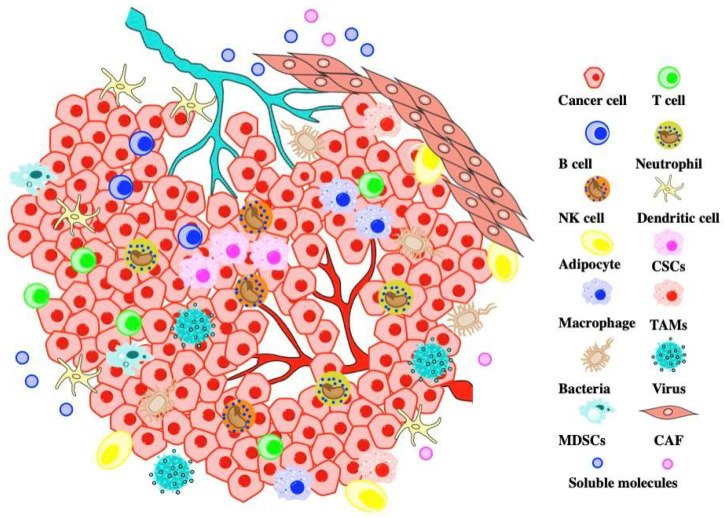
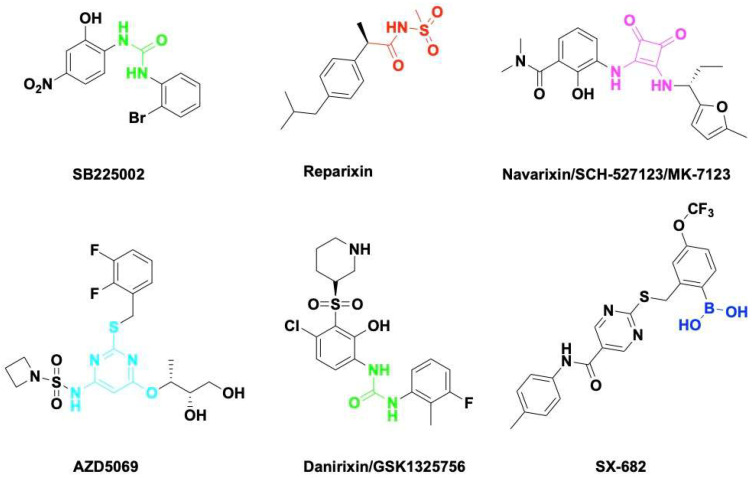
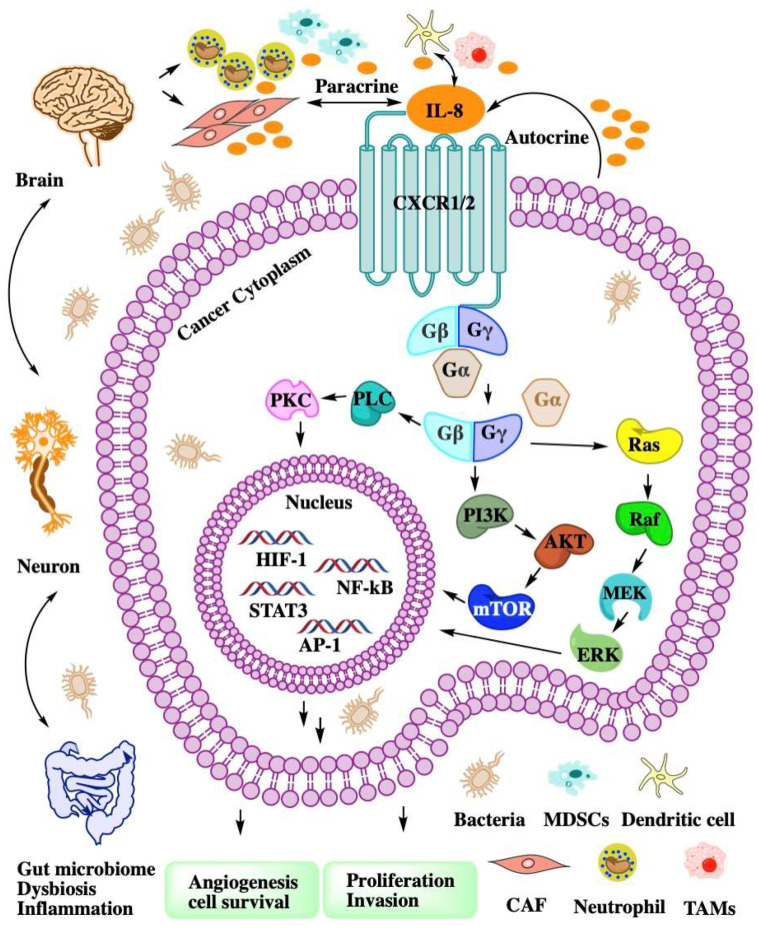
In humans, Interleukin-8 (IL-8 or CXCL8) is a granulocytic chemokine with multiple roles within the tumor microenvironment (TME), such as recruiting immunosuppressive cells to the tumor, increasing tumor angiogenesis, and promoting epithelial-to-mesenchymal transition (EMT). All of these effects of CXCL8 on individual cell types can result in cascading alterations to the TME. The changes in the TME components such as the cancer-associated fibroblasts (CAFs), the immune cells, the extracellular matrix, the blood vessels, or the lymphatic vessels further influence tumor progression and therapeutic resistance. Emerging roles of the microbiome in tumorigenesis or tumor progression revealed the intricate interactions between inflammatory response, dysbiosis, metabolites, CXCL8, immune cells, and the TME. Studies have shown that CXCL8 directly contributes to TME remodeling, cancer plasticity, and the development of resistance to both chemotherapy and immunotherapy. Further, clinical data demonstrate that CXCL8 could be an easily measurable prognostic biomarker in patients receiving immune checkpoint inhibitors. The blockade of the CXCL8-CXCR1/2 axis alone or in combination with other immunotherapy will be a promising strategy to improve antitumor efficacy. Herein, we review recent advances focusing on identifying the mechanisms between TME components and the CXCL8-CXCR1/2 axis for novel immunotherapy strategies.
在人类中,白细胞介素-8(IL-8 或 CXCL8)是一种粒细胞趋化因子,在肿瘤微环境(TME)中具有多种作用,例如招募免疫抑制细胞到肿瘤中,增加肿瘤血管生成,并促进上皮-间充质转化(EMT)。CXCL8 对个体细胞类型的所有这些作用都可能导致 TME 的级联改变。TME 成分的变化,如癌相关成纤维细胞(CAFs)、免疫细胞、细胞外基质、血管或淋巴管,进一步影响肿瘤的进展和治疗抵抗。微生物组在肿瘤发生或肿瘤进展中的新兴作用揭示了炎症反应、生态失调、代谢物、CXCL8、免疫细胞和 TME 之间的复杂相互作用。研究表明,CXCL8 直接促进 TME 重塑、癌症可塑性以及对化疗和免疫治疗的耐药性的发展。此外,临床数据表明,CXCL8 可能是接受免疫检查点抑制剂治疗的患者中一种易于测量的预后生物标志物。单独阻断 CXCL8-CXCR1/2 轴或与其他免疫疗法联合使用将是提高抗肿瘤疗效的有前途的策略。在此,我们回顾了最近的进展,重点关注确定 TME 成分与 CXCL8-CXCR1/2 轴之间的机制,以制定新的免疫治疗策略。