Unigwe Ikenna, Yang Seonkyeong, Song Hyun Jin, Lo-Ciganic Wei-Hsuan, Hincapie-Castillo Juan, Cook Robert L, Park Haesuk
Pharmaceutical Outcomes and Policy, College of Pharmacy, University of Florida, Gainesville, FL 32610, USA.
Department of Epidemiology, College of Public Health, University of North Carolina, Chapel Hill, NC 27599, USA.
J Clin Med. 2021 Dec 24;11(1):71. doi: 10.3390/jcm11010071.
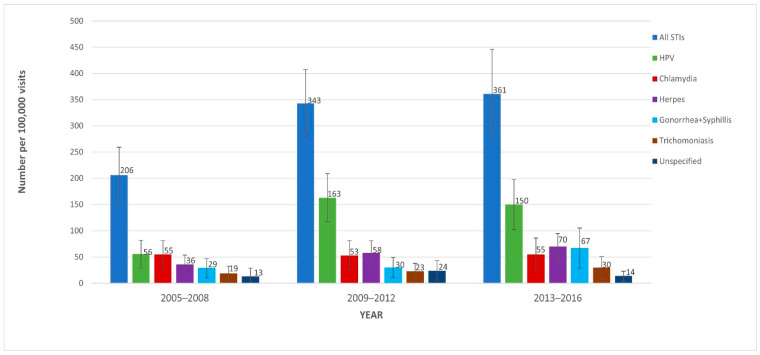
We examined the prevalence trends of non-human immunodeficiency virus (HIV) sexually transmitted infections (STI) and associated patient characteristics in U.S. ambulatory-care settings from 2005-2016. We conducted a retrospective repeated cross-sectional analysis using data from the National Ambulatory Medical Care Survey (NAMCS) for individuals aged 15-64 with a non-HIV STI-related visit. Data were combined into three periods (2005-2008, 2009-2012, and 2013-2016) to obtain reliable estimates. Logistic regression was used for analysis. A total of 19.5 million weighted, non-HIV STI-related ambulatory visits from 2005-2016 were identified. STI-related visits per 100,000 ambulatory care visits increased significantly over the study period: 206 (95% CI = 153-259), 343 (95% CI = 279-407), and 361 (95% CI = 277-446) in 2005-2008, 2009-2012, and 2013-2016, respectively (P = 0.003). These increases were mainly driven by increases in HPV-related visits (56 to 163 per 100,000 visits) from 2005-2008 to 2009-2012, followed by syphilis- or gonorrhea-related visits (30 to 67 per 100,000 visits) from 2009-2012 to 2013-2016. Higher odds of having STI-related visit were associated with younger age (aged 15-24: aOR = 4.45; 95% CI = 3.19-6.20 and aged 25-44: aOR = 3.59; 95% CI = 2.71-4.77) vs. 45-64-year-olds, Black race (aOR = 2.41; 95% CI = 1.78-3.25) vs. White, and HIV diagnosis (aOR = 10.60; 95% CI = 5.50-20.27) vs. no HIV diagnosis. STI-related office visits increased by over 75% from 2005-2016, and were largely driven by HPV-related STIs and syphilis- or gonorrhea-related STIs.
我们研究了2005年至2016年美国门诊护理机构中非人类免疫缺陷病毒(HIV)性传播感染(STI)的流行趋势及相关患者特征。我们使用来自国家门诊医疗护理调查(NAMCS)的数据,对年龄在15 - 64岁且有非HIV性传播感染相关就诊记录的个体进行了回顾性重复横断面分析。数据被合并为三个时期(2005 - 2008年、2009 - 2012年和2013 - 2016年)以获得可靠估计值。采用逻辑回归进行分析。2005年至2016年共识别出1950万次加权的、与非HIV性传播感染相关的门诊就诊。在研究期间,每10万次门诊护理就诊中与性传播感染相关的就诊次数显著增加:2005 - 2008年为206次(95%置信区间 = 153 - 259),2009 - 2012年为343次(95%置信区间 = 279 - 407),2013 - 2016年为361次(95%置信区间 = 277 - 446)(P = 0.003)。这些增加主要由与HPV相关的就诊次数增加所驱动(从2005 - 2008年的每10万次就诊56次增加到2009 - 2012年的163次),其次是与梅毒或淋病相关的就诊次数增加(从2009 - 2012年的每10万次就诊30次增加到2013 - 2016年的67次)。与45 - 64岁人群相比,年龄较小(15 - 24岁:调整后比值比 = 4.45;95%置信区间 = 3.19 - 6.20和25 - 44岁:调整后比值比 = 3.59;95%置信区间 = 2.71 - 4.77)、黑人种族(调整后比值比 = 2.41;95%置信区间 = 1.78 - 3.25)与白人相比、以及有HIV诊断(调整后比值比 = 10.60;95%置信区间 = 5.50 - 20.27)与无HIV诊断相比,有性传播感染相关就诊的几率更高。2005年至2016年期间,与性传播感染相关的门诊就诊次数增加了75%以上,主要由与HPV相关的性传播感染以及与梅毒或淋病相关的性传播感染所驱动。