Voellger Benjamin, Zhang Zhuo, Benzel Julia, Wang Junwen, Lei Ting, Nimsky Christopher, Bartsch Jörg-Walter
Department of Neurosurgery, University Hospital Marburg, Baldingerstr., 35033 Marburg, Germany.
Department of Neurosurgery, Tongji Hospital, Tongji Medical College of Huazhong University of Science and Technology, Wuhan 430030, China.
J Clin Med. 2021 Dec 27;11(1):124. doi: 10.3390/jcm11010124.
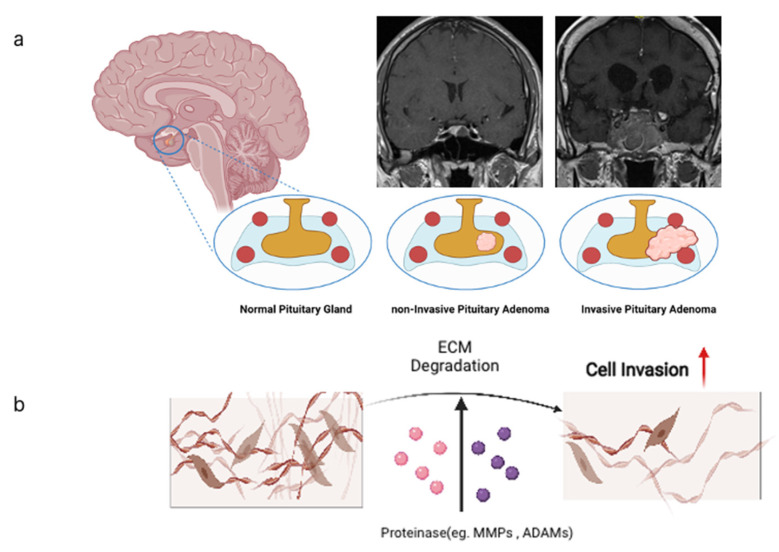
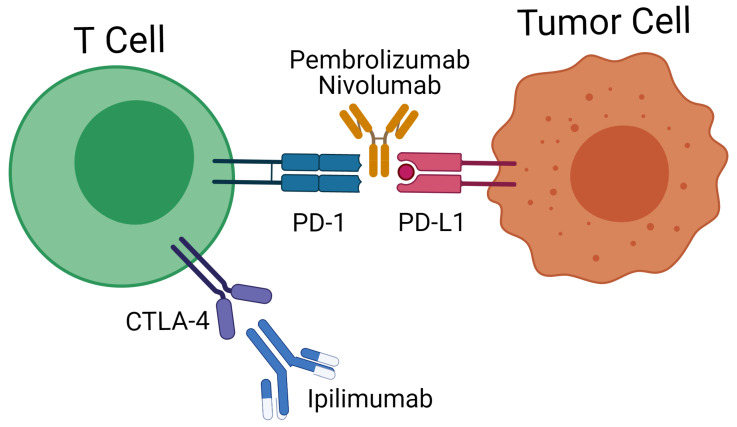
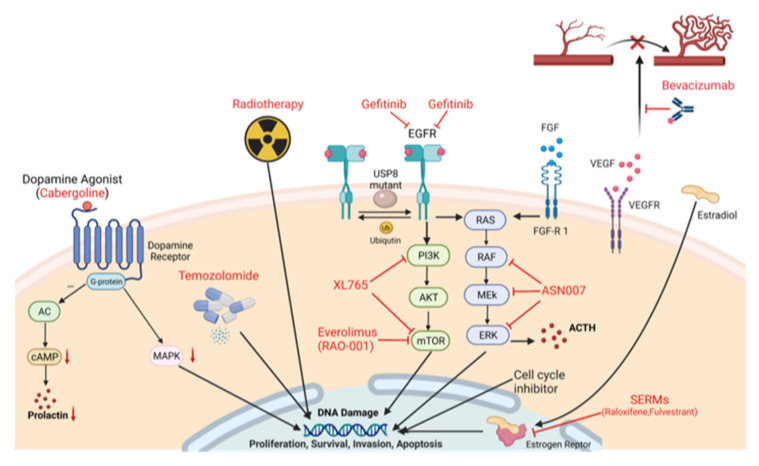
Pituitary adenomas (PAs) are mostly benign endocrine tumors that can be treated by resection or medication. However, up to 10% of PAs show an aggressive behavior with invasion of adjacent tissue, rapid proliferation, or recurrence. Here, we provide an overview of target structures in aggressive PAs and summarize current clinical trials including, but not limited to, PAs. Mainly, drug targets in PAs are based on general features of tumor cells such as immune checkpoints, so that programmed cell death 1 (ligand 1) (PD-1/PD-L1) targeting may bear potential to cure aggressive PAs. In addition, epidermal growth factor receptor (EGFR), mammalian target of rapamycin (mTOR), vascular endothelial growth factor (VEGF), fibroblast growth factor (FGF) and their downstream pathways are triggered in PAs, thereby modulating tumor cell proliferation, migration and/or tumor angiogenesis. Temozolomide (TMZ) can be an effective treatment of aggressive PAs. Combination of TMZ with 5-Fluorouracil (5-FU) or with radiotherapy could strengthen the therapeutic effects as compared to TMZ alone. Dopamine agonists (DAs) are the first line treatment for prolactinomas. Dopamine receptors are also expressed in other subtypes of PAs which renders Das potentially suitable to treat other subtypes of PAs. Furthermore, targeting the invasive behavior of PAs could improve therapy. In this regard, human matrix metalloproteinase (MMP) family members and estrogens receptors (ERs) are highly expressed in aggressive PAs, and numerous studies demonstrated the role of these proteins to modulate invasiveness of PAs. This leaves a number of treatment options for aggressive PAs as reviewed here.
垂体腺瘤(PAs)大多是良性内分泌肿瘤,可通过手术切除或药物治疗。然而,高达10%的垂体腺瘤表现出侵袭性行为,侵犯邻近组织、快速增殖或复发。在此,我们概述侵袭性垂体腺瘤的靶结构,并总结当前的临床试验,包括但不限于垂体腺瘤。主要而言,垂体腺瘤的药物靶点基于肿瘤细胞的一般特征,如免疫检查点,因此靶向程序性细胞死亡蛋白1(配体1)(PD-1/PD-L1)可能具有治愈侵袭性垂体腺瘤的潜力。此外,垂体腺瘤中表皮生长因子受体(EGFR)、哺乳动物雷帕霉素靶蛋白(mTOR)、血管内皮生长因子(VEGF)、成纤维细胞生长因子(FGF)及其下游通路被激活,从而调节肿瘤细胞的增殖、迁移和/或肿瘤血管生成。替莫唑胺(TMZ)可能是治疗侵袭性垂体腺瘤的有效药物。与单独使用替莫唑胺相比,替莫唑胺与5-氟尿嘧啶(5-FU)联合或与放疗联合可增强治疗效果。多巴胺激动剂(DAs)是催乳素瘤的一线治疗药物。多巴胺受体也在垂体腺瘤的其他亚型中表达,这使得多巴胺激动剂有可能适用于治疗其他亚型的垂体腺瘤。此外,针对垂体腺瘤的侵袭行为进行靶向治疗可以改善治疗效果。在这方面,人类基质金属蛋白酶(MMP)家族成员和雌激素受体(ERs)在侵袭性垂体腺瘤中高表达,大量研究证明了这些蛋白在调节垂体腺瘤侵袭性中的作用。本文综述了侵袭性垂体腺瘤的多种治疗选择。