Calabrese Vincenzo, Cernaro Valeria, Battaglia Valeria, Gembillo Guido, Longhitano Elisa, Siligato Rossella, Sposito Giovanna, Ferlazzo Guido, Santoro Domenico
Unit of Nephrology and Dialysis, Department of Clinical and Experimental Medicine, University of Messina, 98125 Messina, Italy.
Unit of Clinical Pathology, Department of Human Pathology of Adults and Developmental Age, University of Messina, 98125 Messina, Italy.
J Clin Med. 2022 Jan 4;11(1):244. doi: 10.3390/jcm11010244.
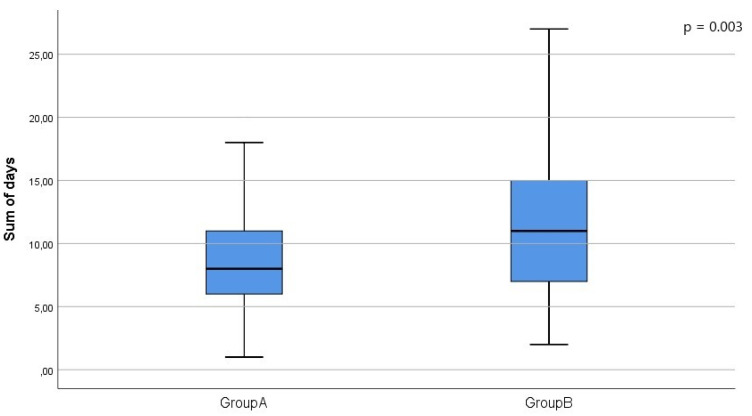
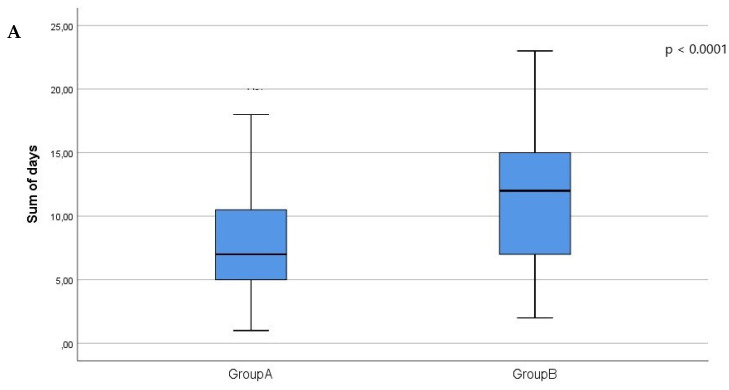
(1) Background: This observational study aimed to verify the association between serum potassium levels and hospitalization days in patients with chronic kidney disease in a follow up of nine months. (2) Methods: Patients with chronic kidney disease were divided into group A (180 patients, potassium ≤ 5.1 mEq/L) and B (90 patients, potassium > 5.1 mEq/L). Student's -test, Mann-Whitney test, Pearson's Chi-Square test, Pearson/Spearman's correlation test and linear regression test were performed in the entire sample and in stage-G4/5 subsample. (3) Results: Groups A and B differed for estimated glomerular filtration rate (eGFR) (34.89 (IQR, 16.24-57.98) vs. 19.8 (IQR, 10.50-32.50) mL/min/1.73 m; < 0.0001), hemoglobin (11.64 ± 2.20 vs. 10.97 ± 2.19 g/dL, = 0.048), sum of hospitalization days (8 (IQR, 6-10) vs. 11 (IQR, 7-15) days; < 0.0001) and use of angiotensin II receptor blockers (40.2% vs. 53.3%; = 0.010). Considering patients with eGFR 6-30 mL/min/1.73 m, differences in the sum of hospitalization days were confirmed. Multivariable regression analysis showed that hyperkalemia is an independent risk factor of increased hospital length. In stage G4-G5, regression analysis showed that hyperkalemia is the only independent risk factor (β = 2.93, 95% confidence interval, 0.077-5.794, = 0.044). (4) Conclusions: We observed significantly greater odds of increased length of hospital stay among patients with higher potassium, mostly in stages G4-G5 chronic kidney disease.
(1) 背景:本观察性研究旨在验证慢性肾脏病患者血清钾水平与九个月随访期间住院天数之间的关联。(2) 方法:将慢性肾脏病患者分为A组(180例,血钾≤5.1 mEq/L)和B组(90例,血钾>5.1 mEq/L)。对整个样本以及G4/5期亚样本进行了学生t检验、曼-惠特尼检验、皮尔逊卡方检验、皮尔逊/斯皮尔曼相关性检验和线性回归检验。(3) 结果:A组和B组在估计肾小球滤过率(eGFR)(34.89(四分位间距,16.24 - 57.98)对19.8(四分位间距,10.50 - 32.50)mL/min/1.73 m²;P<0.0001)、血红蛋白(11.64±2.20对10.97±2.19 g/dL,P = 0.048)、住院天数总和(8(四分位间距,6 - 10)对11(四分位间距,7 - 15)天;P<0.0001)以及血管紧张素II受体阻滞剂的使用(40.2%对53.3%;P = 0.010)方面存在差异。对于eGFR为6 - 30 mL/min/1.73 m²的患者,住院天数总和的差异得到确认。多变量回归分析表明高钾血症是住院时间延长的独立危险因素。在G4 - G5期,回归分析表明高钾血症是唯一的独立危险因素(β = 2.93,95%置信区间,0.077 - 5.794,P = 0.044)。(4) 结论:我们观察到血钾较高的患者住院时间延长的几率显著更高,主要是在G4 - G5期慢性肾脏病患者中。