Tin Huynh-Xuan, Thuy Ngo-Thanh, Seo Soo-Yeon
Faculty of Civil Engineering, University of Transport and Communications, No. 3 Cau Giay Street, Lang Thuong Ward, Dong Da District, Hanoi 11512, Vietnam.
Department of Architectural Engineering, Korea National University of Transportation, Chungju 27469, Korea.
Polymers (Basel). 2021 Dec 25;14(1):75. doi: 10.3390/polym14010075.
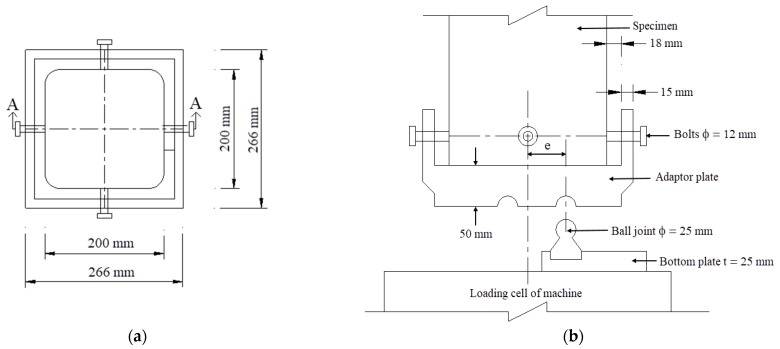
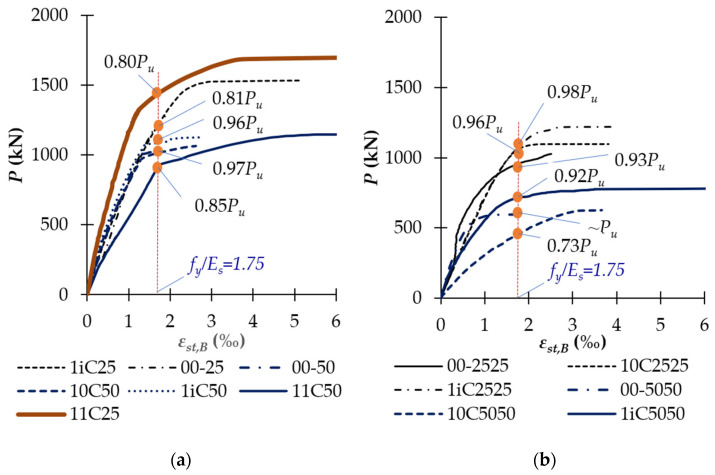
Various researches have been performed to find an effective confining method using FRP sheet in order to improve the structural capacity of reinforced concrete column. However, most of these researches were undertaken for the columns subjected to concentric compressive load or fully confined RC columns. To date, it remains hard to find studies on partially FRP-confined RC columns under eccentric load. In this manner, an experimental investigation was carried out to assess the performance of rectangular RC column with different patterns of CFRP-wrap subject to eccentric loads in this paper. The experiment consists of fourteen mid-scale rectangular RC columns of 200 mm × 200 mm × 800 mm, including five controlled columns and nine CFRP-strengthened ones. All CFRP-strengthened columns were reinforced with one layer of vertical CFRP sheet with the main fiber along the axial axis at four sides, then divided into three groups according to confinement purpose, namely unconfined, partially CFRP-confined, and fully CFRP-confined group. Two loading conditions, namely uniaxially and biaxially eccentric loads, are considered as one of the test parameters. From the test of uniaxial eccentric load, partial and full CFRP-wraps provided 19% and 33% increased load-carrying capacity at an eccentricity-to-column thickness ratio (/) of 0.125, respectively, compared to controlled columns, and 8% and 11% at / = 0.25, respectively. For the partially CFRP-confined columns subjected to biaxial eccentric load with / = 0.125 and 0.25, the load-carrying capacities were improved by 19% and 31%, respectively. This means that the partial confinement with CFRP effectively improves the load-carrying capacity at larger biaxial eccentric load. It was found that the load-carrying capacity could be properly predicted by using code equations of ACI 440.2R-17 and Fib Bulletin 14 Guideline for the full CFRP-confined or partially CFRP-confined columns under uniaxial load. For partially CFRP-confined columns under biaxial loading, however, the safety factors using the Fib calculation process were 20% to 31% lower than that of uniaxially loaded columns.
为了提高钢筋混凝土柱的结构性能,已经进行了各种研究以寻找一种使用纤维增强复合材料(FRP)板的有效约束方法。然而,这些研究大多是针对承受同心压缩荷载的柱或完全约束的钢筋混凝土柱进行的。迄今为止,仍然很难找到关于偏心荷载作用下部分FRP约束钢筋混凝土柱的研究。基于此,本文进行了一项试验研究,以评估不同碳纤维增强塑料(CFRP)包裹形式的矩形钢筋混凝土柱在偏心荷载作用下的性能。试验包括14根尺寸为200mm×200mm×800mm的中型矩形钢筋混凝土柱,其中包括5根对照柱和9根CFRP加固柱。所有CFRP加固柱在四个侧面均用一层垂直的CFRP板加固,主纤维沿轴向,然后根据约束目的分为三组,即无约束组、部分CFRP约束组和完全CFRP约束组。试验参数之一考虑了两种加载条件,即单轴和双轴偏心荷载。从单轴偏心荷载试验来看,与对照柱相比,部分和完全CFRP包裹在偏心距与柱厚度比(/)为0.125时,分别使承载能力提高了19%和33%,在/ = 0.25时,分别提高了8%和11%。对于承受双轴偏心荷载且/ = 0.125和0.25的部分CFRP约束柱,其承载能力分别提高了19%和31%。这意味着在较大双轴偏心荷载下,CFRP的部分约束有效地提高了承载能力。研究发现,对于单轴荷载作用下的完全CFRP约束或部分CFRP约束柱,使用美国混凝土学会(ACI)440.2R - 17规范方程和国际混凝土结构联合会(Fib)公告14指南可以合理预测其承载能力。然而,对于双轴荷载作用下的部分CFRP约束柱,使用Fib计算过程得到的安全系数比单轴荷载柱低20%至31%。