Department of Internal Medicine, Division of General Internal Medicine, Section Geriatric Medicine, Maastricht University Medical Centre, PO Box 5800, 6202, AZ, Maastricht, The Netherlands.
Department of Hospital Pharmacy, Erasmus MC, University Medical Center Rotterdam, 3015, GD, Rotterdam, The Netherlands.
BMC Geriatr. 2022 Jan 10;22(1):36. doi: 10.1186/s12877-021-02723-8.
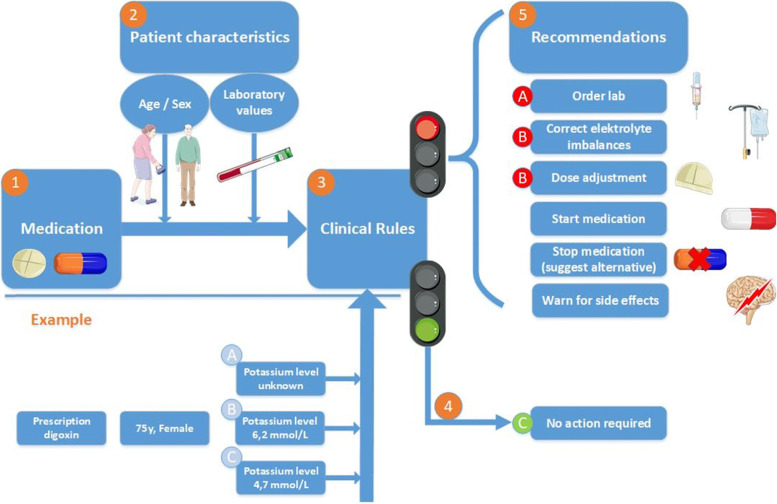
Due to ageing of the population the incidence of multimorbidity and polypharmacy is rising. Polypharmacy is a risk factor for medication-related (re)admission and therefore places a significant burden on the healthcare system. The reported incidence of medication-related (re)admissions varies widely due to the lack of a clear definition. Some medications are known to increase the risk for medication-related admission and are therefore published in the triggerlist of the Dutch guideline for Polypharmacy in older patients. Different interventions to support medication optimization have been studied to reduce medication-related (re)admissions. However, the optimal template of medication optimization is still unknown, which contributes to the large heterogeneity of their effect on hospital readmissions. Therefore, we implemented a clinical decision support system (CDSS) to optimize medication lists and investigate whether continuous use of a CDSS reduces the number of hospital readmissions in older patients, who previously have had an unplanned probably medication-related hospitalization.
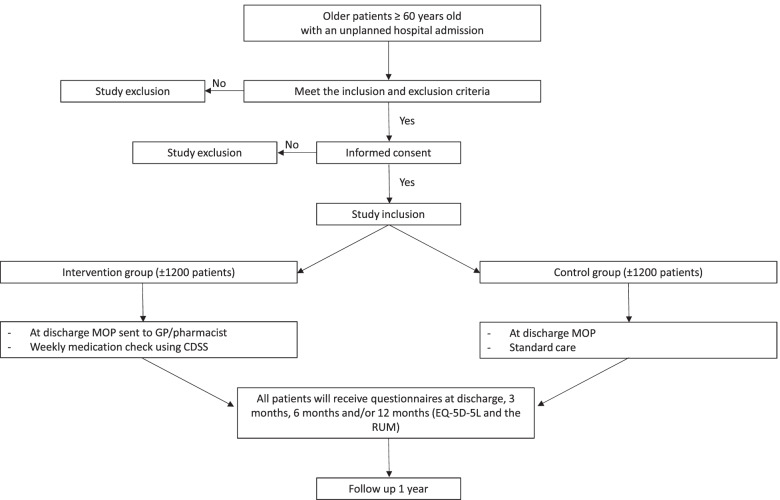
The CHECkUP study is a multicentre randomized study in older (≥60 years) patients with an unplanned hospitalization, polypharmacy (≥5 medications) and using at least two medications from the triggerlist, from Zuyderland Medical Centre and Maastricht University Medical Centre+ in the Netherlands. Patients will be randomized. The intervention consists of continuous (weekly) use of a CDSS, which generates a Medication Optimization Profile, which will be sent to the patient's general practitioner and pharmacist. The control group will receive standard care. The primary outcome is hospital readmission within 1 year after study inclusion. Secondary outcomes are one-year mortality, number of emergency department visits, nursing home admissions, time to hospital readmissions and we will evaluate the quality of life and socio-economic status.
This study is expected to add evidence on the knowledge of medication optimization and whether use of a continuous CDSS ameliorates the risk of adverse outcomes in older patients, already at an increased risk of medication-related (re)admission. To our knowledge, this is the first large study, providing one-year follow-up data and reporting not only on quality of care indicators, but also on quality-of-life.
The trial was registered in the Netherlands Trial Register on October 14, 2018, identifier: NL7449 (NTR7691). https://www.trialregister.nl/trial/7449 .
由于人口老龄化,多种疾病和多种药物的发病率正在上升。多种药物治疗是与药物相关的(再)入院的一个危险因素,因此给医疗保健系统带来了巨大的负担。由于缺乏明确的定义,与药物相关的(再)入院的报告发病率差异很大。一些药物已知会增加与药物相关的入院风险,因此被列入荷兰老年人多种药物治疗指南的触发清单中。已经研究了不同的干预措施来支持药物优化,以减少与药物相关的(再)入院。然而,最佳的药物优化模板仍然未知,这导致了它们对医院再入院的影响存在很大的异质性。因此,我们实施了一个临床决策支持系统(CDSS)来优化药物清单,并调查在以前经历过非计划的可能与药物相关的住院治疗的老年患者中,连续使用 CDSS 是否会降低医院再入院的数量。
CHECkUP 研究是一项多中心随机研究,纳入了来自荷兰祖伊德兰医疗中心和马斯特里赫特大学医学中心的年龄在 60 岁以上、有非计划性住院、多种药物治疗(≥5 种药物)和使用触发清单中至少两种药物的老年患者。患者将被随机分组。干预措施包括连续(每周)使用 CDSS,生成药物优化档案,将其发送给患者的全科医生和药剂师。对照组将接受标准护理。主要结局是研究纳入后 1 年内的医院再入院。次要结局是 1 年死亡率、急诊就诊次数、疗养院入院、医院再入院时间,我们将评估生活质量和社会经济状况。
这项研究有望增加关于药物优化的知识,以及在已经处于与药物相关(再)入院风险增加的老年患者中,连续使用 CDSS 是否可以改善不良结局的风险。据我们所知,这是第一项提供一年随访数据并不仅报告护理质量指标,还报告生活质量的大型研究。
该试验于 2018 年 10 月 14 日在荷兰试验注册处注册,注册号为 NL7449(NTR7691)。[www.trialregister.nl/trial/7449]。