Department of Psychiatry, University of Colorado Anschutz Medical Campus, Aurora, USA.
Division of Adult Psychosocial Oncology and Palliative Care, Dana Farber Cancer Institute, Harvard Medical School, Boston, MA, USA.
Health Qual Life Outcomes. 2022 Jan 10;20(1):6. doi: 10.1186/s12955-021-01909-3.
Hematopoietic stem cell transplantation (HSCT) is an aggressive medical procedure which significantly impacts the shared emotional well-being of patients and family caregivers (FC). Prior work has highlighted the significant overlap in well-being among patients and FCs; however, how this interdependence may change over the course of HSCT has received less attention.
We conducted secondary analyses of a supportive intervention delivered to 154 FCs of HSCT patients and examined relationships at baseline, 6 weeks, 3 and 6 months post-HSCT. Actor Partner Interdependence Modeling examined patient quality of life (QOL) and FC anxiety/depression.
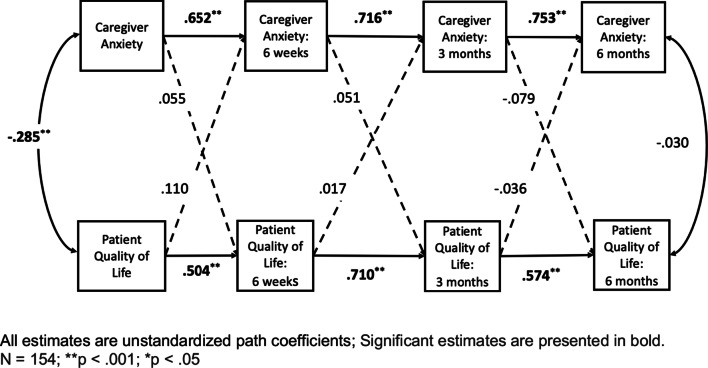
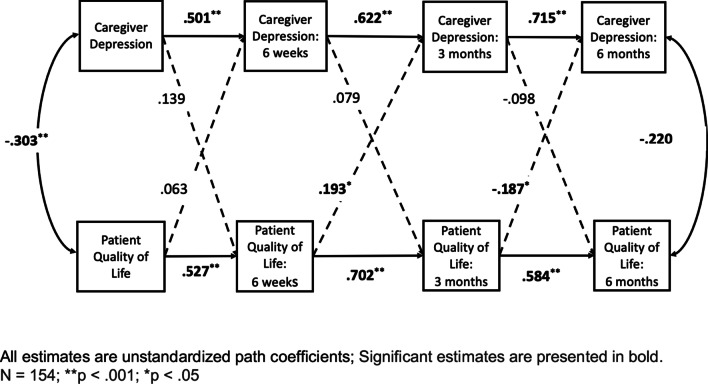
The data did not fit a multigroup approach limiting our ability to test intervention effects; however, bivariate analyses indicated FC depression significantly correlated to patient QOL at baseline (r = - .32), 6 weeks (r = - .22) and 6 months post-HSCT (r = - .34; p's < .05); whereas FC anxiety was only correlated with patient QOL at the first two timepoints (p's < .05). There was an unexpected, partner effect such that worse patient QOL at 6-weeks significantly related to lower FC depression at 3-months (B = .193; p = .026) and changed direction with patient QOL at 3-months being related to more FC depression at 6-months (B = - .187; p = .001).
These findings highlight the significant, yet nuanced, interdependence of patient QOL and FC well-being during HSCT. Specifically, greater interdependence was observed between patient QOL and FC depression compared to FC anxiety, suggesting potential treatment targets for patients and their families. Trial was registered at ClinicalTrials.gov Identifier: NCT02037568; first registered: January 16, 2014; https://clinicaltrials.gov/ct2/show/NCT02037568.
造血干细胞移植(HSCT)是一种侵袭性的医疗程序,它会显著影响患者和其家庭照顾者(FC)的共同情感健康。先前的研究已经强调了患者和 FC 之间在幸福感方面的显著重叠;然而,这种相互依存关系在 HSCT 过程中如何变化还没有得到太多关注。
我们对 154 名 HSCT 患者的 FC 进行了支持性干预的二次分析,并在 HSCT 后 6 周、3 个月和 6 个月检查了基线时的关系。演员-伙伴相互依赖模型检查了患者的生活质量(QOL)和 FC 的焦虑/抑郁。
数据不适合多组方法,限制了我们测试干预效果的能力;然而,双变量分析表明,FC 抑郁在基线(r=−.32)、6 周(r=−.22)和 6 个月(r=−.34;p<.05)时与患者 QOL 显著相关;而 FC 焦虑仅在前两个时间点与患者 QOL 相关(p<.05)。出乎意料的是,有一个伙伴效应,即 6 周时患者 QOL 恶化与 3 个月时 FC 抑郁降低显著相关(B=.193;p=.026),并且患者 3 个月时的 QOL 与 6 个月时的 FC 抑郁增加相关的方向发生了变化(B=−.187;p=.001)。
这些发现强调了 HSCT 期间患者 QOL 和 FC 健康状况之间显著而微妙的相互依存关系。具体来说,与 FC 焦虑相比,患者 QOL 与 FC 抑郁之间的相互依存关系更大,这表明患者及其家庭可能存在潜在的治疗目标。试验在 ClinicalTrials.gov 标识符:NCT02037568;首次注册:2014 年 1 月 16 日;https://clinicaltrials.gov/ct2/show/NCT02037568。