School of Mechanical Engineering, Sungkyunkwan University (SKKU), Suwon, 16419, South Korea.
Bioprocessing Technology Institute (BTI), Agency for Science, Technology and Research (A*STAR), Singapore, 138668, Singapore.
J Nanobiotechnology. 2022 Jan 10;20(1):30. doi: 10.1186/s12951-021-01213-8.
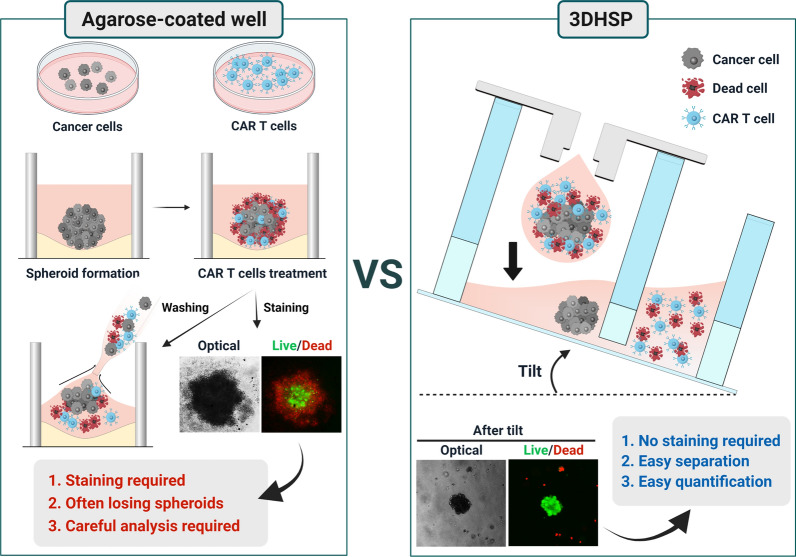
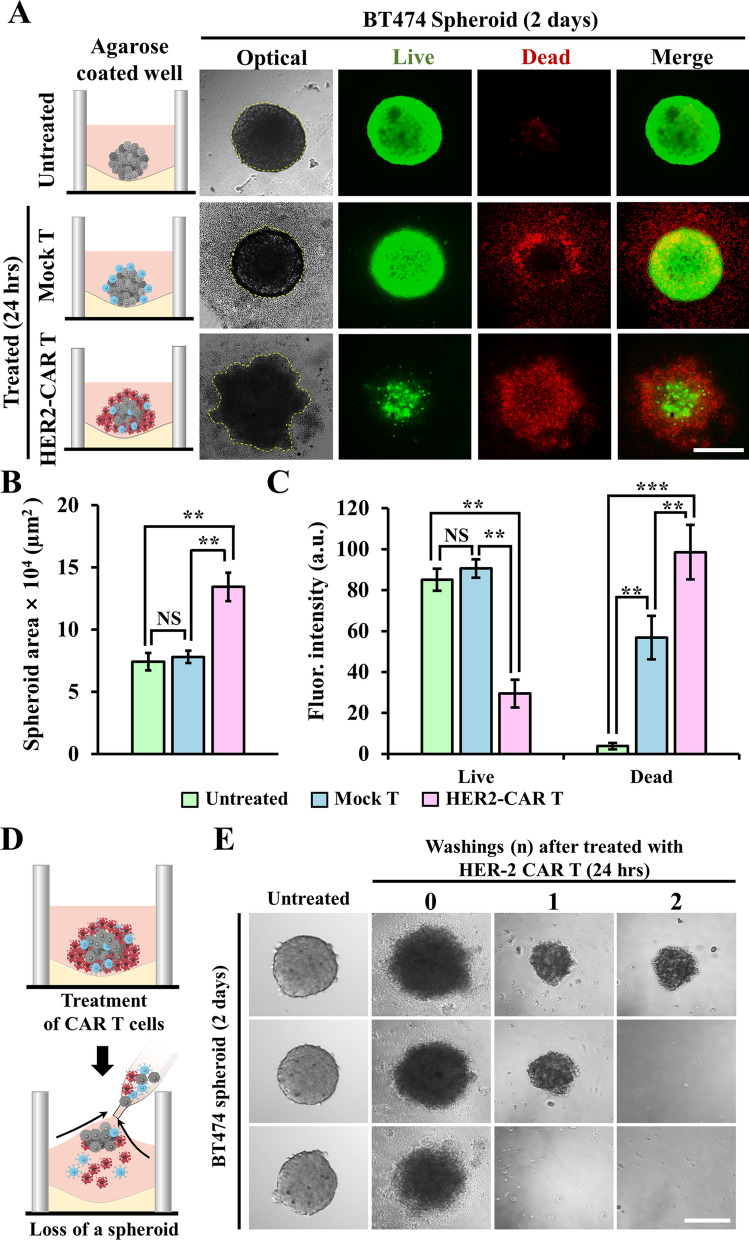
Most high-throughput screening (HTS) systems studying the cytotoxic effect of chimeric antigen receptor (CAR) T cells on tumor cells rely on two-dimensional cell culture that does not recapitulate the tumor microenvironment (TME). Tumor spheroids, however, can recapitulate the TME and have been used for cytotoxicity assays of CAR T cells. But a major obstacle to the use of tumor spheroids for cytotoxicity assays is the difficulty in separating unbound CAR T and dead tumor cells from spheroids. Here, we present a three-dimensional hanging spheroid plate (3DHSP), which facilitates the formation of spheroids and the separation of unbound and dead cells from spheroids during cytotoxicity assays.
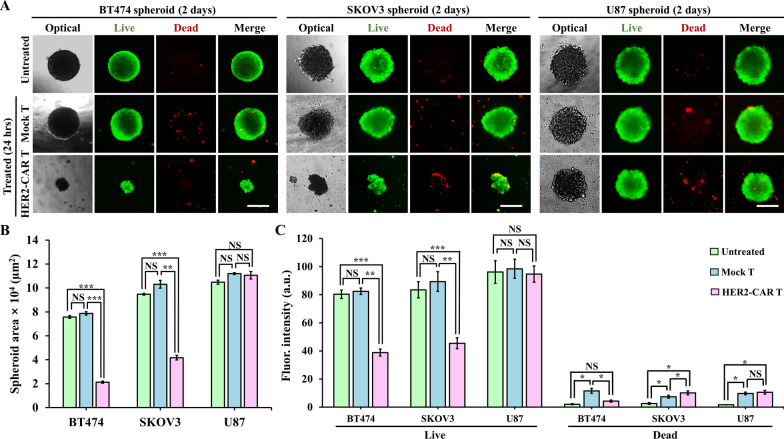
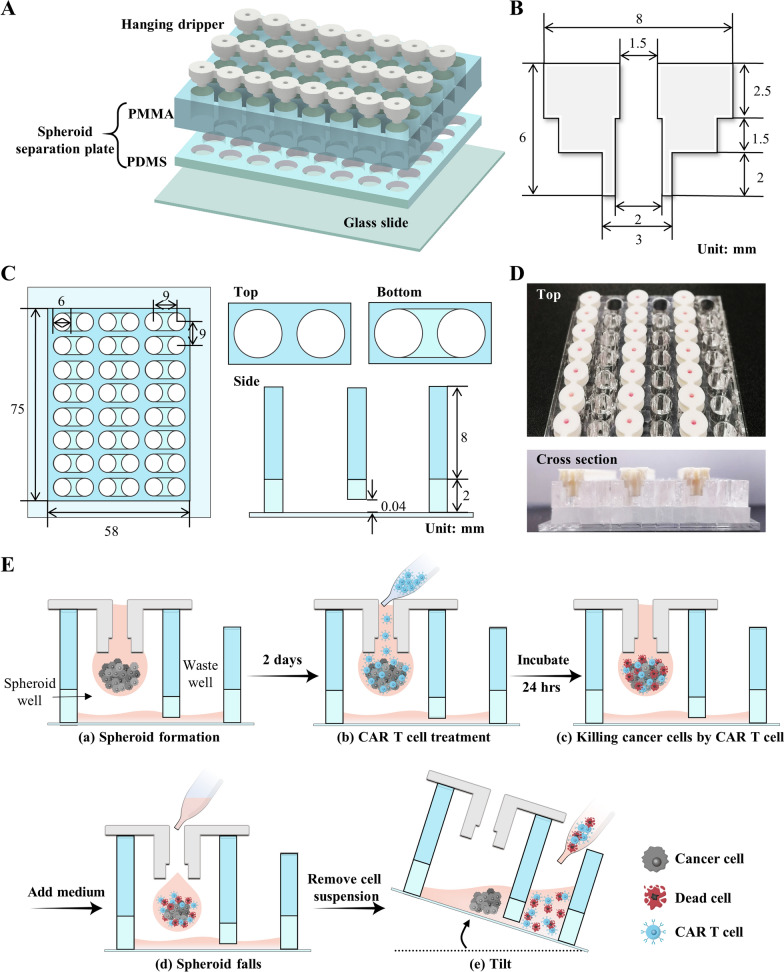
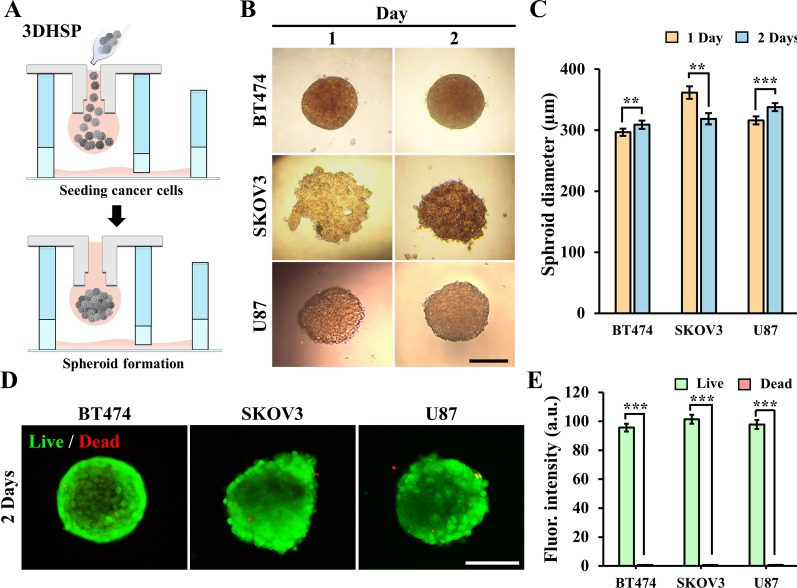
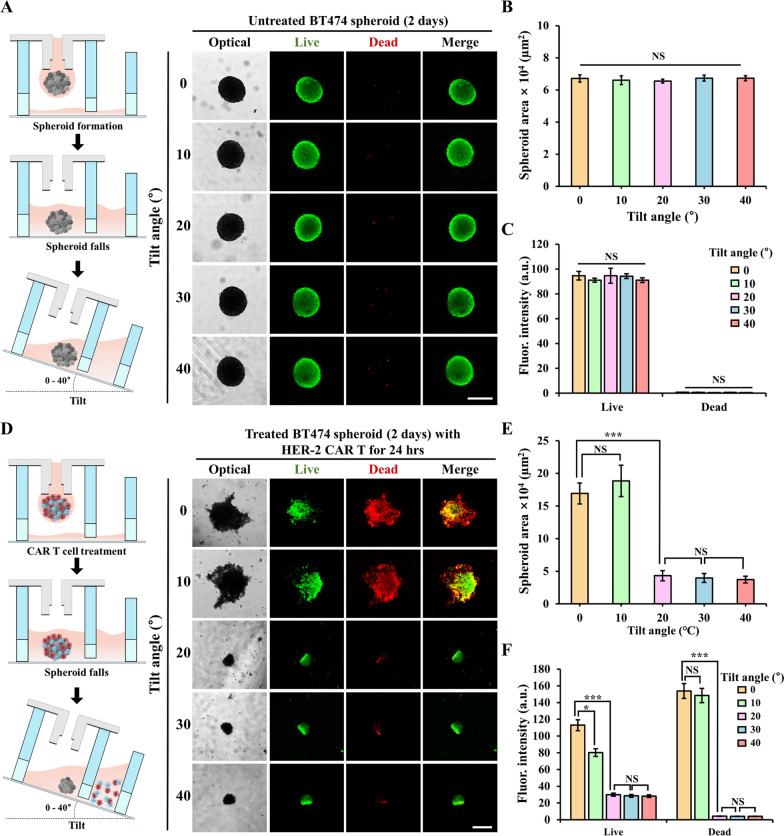
The 3DHSP is a 24-well plate, with each well composed of a hanging dripper, spheroid wells, and waste wells. In the dripper, a tumor spheroid was formed and mixed with CAR T cells. In the 3DHSP, droplets containing the spheroids were deposited into the spheroid separation well, where unbound and dead T and tumor cells were separated from the spheroid through a gap into the waste well by tilting the 3DHSP by more than 20°. Human epidermal growth factor receptor 2 (HER2)-positive tumor cells (BT474 and SKOV3) formed spheroids of approximately 300-350 μm in diameter after 2 days in the 3DHSP. The cytotoxic effects of T cells engineered to express CAR recognizing HER2 (HER2-CAR T cells) on these spheroids were directly measured by optical imaging, without the use of live/dead fluorescent staining of the cells. Our results suggest that the 3DHSP could be incorporated into a HTS system to screen for CARs that enable T cells to kill spheroids formed from a specific tumor type with high efficacy or for spheroids consisting of tumor types that can be killed efficiently by T cells bearing a specific CAR.
The results suggest that the 3DHSP could be incorporated into a HTS system for the cytotoxic effects of CAR T cells on tumor spheroids.
大多数研究嵌合抗原受体 (CAR) T 细胞对肿瘤细胞细胞毒性作用的高通量筛选 (HTS) 系统依赖于不能再现肿瘤微环境 (TME) 的二维细胞培养。然而,肿瘤球体可以再现 TME,并且已被用于 CAR T 细胞的细胞毒性测定。但是,使用肿瘤球体进行细胞毒性测定的一个主要障碍是难以将未结合的 CAR T 和死亡的肿瘤细胞从球体中分离出来。在这里,我们提出了一种三维悬滴球体板 (3DHSP),它便于球体的形成,并且在细胞毒性测定过程中从球体中分离未结合的和死亡的细胞。
3DHSP 是一种 24 孔板,每个孔由一个悬挂滴头、球体孔和废物孔组成。在滴头中,形成了一个肿瘤球体,并与 CAR T 细胞混合。在 3DHSP 中,含有球体的液滴被沉积到球体分离孔中,通过将 3DHSP 倾斜超过 20°,使未结合的和死亡的 T 和肿瘤细胞通过间隙进入废物孔,从而从球体中分离出来。在 3DHSP 中,HER2 阳性肿瘤细胞(BT474 和 SKOV3)在 2 天后形成直径约 300-350μm 的球体。通过光学成像直接测量了表达识别 HER2 的 CAR 的 T 细胞(HER2-CAR T 细胞)对这些球体的细胞毒性作用,而无需对细胞进行活/死荧光染色。我们的结果表明,3DHSP 可以整合到 HTS 系统中,用于筛选能够使 T 细胞以高疗效杀死特定肿瘤类型形成的球体或能够有效杀死携带特定 CAR 的 T 细胞的肿瘤类型球体的 CAR,以用于筛选。
结果表明,3DHSP 可以整合到 HTS 系统中,用于测定 CAR T 细胞对肿瘤球体的细胞毒性作用。