Liang Liang, Chen Junyu, Xiao Ling, Wang Qing, Wang Gaohua
Department of Psychology, The Fourth Affiliated Hospital of Xinjiang Medical University, Urumqi, Xinjiang, China.
Department of Psychiatry, Renmin Hospital of Wuhan University, Hubei Zhang Road (formerly Ziyang Road), Wuchang District No. 99, Jiefang Road 238, Wuhan, Hubei, China.
Transl Psychiatry. 2022 Jan 10;12(1):4. doi: 10.1038/s41398-021-01727-7.
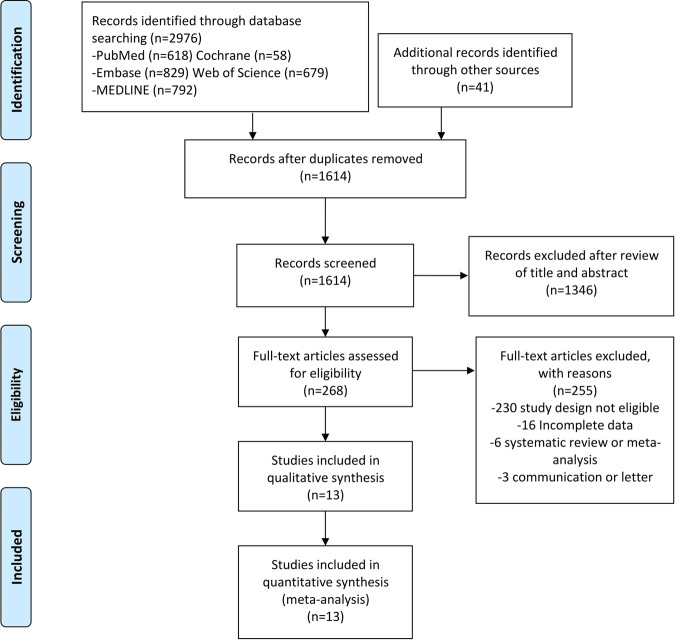
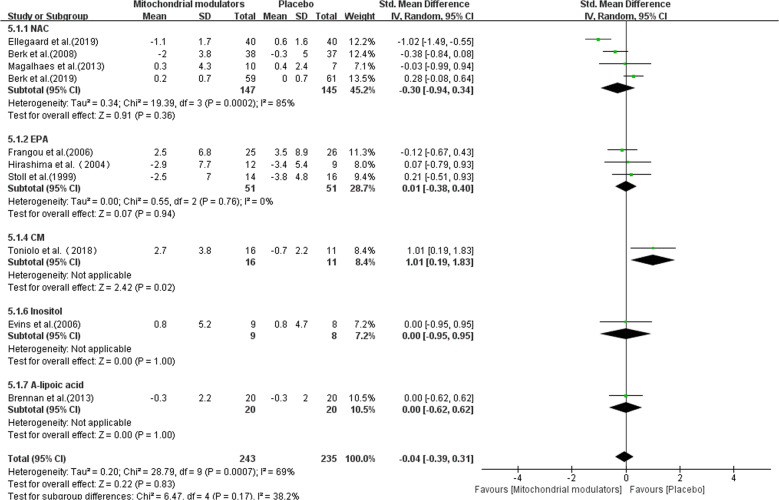
Mitochondrial dysfunction has been implicated in the risk, pathophysiology, and progression of mood disorders, especially bipolar disorder (BD). Thus, the objective of this meta-analysis was to determine the overall antidepressant effect of mitochondrial modulators in the treatment of bipolar depression. Outcomes included improvement in depression scale scores, Young Mania Rating Scale (YMRS) and Clinical Global Impression-Severity Scale (CGI-S) score. Data from randomized controlled trials (RCTs) assessing the antidepressant effect of diverse mitochondrial modulators were pooled to determine standard mean differences (SMDs) compared with placebo.13 RCTs were identified for qualitative review. The overall effect size of mitochondrial modulators on depressive symptoms was -0.48 (95% CI: -0.83 to -0.14, p = 0.007, I = 75%), indicative of a statistically significant moderate antidepressant effect. In the subgroup analysis, NAC improved depressive symptoms compared with placebo (-0.88, 95% CI: -1.48 to -0.27, I = 81%). In addition, there was no statistical difference between mitochondrial modulators and placebo in YMRS. Although mitochondrial modulators were superior to placebo in CGI-S score (-0.44, 95% CI: -0.83 to -0.06, I = 71%), only EPA was superior to placebo in subgroup analysis. Overall, a moderate antidepressant effect was observed for mitochondrial modulators compared with placebo in the treatment of bipolar depression. The small number of studies, diversity of agents, and small sample sizes limited interpretation of the current analysis.
线粒体功能障碍与情绪障碍尤其是双相情感障碍(BD)的风险、病理生理学及病情进展有关。因此,本荟萃分析的目的是确定线粒体调节剂在治疗双相抑郁中的总体抗抑郁效果。结局指标包括抑郁量表评分、杨氏躁狂评定量表(YMRS)及临床总体印象-严重程度量表(CGI-S)评分的改善情况。汇总评估多种线粒体调节剂抗抑郁效果的随机对照试验(RCT)数据,以确定与安慰剂相比的标准平均差(SMD)。共纳入13项RCT进行定性综述。线粒体调节剂对抑郁症状的总体效应量为-0.48(95%CI:-0.83至-0.14,p = 0.007,I² = 75%),表明存在具有统计学意义的中度抗抑郁效果。在亚组分析中,与安慰剂相比,NAC改善了抑郁症状(-0.88,95%CI:-1.48至-0.27,I² = 81%)。此外,线粒体调节剂与安慰剂在YMRS方面无统计学差异。尽管线粒体调节剂在CGI-S评分上优于安慰剂(-0.44,95%CI:-0.83至-0.06,I² = 71%),但在亚组分析中只有二十碳五烯酸(EPA)优于安慰剂。总体而言,与安慰剂相比,线粒体调节剂在治疗双相抑郁时观察到中度抗抑郁效果。研究数量少、药物种类多样及样本量小限制了当前分析结果的解释。