The MARCS Institute for Brain, Behaviour and Development, Western Sydney University, Sydney, Australia.
School of Psychology, The University of Sydney, Sydney, Australia.
Sci Data. 2022 Jan 10;9(1):3. doi: 10.1038/s41597-021-01102-7.
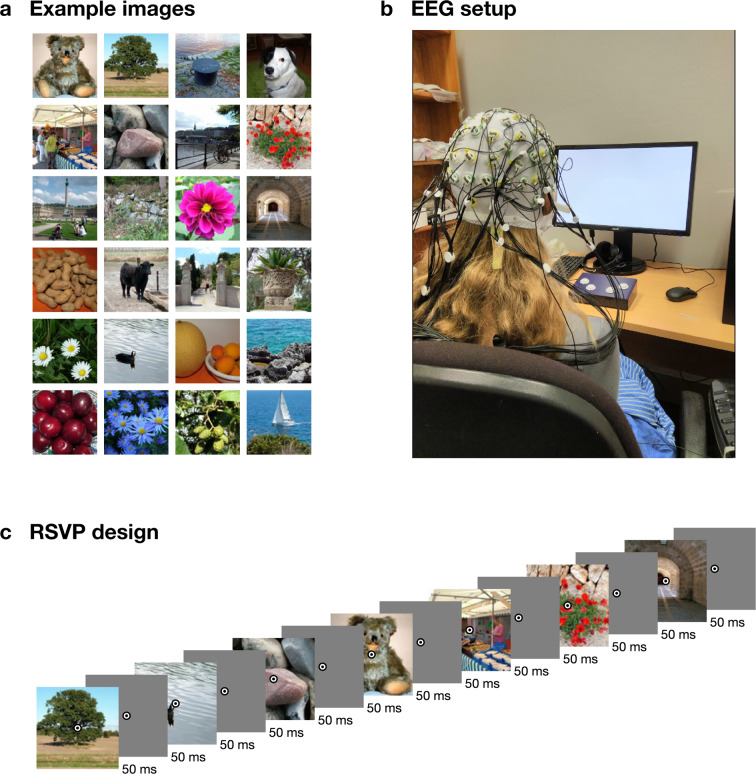
The neural basis of object recognition and semantic knowledge has been extensively studied but the high dimensionality of object space makes it challenging to develop overarching theories on how the brain organises object knowledge. To help understand how the brain allows us to recognise, categorise, and represent objects and object categories, there is a growing interest in using large-scale image databases for neuroimaging experiments. In the current paper, we present THINGS-EEG, a dataset containing human electroencephalography responses from 50 subjects to 1,854 object concepts and 22,248 images in the THINGS stimulus set, a manually curated and high-quality image database that was specifically designed for studying human vision. The THINGS-EEG dataset provides neuroimaging recordings to a systematic collection of objects and concepts and can therefore support a wide array of research to understand visual object processing in the human brain.
物体识别和语义知识的神经基础已经得到了广泛的研究,但由于物体空间的高维度,要开发出关于大脑如何组织物体知识的总体理论具有挑战性。为了帮助理解大脑如何使我们能够识别、分类和表示物体和物体类别,人们越来越感兴趣地使用大规模的图像数据库进行神经影像学实验。在当前的论文中,我们提出了 THINGS-EEG,这是一个包含 50 名被试的人类脑电图反应的数据集,针对 THINGS 刺激集的 1854 个物体概念和 22248 个图像。THINGS 刺激集是一个经过精心整理的高质量图像数据库,专门用于研究人类视觉。THINGS-EEG 数据集提供了对系统收集的物体和概念的神经影像学记录,因此可以支持广泛的研究,以了解人类大脑中的视觉物体处理。