Department of Medicine, University of California, San Francisco, San Francisco, CA, USA.
San Francisco Veterans Administration, San Francisco, CA, USA.
J Gen Intern Med. 2022 Nov;37(14):3535-3544. doi: 10.1007/s11606-021-07302-6. Epub 2022 Jan 10.
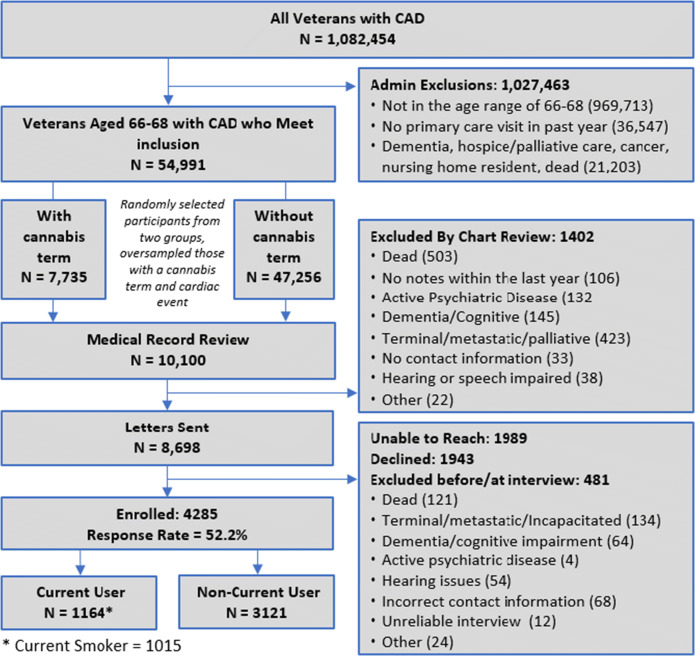
Evidence on the cardiovascular health effects of cannabis use is limited. We designed a prospective cohort study of older Veterans (66 to 68 years) with coronary artery disease (CAD) to understand the cardiovascular consequences of cannabis use. We describe the cohort construction, baseline characteristics, and health behaviors that were associated with smoking cannabis.
To understand the cardiovascular consequences of cannabis use.
We designed a prospective cohort study of older Veterans (66 to 68 years) with CAD.
A total of 1,015 current cannabis smokers and 3,270 non-cannabis smokers with CAD.
Using logistic regression, we examined the association of baseline variables with smoking cannabis in the past 30 days.
The current cannabis smokers and non-current smokers were predominantly male (97.2% vs 97.1%, p=0.96). Characteristics associated with recent cannabis use in multivariable analyses included lack of a high school education (odds ratio [OR] 2.15, 95% confidence interval [CI]: 1.10 to 4.19), financial difficulty (OR 1.47, 95% CI: 1.02 to 2.11), tobacco use (OR 3.02, 95% CI: 1.66 to 5.48), current drug use (OR 2.82, 95% CI: 1.06 to 7.46), and prior drug use (OR 2.84, 95% CI: 2.11 to 3.82). In contrast, compared to individuals with 0 to 1 comorbid conditions, those with 5 chronic conditions or more (OR 0.43, 95% CI: 0.27 to 0.70) were less likely to smoke cannabis.
In this older high-risk cohort, smoking cannabis was associated with higher social and behavioral risk, but with fewer chronic health conditions.
关于大麻使用对心血管健康影响的证据有限。我们设计了一项针对患有冠状动脉疾病(CAD)的老年退伍军人(66 至 68 岁)的前瞻性队列研究,以了解大麻使用的心血管后果。我们描述了队列的构建、基线特征以及与吸食大麻相关的健康行为。
了解大麻使用对心血管的影响。
我们设计了一项针对患有 CAD 的老年退伍军人(66 至 68 岁)的前瞻性队列研究。
共有 1015 名当前吸食大麻者和 3270 名非吸食大麻者患有 CAD。
使用逻辑回归,我们检查了基线变量与过去 30 天内吸食大麻的关联。
当前吸食大麻者和非当前吸食大麻者主要为男性(97.2%比 97.1%,p=0.96)。多变量分析中与近期大麻使用相关的特征包括未完成高中学业(优势比[OR]2.15,95%置信区间[CI]:1.10 至 4.19)、经济困难(OR 1.47,95% CI:1.02 至 2.11)、吸烟(OR 3.02,95% CI:1.66 至 5.48)、当前药物使用(OR 2.82,95% CI:1.06 至 7.46)和既往药物使用(OR 2.84,95% CI:2.11 至 3.82)。相比之下,与患有 0 至 1 种合并症的个体相比,患有 5 种或更多慢性疾病的个体(OR 0.43,95% CI:0.27 至 0.70)不太可能吸食大麻。
在这个年龄较大的高危队列中,吸食大麻与更高的社会和行为风险相关,但与较少的慢性健康状况相关。