Department of Internal Medicine Northwestern University Feinberg School of Medicine Chicago IL.
Department of Preventive Medicine Northwestern University Feinberg School of Medicine Chicago IL.
J Am Heart Assoc. 2022 Jan 18;11(2):e023791. doi: 10.1161/JAHA.121.023791. Epub 2022 Jan 11.
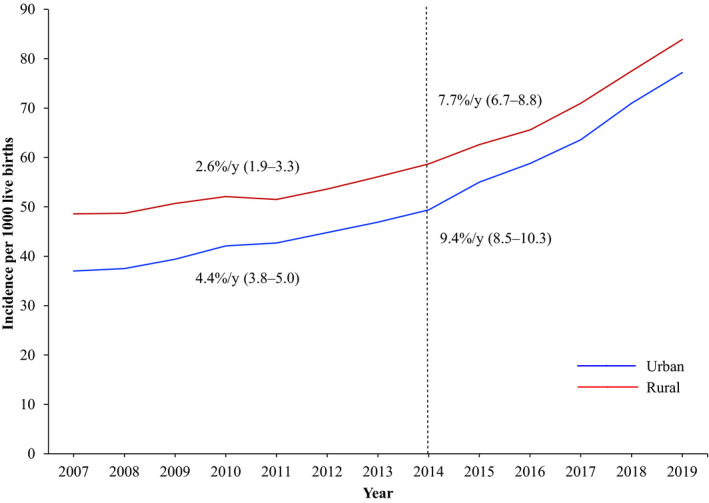
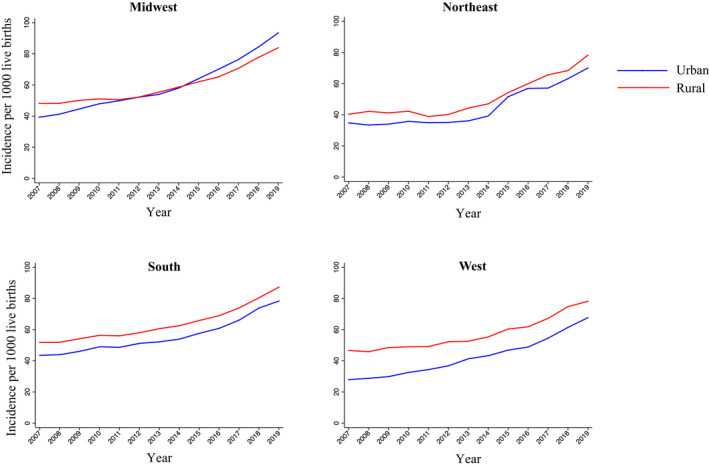
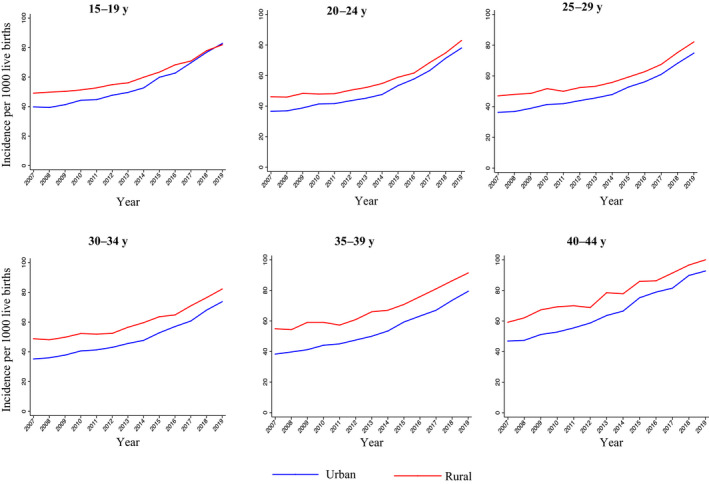
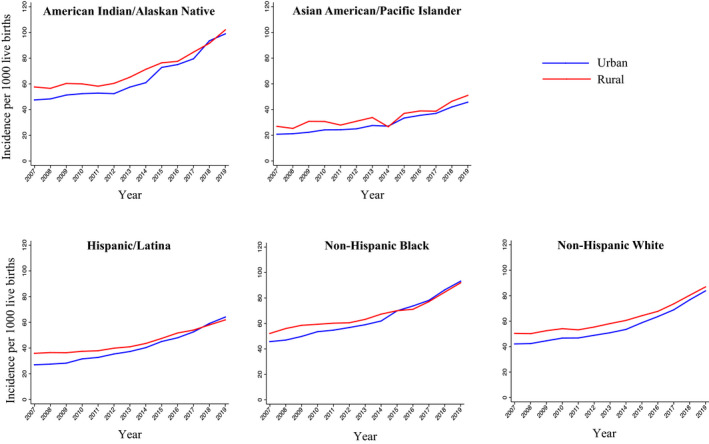
Background Hypertensive disorders of pregnancy are growing public health problems that contribute to maternal morbidity, mortality, and future risk of cardiovascular disease. Given established rural-urban differences in maternal cardiovascular health, we described contemporary trends in new-onset hypertensive disorders of pregnancy in the United States. Methods and Results We conducted a serial, cross-sectional analysis of 51 685 525 live births to individuals aged 15 to 44 years from 2007 to 2019 using the Centers for Disease Control and Prevention Natality Database. We included gestational hypertension and preeclampsia/eclampsia in individuals without chronic hypertension and calculated the age-adjusted incidence (95% CI) per 1000 live births overall and by urbanization status (rural or urban). We used Joinpoint software to identify inflection points and calculate rate of change. We quantified rate ratios to compare the relative incidence in rural compared with urban areas. Incidence (95% CI) of new-onset hypertensive disorders of pregnancy increased from 2007 to 2019 in both rural (48.6 [48.0-49.2] to 83.9 [83.1-84.7]) and urban (37.0 [36.8-37.2] to 77.2 [76.8-77.6]) areas. The rate of annual increase in new-onset hypertensive disorders of pregnancy was more rapid after 2014 with greater acceleration in urban compared with rural areas. Rate ratios (95% CI) comparing incidence of new-onset hypertensive disorders of pregnancy in rural and urban areas decreased from 1.31 (1.30-1.33) in 2007 to 1.09 (1.08-1.10) in 2019. Conclusions Incidence of new-onset hypertensive disorders of pregnancy doubled from 2007 to 2019 with persistent rural-urban differences highlighting the need for targeted interventions to improve the health of pregnant individuals and their offspring.
妊娠高血压疾病是日益严重的公共卫生问题,可导致产妇发病率和死亡率增加,并增加未来患心血管疾病的风险。鉴于城乡产妇心血管健康状况存在差异,我们描述了美国目前新发生的妊娠高血压疾病的趋势。
我们使用疾病控制和预防中心生育数据库,对 2007 年至 2019 年间年龄在 15 至 44 岁的 5168.525 名活产儿进行了连续的、横断面分析。我们将妊娠期高血压和子痫前期/子痫纳入无慢性高血压的个体,并计算每 1000 例活产儿的年龄调整发病率(95%CI),同时按城市化程度(农村或城市)进行分类。我们使用 Joinpoint 软件确定拐点并计算变化率。我们量化率比,以比较农村与城市地区相对发病率。农村(48.6[48.0-49.2]至 83.9[83.1-84.7])和城市(37.0[36.8-37.2]至 77.2[76.8-77.6])地区新发生的妊娠高血压疾病的发病率均从 2007 年到 2019 年增加。2014 年后,新发生的妊娠高血压疾病的发病率呈加速上升趋势,城市地区的上升速度快于农村地区。与农村地区相比,农村和城市地区新发生的妊娠高血压疾病发病率之比(95%CI)从 2007 年的 1.31(1.30-1.33)下降到 2019 年的 1.09(1.08-1.10)。
2007 年至 2019 年期间,新发生的妊娠高血压疾病的发病率增加了一倍,且城乡之间仍存在差异,这突出表明需要采取有针对性的干预措施来改善孕妇及其后代的健康状况。