Unité EERA, Institut Pasteurgrid.428999.7, APHP, Université Paris-Saclay, Paris, France.
UMR3525, CNRS, Université de Paris, Paris, France.
mSystems. 2022 Feb 22;7(1):e0116921. doi: 10.1128/msystems.01169-21. Epub 2022 Jan 11.
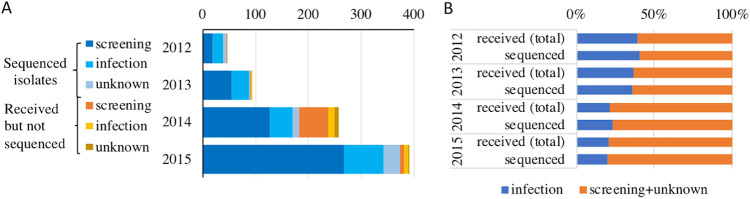
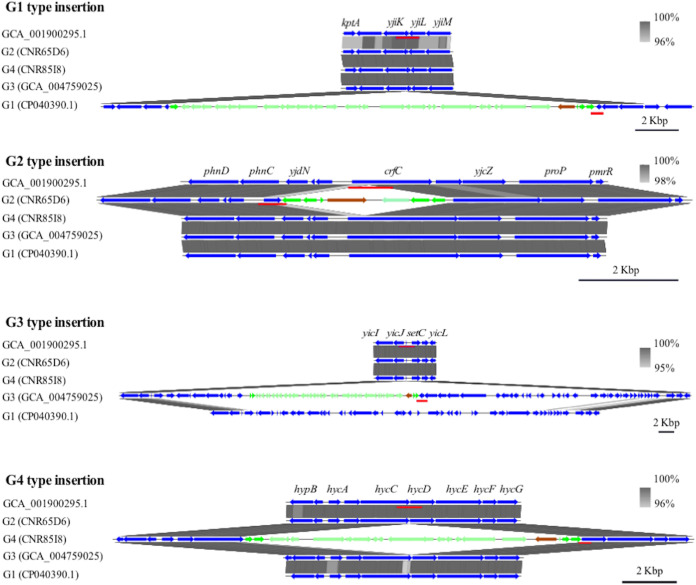
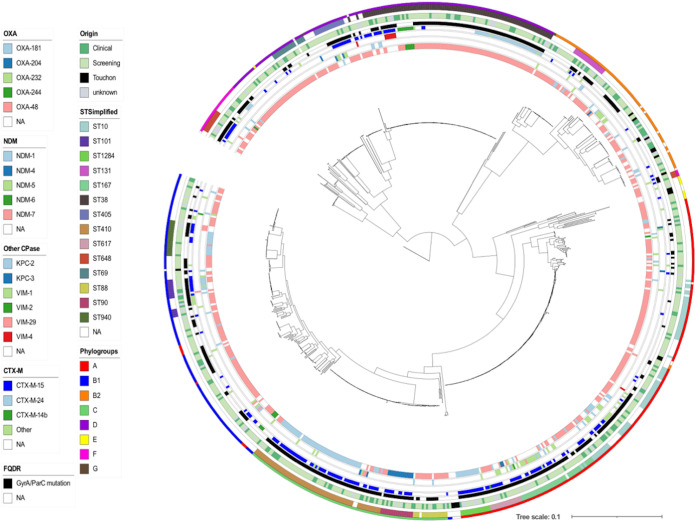
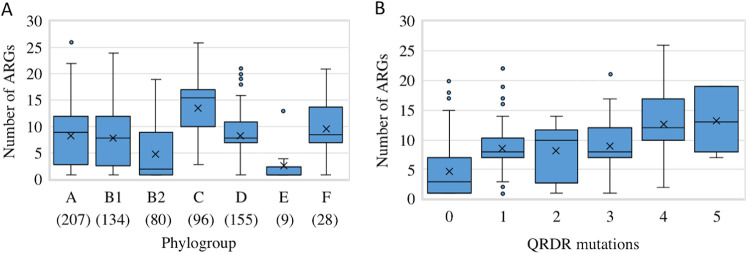
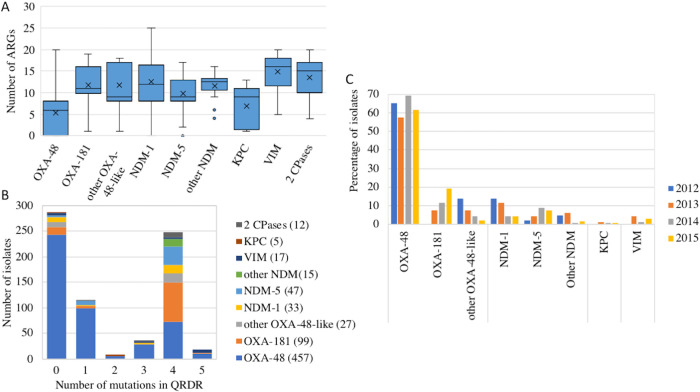
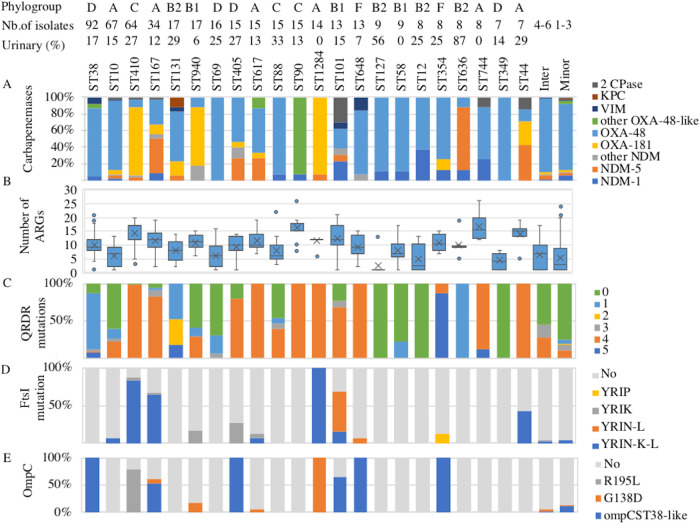
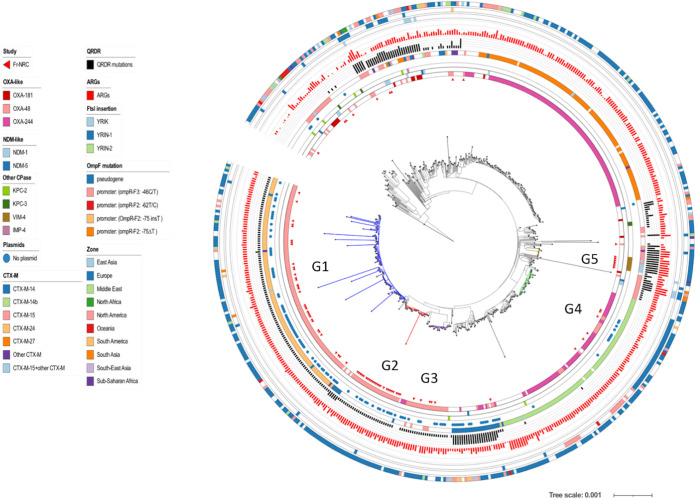
Carbapenemase-producing Escherichia coli (CP-) represents a major public health threat with a risk of dissemination in the community as has occurred for lineages producing extended-spectrum β-lactamases. To characterize the extent of CP- spread in France, isolates from screening and infection samples received at the French National Reference Center (F-NRC) laboratory for carbapenemase-producing were investigated. A total of 691 CP- isolates collected between 2012 and 2015 and 22 isolates collected before 2012 were fully sequenced. Analysis of their genome sequences revealed some disseminating multidrug-resistant (MDR) lineages frequently acquiring diverse carbapenemase genes mainly belonging to clonal complex 23 (CC23) (sequence type 410 [ST410]) and CC10 (ST10 and ST167) and sporadic isolates, including rare ST131 isolates ( = 17). However, the most represented sequence type (ST) was ST38 ( = 92) with four disseminated lineages carrying genes inserted in the chromosome. Globally, the most frequent carbapenemase gene ( = 457) was . It was also less frequently associated with MDR isolates being the only resistance gene in 119 isolates. Thus, outside the ST38 clades, its acquisition was frequently sporadic with no sign of dissemination, reflecting the circulation of the IncL plasmid pOXA-48 in France and its high frequency of conjugation. In contrast, and genes were often associated with the evolution of MDR E. coli lineages characterized by mutations in and Carbapenemase-producing Escherichia coli (CP-) might be difficult to detect, as MICs can be very low. However, their absolute number and their proportion among carbapenem-resistant have been increasing, as reported by WHO and national surveillance programs. This suggests a still largely uncharacterized community spread of these isolates. Here, we have characterized the diversity and evolution of CP- isolated in France before 2016. We show that carbapenemase genes are associated with a wide variety of E. coli genomic backgrounds and a small number of dominant phylogenetic lineages. In a significant proportion of CP-, the most frequent carbapenemase gene , was detected in isolates lacking any other resistance gene, reflecting the dissemination of pOXA-48 plasmids, likely in the absence of any antibiotic pressure. In contrast, carbapenemase gene transfer may also occur in multidrug-resistant E. coli, ultimately giving rise to at-risk lineages encoding carbapenemases with a high potential of dissemination.
产碳青霉烯酶的大肠杆菌(CP-)是一个主要的公共卫生威胁,具有在社区中传播的风险,就像产生扩展谱β-内酰胺酶的谱系一样。为了描述 CP-在法国的传播程度,对法国国家参考中心(F-NRC)实验室收到的筛查和感染样本中的产碳青霉烯酶进行了研究。2012 年至 2015 年间共收集了 691 株 CP-分离株,2012 年前收集了 22 株分离株,对其全基因组序列进行了分析。对其基因组序列的分析揭示了一些传播的多药耐药(MDR)谱系,这些谱系经常获得不同的碳青霉烯酶基因,主要属于克隆复合体 23(CC23)(序列类型 410 [ST410])和 CC10(ST10 和 ST167)以及散发性分离株,包括罕见的 ST131 分离株( = 17)。然而,最具代表性的序列类型(ST)是 ST38( = 92),有四个传播谱系携带 基因插入染色体。总的来说,最常见的碳青霉烯酶基因( = 457)是. 它也很少与 MDR 分离株相关,在 119 株分离株中是唯一的耐药基因。因此,在 ST38 之外,其获得通常是散发性的,没有传播的迹象,这反映了 IncL 质粒 pOXA-48 在法国的循环及其高频的接合。相比之下, 和 基因经常与 MDR 大肠杆菌谱系的进化相关,这些谱系的特征是 和 产碳青霉烯酶的大肠杆菌(CP-)可能难以检测,因为 MIC 可能非常低。然而,正如世界卫生组织和国家监测计划所报告的那样,它们的绝对数量及其在耐碳青霉烯类抗生素的大肠杆菌中的比例一直在增加。这表明这些分离株在社区中的传播仍在很大程度上未被描述。在这里,我们描述了 2016 年前法国分离的 CP-的多样性和进化。我们表明,碳青霉烯酶基因与广泛的大肠杆菌基因组背景和少数优势进化谱系相关。在相当一部分 CP-中,检测到最常见的碳青霉烯酶基因 在缺乏任何其他耐药基因的分离株中,这反映了 pOXA-48 质粒的传播,可能是在没有任何抗生素压力的情况下发生的。相比之下,碳青霉烯酶基因的转移也可能发生在多药耐药的大肠杆菌中,最终导致具有高传播潜力的危险谱系编码碳青霉烯酶。