Aligail Khalid, Dave Joel A, Ross Ian Louis
Division of Endocrinology, Department of Medicine, Faculty of Health Sciences, Groote Schuur Hospital and University of Cape Town, J47-85 Old Main Building, Private Bag X3, Observatory, Cape Town, 7935, South Africa.
J Med Case Rep. 2022 Jan 12;16(1):22. doi: 10.1186/s13256-021-03220-7.
Tumor-induced osteomalacia is a rare, acquired paraneoplastic syndrome, including hypophosphatemia, high serum alkaline phosphatase, reduced active vitamin D, suboptimal bone mineral density, bone pain, fragility fractures, and muscle weakness.
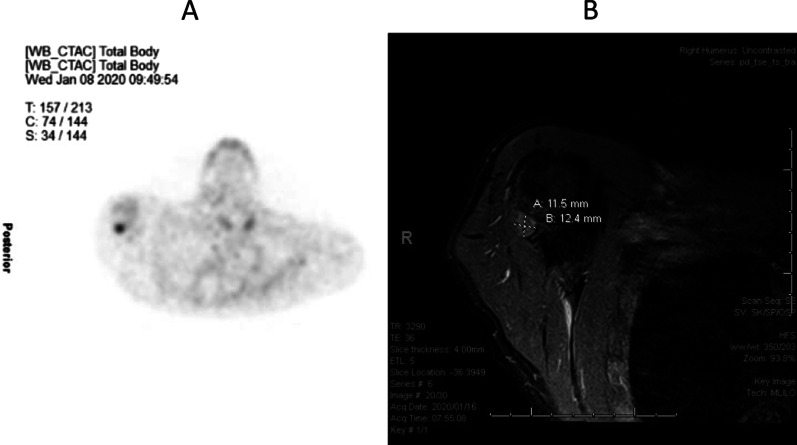
We report a case of 74-year-old male of mixed ancestry with hypophosphatemia resistant to treatment despite optimal compliance, associated with profound reduction of bone mineral density and multiple nontraumatic fractures, including bilateral rib fractures, lower-thoracic (T11, T12) vertebrae, and two fractures involving the surgical and anatomical neck of the right humerus. We discuss an approach to identifying the underlying cause of hypophosphatemia associated with fragility fractures, and options for management of this rare condition.
Although rare, tumor-induced osteomalacia can be diagnosed if a logical stepwise approach is implemented. Surgery could be curative if the tumor is properly located and is resectable.
肿瘤诱导的骨软化症是一种罕见的获得性副肿瘤综合征,包括低磷血症、高血清碱性磷酸酶、活性维生素D降低、骨矿物质密度欠佳、骨痛、脆性骨折和肌肉无力。
我们报告一例74岁的混血男性病例,尽管患者依从性良好,但低磷血症仍难以治疗,同时伴有骨矿物质密度显著降低和多处非创伤性骨折,包括双侧肋骨骨折、下胸椎(T11、T12)骨折以及右侧肱骨外科颈和解剖颈两处骨折。我们讨论了一种识别与脆性骨折相关的低磷血症潜在病因的方法,以及针对这种罕见病症的管理选择。
尽管罕见,但如果实施合理的逐步诊断方法,肿瘤诱导的骨软化症是可以诊断的。如果肿瘤位置合适且可切除,手术可能治愈该病。