Department of Neurology, People's Hospital of Zhengzhou, Zhengzhou, China.
Department of Neurology, People's Hospital of Henan University of Chinese Medicine, Zhengzhou, China.
Ann Clin Transl Neurol. 2022 Jan;9(1):79-90. doi: 10.1002/acn3.51497. Epub 2022 Jan 12.
This study aimed to compare effects of cerebral small-vessel disease (cSVD) burden and cerebral artery stenosis (CAS) on acute ischemia in intracerebral hemorrhage (ICH) and their interaction with mean arterial pressure (MAP) change.
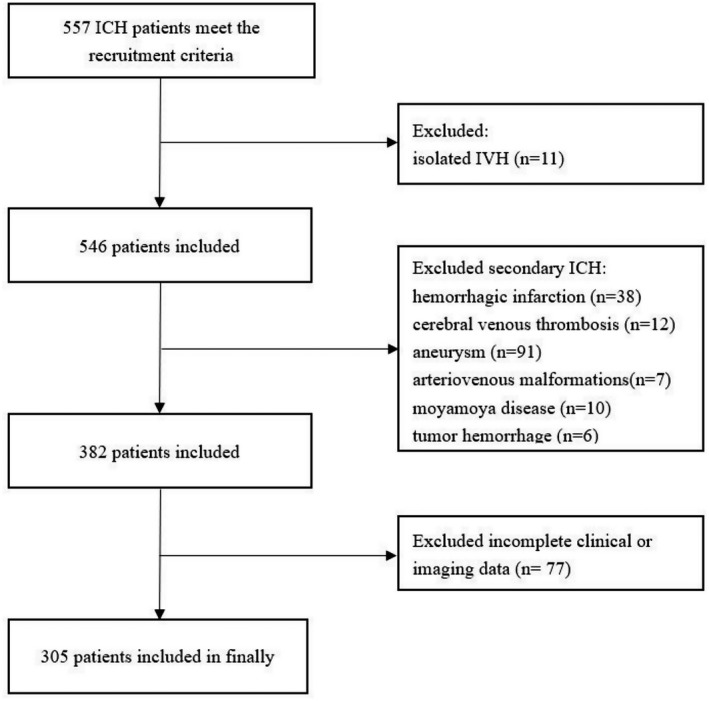
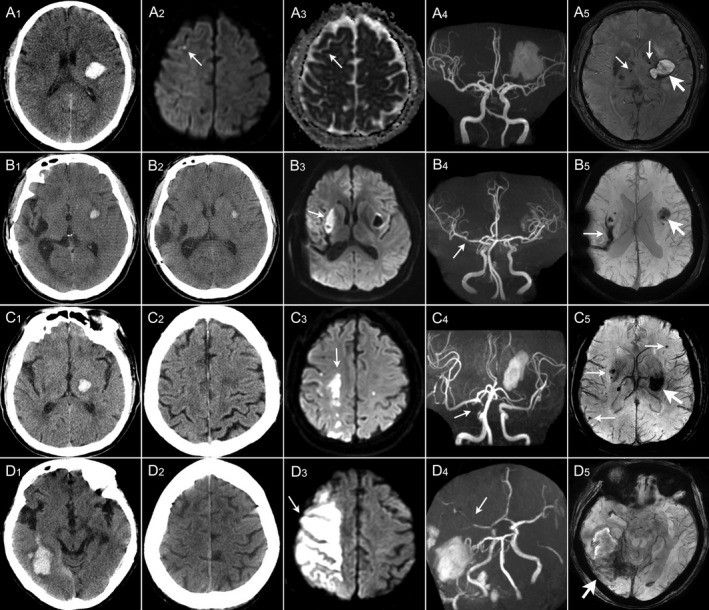
We recruited consecutive patients with acute primary ICH. Brain magnetic resonance imaging and angiography were performed to quantify diffusion-weighted imaging (DWI) lesions, CAS, and cSVD markers, which were calculated for the total cSVD score. Multivariable regression models were adopted to explore their associations by DWI lesions size (<15 vs. ≥15 mm) and median MAP change stratification.
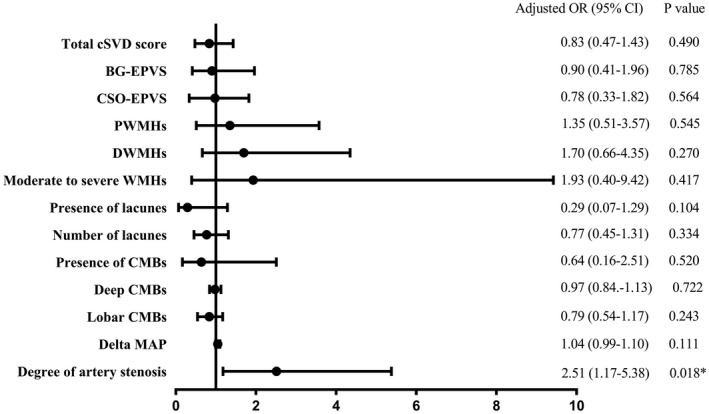
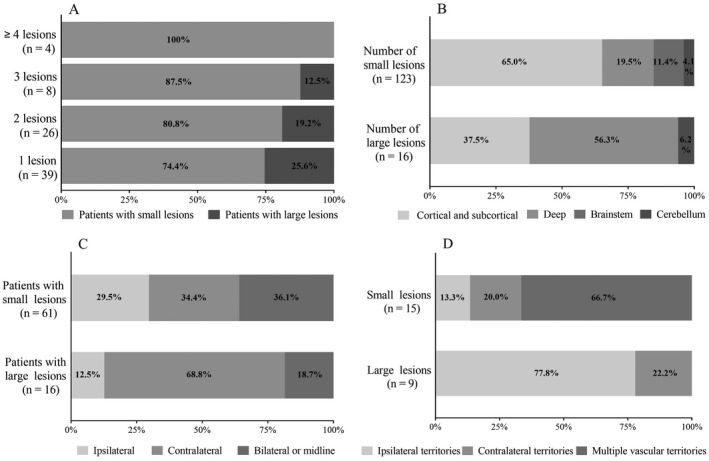
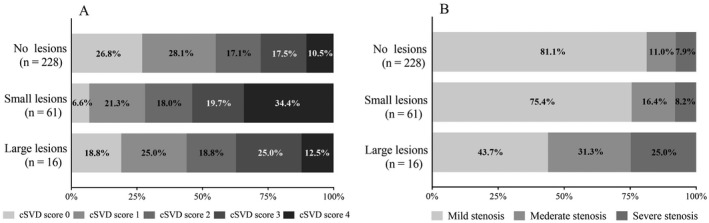
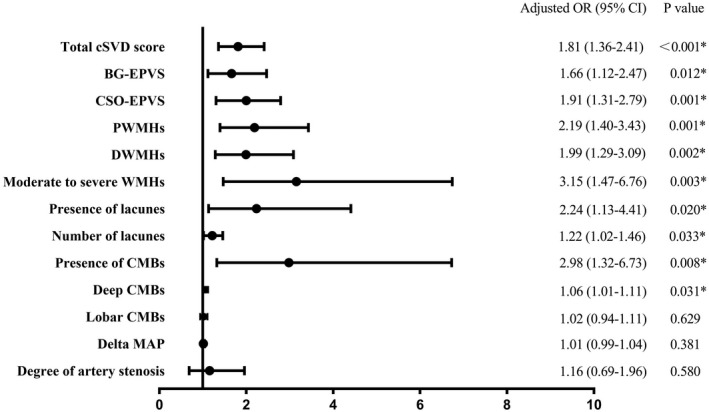
Of 305 included patients (mean age 59.5 years, 67.9% males), 77 (25.2%) had DWI lesions (small, 79.2%; large, 20.8%) and 67 (22.0%) had moderate and severe CAS. In multivariable analysis, small DWI lesions were independently associated with higher total cSVD score (odds ratio [OR] 1.81, 95% confidence interval [CI] 1.36-2.41). and large DWI lesions were associated with more severe CAS (OR 2.51, 95% CI 1.17-5.38). This association was modified by MAP change (interaction p = 0.016), with stratified analysis showing an increased risk of large DWI lesions in severe CAS with greater MAP change (≥44 mmHg) (OR 3.48, 95% CI 1.13-10.74) but not with mild MAP change (<44 mmHg) (OR 1.21, 95% CI 0.20-7.34).
Total cSVD burden is associated with small DWI lesions, whereas the degree of CAS is associated with large DWI lesions, specifically with greater MAP change, suggesting that large-artery atherosclerosis may be involved in ischemic brain injury, which is different from small-vessel pathogenesis in ICH.
本研究旨在比较脑小血管病(cSVD)负担和脑动脉狭窄(CAS)对脑出血(ICH)中急性缺血的影响,并探讨其与平均动脉压(MAP)变化的相互作用。
我们连续招募了急性原发性 ICH 患者。进行脑磁共振成像和血管造影以量化弥散加权成像(DWI)病变、CAS 和 cSVD 标志物,并计算总 cSVD 评分。采用多变量回归模型,通过 DWI 病变大小(<15 与≥15mm)和中值 MAP 变化分层来探讨它们之间的关系。
在纳入的 305 例患者中(平均年龄 59.5 岁,67.9%为男性),77 例(25.2%)有 DWI 病变(小,79.2%;大,20.8%),67 例(22.0%)有中度和重度 CAS。多变量分析显示,小 DWI 病变与更高的总 cSVD 评分独立相关(比值比 [OR] 1.81,95%置信区间 [CI] 1.36-2.41),大 DWI 病变与更严重的 CAS 相关(OR 2.51,95%CI 1.17-5.38)。这种相关性受 MAP 变化的修饰(交互作用 p=0.016),分层分析显示,在 MAP 变化较大(≥44mmHg)时,严重 CAS 与大 DWI 病变相关的风险增加(OR 3.48,95%CI 1.13-10.74),但在 MAP 变化较轻(<44mmHg)时则没有(OR 1.21,95%CI 0.20-7.34)。
总 cSVD 负担与小 DWI 病变相关,而 CAS 程度与大 DWI 病变相关,特别是与更大的 MAP 变化相关,提示大动脉粥样硬化可能参与缺血性脑损伤,与 ICH 的小血管发病机制不同。