Malik Vidhi, Kumar Vipul, Kaul Sunil C, Wadhwa Renu, Sundar Durai
DAILAB, Department of Biochemical Engineering & Biotechnology, Indian Institute of Technology (IIT)-Delhi, Hauz Khas, New Delhi, 110-016, India.
AIST-INDIA DAILAB, DBT-AIST International Center for Translational & Environmental Research (DAICENTER), National Institute of Advanced Industrial Science & Technology (AIST), Tsukuba, 305-8565, Japan.
Curr Res Struct Biol. 2021 Nov 18;3:301-311. doi: 10.1016/j.crstbi.2021.11.004. eCollection 2021.
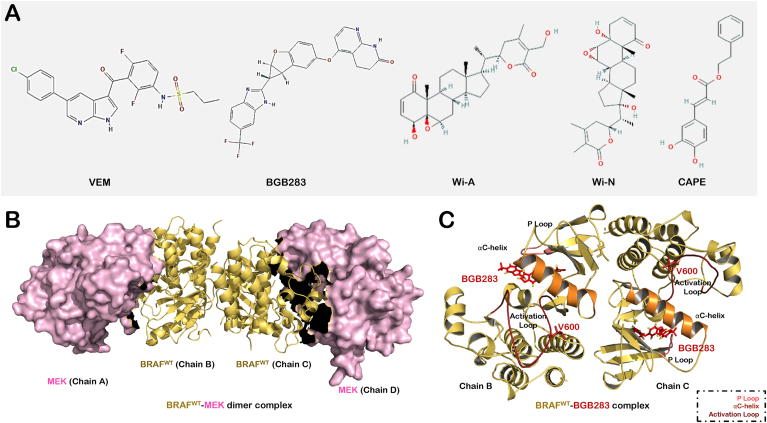
Serine/threonine-protein kinase B-raf (BRAF) plays a significant role in regulating cell division and proliferation through MAPK/ERK pathway. The constitutive expression of wild-type BRAF (BRAF) and its mutant forms, especially V600E (BRAF), has been linked to multiple cancers. Various synthetic drugs have been approved and are in clinical trials, but most of them are reported to become ineffective within a short duration. Therefore, combinational therapy involving multiple drugs are often recruited for cancer treatment. However, they lead to toxicity and adverse side effects. In this computational study, we have investigated three natural compounds, namely Withaferin-A (Wi-A), Withanone (Wi-N) and Caffeic Acid Phenethyl ester (CAPE) for anti-BRAF and anti-BRAF activity. We found that these compounds could bind stably at ATP-binding site in both BRAF and BRAF proteins. In-depth analysis revealed that these compounds maintained the active conformation of wild-type BRAF protein by inducing αC-helix-In, DFG-In, extended activation segment and well-aligned R-spine residues similar to already known drugs Vemurafenib (VEM), BGB283 and Ponatinib. In terms of binding energy, among the natural compounds, CAPE showed better affinity towards both wild-type and V600E mutant proteins than the other two compounds. These data suggested that CAPE, Wi-A and Wi-N have potential to block constitutive autophosphorylation of BRAF and hence warrant and experimental validation.
丝氨酸/苏氨酸蛋白激酶B-raf(BRAF)通过MAPK/ERK途径在调节细胞分裂和增殖中发挥重要作用。野生型BRAF(BRAF)及其突变形式,尤其是V600E(BRAF)的组成型表达与多种癌症有关。各种合成药物已获批准并正在进行临床试验,但据报道其中大多数在短时间内就会失效。因此,癌症治疗通常采用多种药物联合治疗。然而,它们会导致毒性和不良副作用。在这项计算研究中,我们研究了三种天然化合物,即Withaferin-A(Wi-A)、Withanone(Wi-N)和咖啡酸苯乙酯(CAPE)的抗BRAF和抗BRAF活性。我们发现这些化合物可以在BRAF和BRAF蛋白的ATP结合位点稳定结合。深入分析表明,这些化合物通过诱导αC-螺旋内、DFG-内、延长的激活片段和排列良好的R-脊柱残基,维持了野生型BRAF蛋白的活性构象,类似于已知药物维莫非尼(VEM)、BGB283和波纳替尼。就结合能而言,在天然化合物中,CAPE对野生型和V600E突变蛋白的亲和力均优于其他两种化合物。这些数据表明,CAPE、Wi-A和Wi-N有潜力阻断BRAF的组成型自磷酸化,因此值得进行实验验证。