First Clinical Medical College, Shandong University of Traditional Chinese Medicine, Jinan, Shandong 250000, China.
Department of Neurology, Key Lab of Cerebral Microcirculation in Universities of Shandong, Shandong First Medical University & Shandong Academy of Medical Sciences, Taian, Shandong 271000, China.
Oxid Med Cell Longev. 2022 Jan 5;2022:1733834. doi: 10.1155/2022/1733834. eCollection 2022.
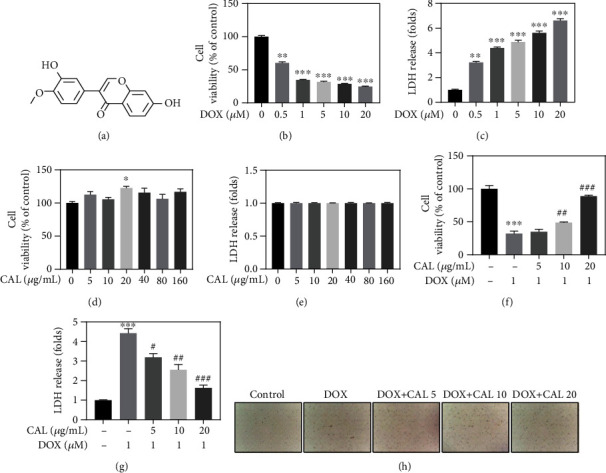
Calycosin (CAL) is the main active component present in and reportedly possesses diverse pharmacological properties. However, the cardioprotective effect and underlying mechanism of CAL against doxorubicin- (DOX-) induced cardiotoxicity need to be comprehensively examined. Herein, we aimed to investigate whether the cardioprotective effects of CAL are related to its antipyroptotic effect. A cardiatoxicity model was established by stimulating H9c2 cells and C57BL/6J mice using DOX. , CAL increased H9c2 cell viability and decreased DOX-induced pyroptosis via NLRP3, caspase-1, and gasdermin D signaling pathways in a dose-dependent manner. , CAL-DOX cotreatment effectively suppressed DOX-induced cytotoxicity as well as inflammatory and cardiomyocyte pyroptosis via the same molecular mechanism. Next, we used nigericin (Nig) and NLRP3 forced overexpression to determine whether CAL imparts antipyroptotic effects by inhibiting the NLRP3 inflammasome Furthermore, CAL suppressed DOX-induced mitochondrial oxidative stress injury in H9c2 cells by decreasing the generation of reactive oxygen species and increasing mitochondrial membrane potential and adenosine triphosphate. Likewise, CAL attenuated the DOX-induced increase in malondialdehyde content and decreased superoxide dismutase and glutathione peroxidase activities in H9c2 cells. , CAL afforded a protective effect against DOX-induced cardiac injury by improving myocardial function, inhibiting brain natriuretic peptide, and improving the changes of the histological morphology of DOX-treated mice. Collectively, our findings confirmed that CAL alleviates DOX-induced cardiotoxicity and pyroptosis by inhibiting NLRP3 inflammasome activation o and
毛蕊异黄酮(CAL)是黄芪中的主要活性成分,具有多种药理作用。然而,CAL 对阿霉素(DOX)诱导的心脏毒性的心脏保护作用及其潜在机制尚需全面研究。在此,我们旨在研究 CAL 的心脏保护作用是否与其抗细胞焦亡作用有关。通过用 DOX 刺激 H9c2 细胞和 C57BL/6J 小鼠建立心脏毒性模型。结果表明,CAL 以剂量依赖性方式增加 H9c2 细胞活力并降低 DOX 诱导的细胞焦亡,其作用机制与 NLRP3、半胱氨酸天冬氨酸蛋白酶-1(caspase-1)和 Gasdermin D 信号通路有关。此外,CAL-DOX 共处理通过相同的分子机制有效抑制 DOX 诱导的细胞毒性以及炎症和心肌细胞焦亡。接下来,我们使用 Nigericin(Nig)和 NLRP3 强制过表达来确定 CAL 是否通过抑制 NLRP3 炎性小体来发挥抗细胞焦亡作用。结果表明,CAL 通过减少活性氧的产生和增加线粒体膜电位和三磷酸腺苷来抑制 DOX 诱导的 H9c2 细胞线粒体氧化应激损伤。同样,CAL 减轻了 DOX 诱导的 H9c2 细胞丙二醛含量增加以及超氧化物歧化酶和谷胱甘肽过氧化物酶活性降低。体内研究结果表明,CAL 通过改善心肌功能、抑制脑钠肽和改善 DOX 处理小鼠组织形态学变化,对 DOX 诱导的心脏损伤发挥保护作用。总之,我们的研究结果证实,CAL 通过抑制 NLRP3 炎性小体的激活来减轻 DOX 诱导的心脏毒性和细胞焦亡。