Das Piyush Ranjan, Mendhe Vinod Atmaram, Kamble Alka Damodhar, Sharma Pushpa, Shukla Priyanka, Varma Atul Kumar
Department of Applied Geology, Indian Institute of Technology (ISM), Dhanbad 826 004, Jharkhand, India.
CSIR-Central Institute of Mining and Fuel Research (CIMFR), Dhanbad 826 015, Jharkhand, India.
ACS Omega. 2021 Dec 28;7(1):299-324. doi: 10.1021/acsomega.1c02040. eCollection 2022 Jan 11.
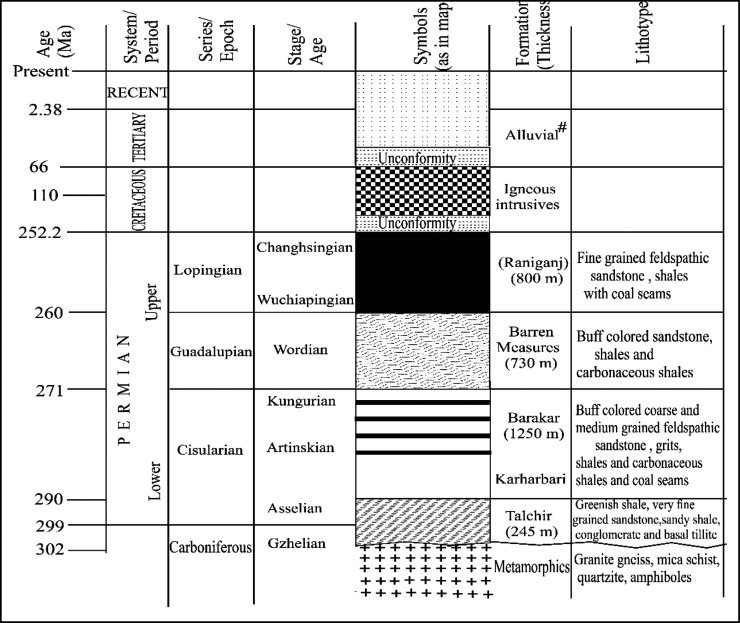
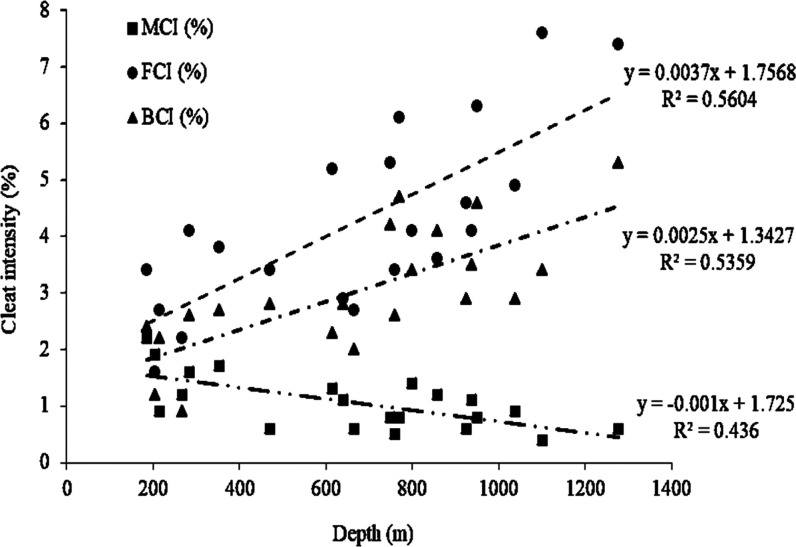
The Barakar coal seams of Jharia Basin have been evaluated for the geochemical and petrographic control of coalbed methane (CBM) reservoir characteristics. The coal core samples are analyzed for the total gas content, gas chromatography, stable isotopes (δC), and geochemical, petrographic and vitrinite reflectance. The significant face (1.6-7.6%) and butt (0.9-5.3%) cleat intensities specify the brittle characteristics of coal seams and also favor the gas flow mechanism. The thermal cracking position of hydrocarbon compounds was evaluated, which signifies the excellent source rock potential of coal for gas genesis. The inputs of type III and IV organic matter illustrated by the van Krevelan diagram signify thermally matured coal seams. The low values of sorption time (τ) between 2.1 and 5.6 days designate excellent diffusion characteristics that is favored by the cleat intensities. The values of total gas content and sorption capacity ( ) reveal that moderate saturation indicates a higher gas content, attributed to the seam thickness and thermal maturity. Similarly, the CH concentrations (89.4-96.6 vol %) display that the genesis pattern is a function of thermal maturity; however, some samples fall under the mixed type substantiated by the stable isotope (δC) (-25.40 to -64.90‰), emphasizing bacterial hold by seasonal influx of freshwater. The ternary facies diagram (V, I, L) also supports notable generation of methane gas and storage in the coal seams of the Jharia Basin. The volume percentage of each maceral determined from petrographic study was used to estimate the fraction of conversion (f) of the organic content (0.19-0.97). The values of "f" indicate that the Barakar coal has undergone maximum conversion, which may be attributed to the older early Permian coal and placed at a greater depth after deposition due to the basin sink. The high fraction of conversion and thermal maturity may also be explained due to the existence of volcanic intrusion (sills and dykes). The uniformity in the distribution of functional groups is shown by Fourier transform infrared spectra representing moderate to stronger peaks of aromatic carbon (CO and C=C) between 1750 and 1450 cm, which indicates that the presence of a larger total organic carbon content likely validates the removal of aliphatic compounds during gas genesis. The variations in the BET curve have been categorized as H1 hysteresis following the type II adsorption pattern, suggesting that cylindrical pores and some of the coal samples have a type IV H4 hysteresis pattern, characterized as the slit type of pores. The average values of the pore diameter indicate the dominance of mesopores suitable for gas storage and release and hence a major part of the pore volume is contributed by the mesopores having a width mainly between 2.98 and 4.48 nm. The significant role of the meso-macropore network ( fractals) in methane storage of the coal matrix is represented by a moderate positive relationship of with , which accentuated that meso-macropores developed due to devolatilization and dehydration of organic matter and also by geochemical alteration of macerals and minerals formed heterogenetic inner surfaces suitable for gas adsorption. The estimated recoverable resource applying Mavor Pratt methods is 8.78 BCM, which is found to be a more realistic resource value for the studied CBM block.
已对贾里亚盆地的巴拉卡尔煤层进行了评估,以研究煤层气(CBM)储层特征的地球化学和岩石学控制因素。对煤芯样本进行了总气体含量、气相色谱、稳定同位素(δC)以及地球化学、岩石学和镜质体反射率分析。显著的面割理强度(1.6 - 7.6%)和端割理强度(0.9 - 5.3%)表明了煤层的脆性特征,也有利于气体流动机制。对烃类化合物的热裂解位置进行了评估,这表明煤作为气源岩具有良好的产气潜力。由范克雷维伦图所示的Ⅲ型和Ⅳ型有机质输入表明煤层已达到热成熟。吸附时间(τ)在2.1至5.6天之间的低值表明扩散特性良好,这得益于割理强度。总气体含量和吸附容量的值表明,中等饱和度表明气体含量较高,这归因于煤层厚度和热成熟度。同样,CH浓度(89.4 - 96.6体积%)表明成因模式是热成熟度的函数;然而,一些样本属于由稳定同位素(δC)(-25.40至-64.90‰)证实的混合类型,强调了淡水季节性流入导致的细菌作用。三元相图(V、I、L)也支持贾里亚盆地煤层中甲烷气体的显著生成和储存。通过岩石学研究确定的每种煤岩组分的体积百分比用于估计有机含量(0.19至0.97)的转化分数(f)。“f”值表明巴拉卡尔煤已经历了最大程度的转化,这可能归因于早二叠世较老的煤,且由于盆地沉降,沉积后处于更深的位置。转化分数高和热成熟度也可能是由于火山侵入(岩床和岩脉)的存在。傅里叶变换红外光谱显示官能团分布均匀,在1750至1450 cm之间有中等至较强的芳香碳(CO和C = C)峰,这表明较大的总有机碳含量的存在可能证实了产气过程中脂肪族化合物的去除。BET曲线的变化按照Ⅱ型吸附模式归类为H1滞后,表明一些煤样具有Ⅳ型H4滞后模式,其特征为狭缝型孔隙。平均孔径值表明中孔占主导,适合气体储存和释放,因此大部分孔体积由宽度主要在2.98至4.48 nm之间的中孔贡献。中观 - 大孔网络(分形)在煤基质甲烷储存中的重要作用由与的适度正相关表示,这突出表明中观 - 大孔是由于有机质的脱挥发分和脱水以及煤岩组分和矿物的地球化学变化而形成的,形成了适合气体吸附的非均相内表面。应用马弗·普拉特方法估计的可采资源量为87.8亿立方米,这被认为是所研究的煤层气区块更现实的资源价值。