Narsimulu Bandigi, Qureshi Rahila, Jakkula Pranay, Are Sayanna, Qureshi Insaf Ahmed
Department of Biotechnology & Bioinformatics, School of Life Sciences, University of Hyderabad, Prof. C. R. Rao Road, Hyderabad 500046, India.
Private Location, Hyderabad 500019, India.
ACS Omega. 2021 Dec 17;7(1):548-564. doi: 10.1021/acsomega.1c04967. eCollection 2022 Jan 11.
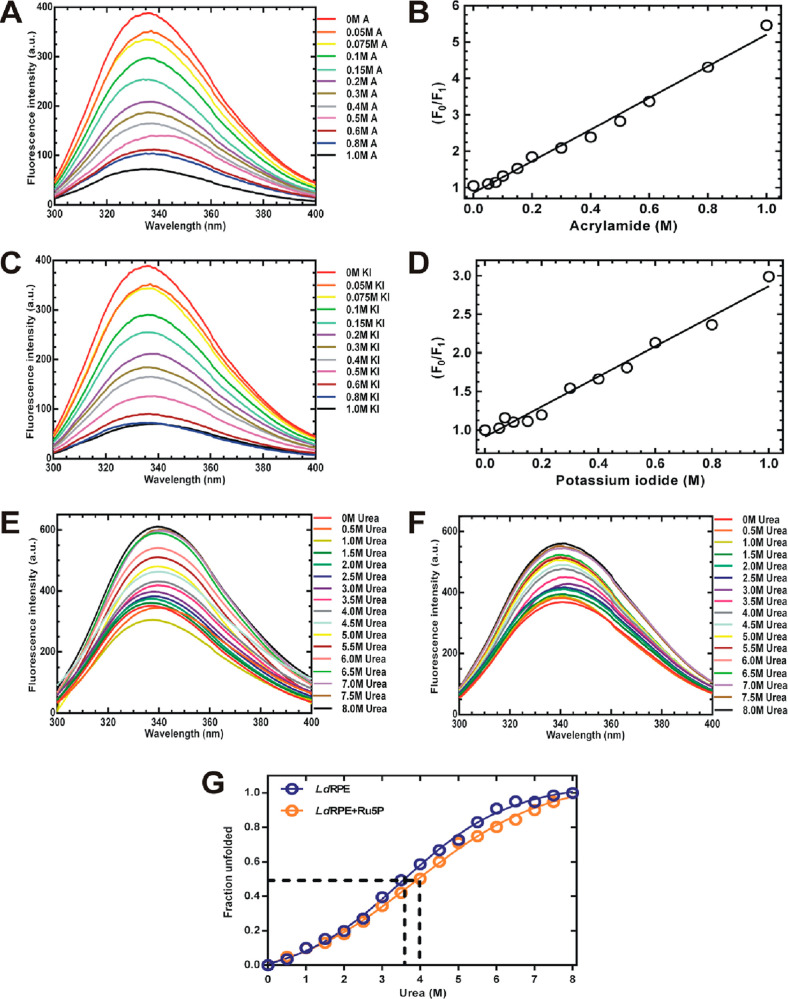
Pentose phosphate pathway (PPP) plays a crucial role in the maintenance of NADPH/NADP homeostasis and provides protection against oxidative stress through detoxification of the reactive oxygen species. Ribulose-5-phosphate epimerase (RPE) participates in catalysis of the interconversion of ribulose-5-phosphate (Ru5P) to xylulose-5-phosphate (Xu5P) during PPP, however the structural attributes of this enzyme are still underexplored in many human pathogens including leishmanial parasites. The present study focuses upon cloning, purification and characterization of RPE of (RPE) using various biophysical and structural approaches. Sequence analysis has shown the presence of trypanosomatid-specific insertions at the N-terminus that are absent in humans and other eukaryotes. Gel filtration chromatography indicated recombinant RPE to exist as a dimer in the solution. Circular dichroism studies revealed a higher alpha helical content at physiological pH and temperature that comparatively varies with changing these parameters. Additionally, intrinsic fluorescence and quenching studies of RPE have depicted that tryptophan residues are mainly buried in the hydrophobic regions, and the recombinant enzyme is moderately tolerant to urea. Moreover, homology modeling was employed to generate the three-dimensional structure of RPE followed by molecular docking with the substrate, product, and substrate analogues. The modeled structure of RPE unravelled the presence of conserved active site residues as well as a single binding pocket for the substrate and product, while an study suggested binding of substrate analogues into a similar pocket with more affinity than the substrate. Additionally, molecular dynamics simulation analysis has deciphered complexes of RPE with most of the ligands exhibiting more stability than its apo form and lesser fluctuations in active site residues in the presence of ligands. Altogether, our study presents structural insights into leishmanial RPE that could provide the basis for its implication to develop potent antileishmanials.
磷酸戊糖途径(PPP)在维持NADPH/NADP稳态中起着关键作用,并通过对活性氧进行解毒来提供抗氧化应激的保护。核糖-5-磷酸差向异构酶(RPE)在PPP过程中参与催化核糖-5-磷酸(Ru5P)向木酮糖-5-磷酸(Xu5P)的相互转化,然而在包括利什曼原虫寄生虫在内的许多人类病原体中,这种酶的结构特性仍未得到充分研究。本研究聚焦于使用各种生物物理和结构方法对利什曼原虫的RPE进行克隆、纯化和表征。序列分析表明,在N端存在锥虫特异性插入序列,而在人类和其他真核生物中不存在。凝胶过滤色谱表明重组RPE在溶液中以二聚体形式存在。圆二色性研究表明,在生理pH和温度下,α螺旋含量较高,并且随着这些参数的变化而相对变化。此外,RPE的内在荧光和猝灭研究表明,色氨酸残基主要埋藏在疏水区域,并且重组酶对尿素具有中等耐受性。此外,采用同源建模生成RPE的三维结构,随后与底物、产物和底物类似物进行分子对接。RPE的建模结构揭示了保守活性位点残基的存在以及底物和产物的单一结合口袋,而一项研究表明底物类似物与类似口袋的结合亲和力高于底物。此外,分子动力学模拟分析已经解析了RPE与大多数配体的复合物,其表现出比其无配体形式更高的稳定性,并且在存在配体的情况下活性位点残基的波动较小。总之,我们的研究提供了关于利什曼原虫RPE的结构见解,这可能为开发有效的抗利什曼原虫药物提供依据。