
提高巴塔哥尼亚地区控制美洲水貂(Neovison vison)的诱捕效率
Improving Trapping Efficiency for Control of American Mink () in Patagonia.
作者信息
Medina-Vogel Gonzalo, Muñoz Francisco, Moeggenberg Meredith, Calvo-Mac Carlos, Barros-Lama Macarena, Ulloa Nickolas, Pons Daniel J, Clapperton B Kay
机构信息
Centro de Investigación para la Sustentabilidad, Facultad Ciencias de la Vida, Universidad Andrés Bello, República 440, Santiago 8320000, Chile.
Instituto de Bioquímica, Facultad de Ciencias, Universidad Austral de Chile, Isla Teja s/n, Valdivia 5090000, Chile.
出版信息
Animals (Basel). 2022 Jan 7;12(2):142. doi: 10.3390/ani12020142.
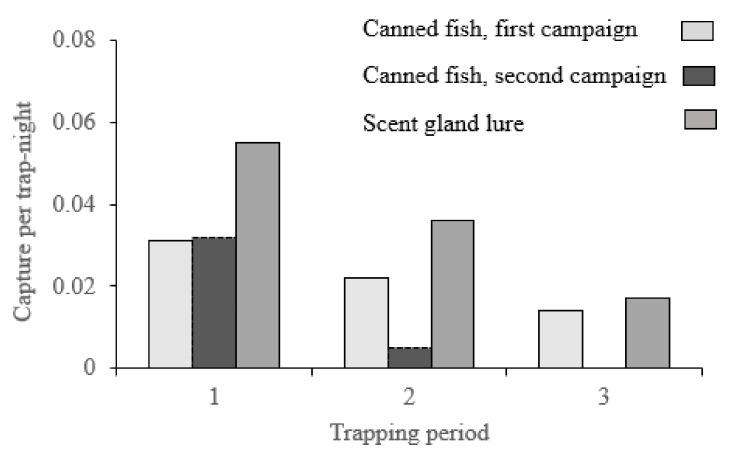
Two main challenges when controlling alien American mink () in Patagonia are to maximize campaign efficacy and cost-effectiveness and to avoid trapping native species. We designed and tested new variants of collapsible wire box traps, compared the efficacy of a food-based bait and a scent lure and compared catch rates in different seasons of the year. We used the data to model the efficiency rate of the trapping and to determine the trapping effort required to remove 70-90% of the estimated discrete mink population. Between January 2018 and March 2021, we operated 59 trapping transects over 103 three-day trapping periods in southern Chile. Traps were first baited with canned fish, and afterwards with mink anal gland lure. We compared the efficacy of mink capture with that of our previous study. We trapped 196 mink (125 males, 71 females), with most captures in summer. The medium-sized GMV-18 trap caught more male mink, but the more compact GMV-13 caught fewer non-target rodents and no native mammals. The scent lure was more successful than the canned fish when the previous campaign's data were included in the analysis. There was also a significant improvement in the proportion of female mink trapped and reduced labour compared with our previous campaign that used larger traps, fish bait and 400-500 m trap spacings. We caught relatively more females than males after the third night of trapping on a transect. Our data analysis supports the use of the GMV-13 variant of wire cage trap as the best trap size: it is effective on female mink, small, cheap and easy to transport. Combined with mink anal scent lure, it reduces the possibility of trapping native species compared with other traps tested in Chile. As the most efficient method for removing at least 70% of the estimated discrete mink population within the area covered by each trap transect in southern Chile tested to date, we recommend trapping campaigns using GMV-13 during summer, with a 200-m trap spacing, for up to 6 days before moving traps to a new site, with a combination of three days with a female scent gland lure, followed by three days with a male scent gland lure.
在巴塔哥尼亚控制外来的美洲水貂()时,两个主要挑战是最大化活动效果和成本效益,以及避免捕获本地物种。我们设计并测试了可折叠金属箱式陷阱的新变体,比较了基于食物的诱饵和气味诱剂的效果,并比较了一年中不同季节的捕获率。我们利用这些数据来模拟诱捕的效率,并确定清除估计离散水貂种群的70%-90%所需的诱捕工作量。2018年1月至2021年3月期间,我们在智利南部103个为期三天的诱捕期内设置了59条诱捕样带。陷阱首先用罐装鱼作诱饵,之后用美洲水貂肛门腺诱剂。我们将美洲水貂捕获效果与之前的研究进行了比较。我们捕获了196只美洲水貂(125只雄性,71只雌性),大多数捕获发生在夏季。中型GMV-18陷阱捕获的雄性美洲水貂更多,但更紧凑的GMV-13陷阱捕获的非目标啮齿动物更少,且未捕获本地哺乳动物。当将之前活动的数据纳入分析时,气味诱剂比罐装鱼更成功。与我们之前使用更大陷阱、鱼诱饵和400-500米陷阱间距的活动相比,捕获的雌性美洲水貂比例也有显著提高,且劳动力减少。在样带诱捕的第三晚之后,我们捕获的雌性相对雄性更多。我们的数据分析支持使用GMV-13变体的铁丝笼陷阱作为最佳陷阱尺寸:它对雌性美洲水貂有效,体积小、价格便宜且易于运输。与在智利测试的其他陷阱相比,结合美洲水貂肛门气味诱剂,它减少了捕获本地物种的可能性。作为在智利南部迄今测试的每个陷阱样带覆盖区域内清除至少70%估计离散美洲水貂种群的最有效方法,我们建议在夏季使用GMV-13进行诱捕活动,陷阱间距为200米,在将陷阱移至新地点之前最多诱捕6天,先使用雌性气味腺诱剂三天,然后使用雄性气味腺诱剂三天。


 Zotero 插件