National Center for Emerging and Zoonotic Infectious Diseases, Centers for Disease Control and Prevention, Atlanta, Georgia, United States of America.
Center for Surveillance, Epidemiology and Laboratory Services, Centers for Disease Control and Prevention, Atlanta, Georgia, United States of America.
PLoS Negl Trop Dis. 2022 Jan 20;16(1):e0010087. doi: 10.1371/journal.pntd.0010087. eCollection 2022 Jan.
Globally, traditional medicine is widely used to treat a variety of injuries and illnesses, including dog bites, and exposures that are risky for rabies. However, efficacy of most traditional remedies used for rabies prevention or treatment has not been demonstrated in controlled trials or proven in community-based surveys.
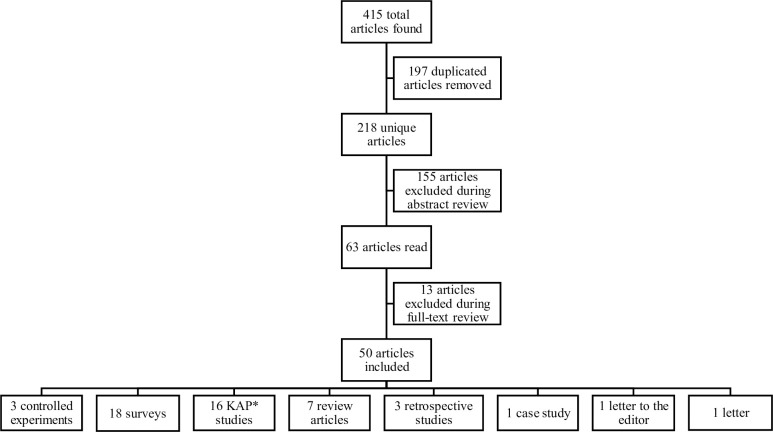
Six databases were searched including the terms rabies, traditional treatment, traditional remedy, traditional therapy, traditional medicine, and medicinal treatment to review traditional remedies used in the prevention and treatment of rabies. In addition, published literature of rabies transmission dynamics was used to estimate statistical likelihood of dog bite victims developing rabies to provide clarity as to why traditional healers have a high apparent success rate when preventing death from rabies in victims bitten by suspected rabid dogs.
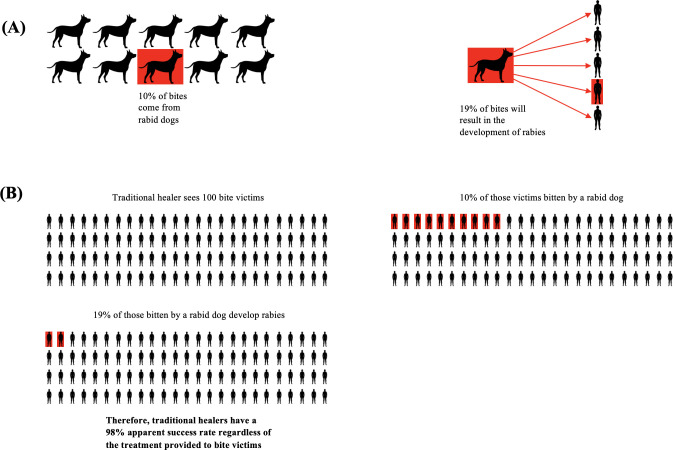
Literature review yielded 50 articles, including three controlled experiments, that described use of traditional remedies for rabies prevention and treatment. Traditional remedies for rabies ranged from plant- or animal-based products to spiritual rituals; however, only a few controlled mice trials were conducted, and none of these trials demonstrated efficacy in preventing or treating rabies. Risk of dying from rabies after a bite from a dog with unknown rabies status is low, 1.90% (0.05%-29.60%). Therefore, traditional healers had a 98.10% (70.40%-99.95%) apparent success rate in preventing death from suspected rabid dog bites despite inefficaciousness of herbal remedies.
There was no universal plant species or route of administration that was consistently used for rabies prevention or treatment across countries. No traditional remedy was efficacious in the prevention or treatment of rabies in randomized controlled experiments. Understanding the cultural context under which traditional remedies are used may facilitate collaboration of traditional healers with the modern medical system to ensure timely and appropriate use of proven therapies for prevention and clinical management of rabies.
在全球范围内,传统医学被广泛用于治疗各种伤害和疾病,包括狗咬伤和狂犬病高危暴露。然而,大多数用于预防或治疗狂犬病的传统疗法在对照试验中并未显示出疗效,也没有在社区调查中得到证实。
通过搜索 6 个数据库,包括“狂犬病”、“传统治疗”、“传统疗法”、“传统药物治疗”和“药物治疗”等术语,综述了用于预防和治疗狂犬病的传统疗法。此外,还使用了已发表的狂犬病传播动力学文献来估计狗咬伤受害者患狂犬病的统计可能性,以明确为什么传统治疗师在预防疑似狂犬病狗咬伤的受害者死亡方面具有很高的成功率。
文献综述共产生了 50 篇文章,其中包括 3 项对照实验,描述了传统疗法在狂犬病预防和治疗中的应用。狂犬病的传统疗法包括植物或动物源性产品以及精神仪式,但只有少数对照老鼠试验,而且这些试验都没有显示出在预防或治疗狂犬病方面的疗效。在被未知狂犬病状态的狗咬伤后,狂犬病死亡风险较低,为 1.90%(0.05%-29.60%)。因此,尽管草药疗法无效,但传统治疗师在预防疑似狂犬病狗咬伤的死亡方面的成功率为 98.10%(70.40%-99.95%)。
在预防或治疗狂犬病方面,没有一种通用的植物物种或给药途径在不同国家得到一致应用。在随机对照试验中,没有一种传统疗法对狂犬病的预防或治疗有效。了解传统疗法使用的文化背景,可能有助于传统治疗师与现代医疗体系合作,确保及时、恰当地使用经过验证的疗法来预防和临床管理狂犬病。