Azam Shofiul, Park Ju-Young, Kim In-Su, Choi Dong-Kug
Department of Applied Life Sciences, Graduate School, BK21 Program, Konkuk University, Chungju 27478, Korea.
Department of Molecular Science and Technology, Ajou University, Suwon 16499, Korea.
Biomedicines. 2022 Jan 12;10(1):154. doi: 10.3390/biomedicines10010154.
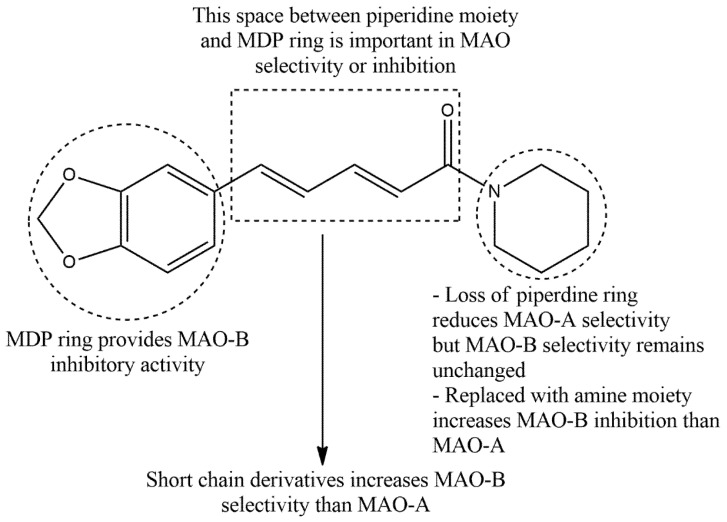
Piperine (PIP) is an active alkaloid of black and long peppers. An increasing amount of evidence is suggesting that PIP and its metabolite's could be a potential therapeutic to intervene different disease conditions including chronic inflammation, cardiac and hepatic diseases, neurodegenerative diseases, and cancer. In addition, the omnipresence of PIP in food and beverages made this compound an important investigational material. It has now become essential to understand PIP pharmacology and toxicology to determine its merits and demerits, especially its effect on the central nervous system (CNS). Although several earlier reports documented that PIP has poor pharmacokinetic properties, such as absorption, bioavailability, and blood-brain barrier permeability. However, its interaction with metabolic enzyme cytochrome P450 superfamily and competitive hydrophobic interaction at (MAO-B) active site have made PIP both a xenobiotics bioenhancer and a potential MAO-B inhibitor. Moreover, recent advancements in pharmaceutical technology have overcome several of PIP's limitations, including bioavailability and blood-brain barrier permeability, even at low doses. Contrarily, the structure activity relationship (SAR) study of PIP suggesting that its several metabolites are reactive and plausibly responsible for acute toxicity or have pharmacological potentiality. Considering the importance of PIP and its metabolites as an emerging drug target, this study aims to combine the current knowledge of PIP pharmacology and biochemistry with neurodegenerative and neurological disease therapy.
胡椒碱(PIP)是黑胡椒和长胡椒中的一种活性生物碱。越来越多的证据表明,PIP及其代谢产物可能是干预多种疾病状态的潜在治疗方法,这些疾病包括慢性炎症、心脏和肝脏疾病、神经退行性疾病以及癌症。此外,PIP在食品和饮料中广泛存在,这使得该化合物成为一种重要的研究材料。现在,了解PIP的药理学和毒理学以确定其优缺点,尤其是其对中枢神经系统(CNS)的影响变得至关重要。尽管早期的一些报告记录了PIP具有较差的药代动力学性质,如吸收、生物利用度和血脑屏障通透性。然而,它与代谢酶细胞色素P450超家族的相互作用以及在单胺氧化酶B(MAO - B)活性位点的竞争性疏水相互作用,使PIP既是一种外源性生物增强剂,又是一种潜在的MAO - B抑制剂。此外,制药技术的最新进展克服了PIP的一些局限性,包括生物利用度和血脑屏障通透性,即使在低剂量下也是如此。相反,PIP的构效关系(SAR)研究表明,其几种代谢产物具有反应活性,可能是急性毒性的原因或具有药理潜力。考虑到PIP及其代谢产物作为新兴药物靶点的重要性,本研究旨在将PIP药理学和生物化学的现有知识与神经退行性疾病和神经系统疾病治疗相结合。