Kim Insoo, Park So Jeong, Jeong Changwook, Shim Munbo, Kim Dae Sin, Kim Gyu-Tae, Seok Junhee
School of Electrical Engineering, Korea University, Seoul, Korea.
Electronic Components Examination Division, Korean Intellectual Property Office, Daejeon, 35208, Korea.
Sci Rep. 2022 Jan 21;12(1):1140. doi: 10.1038/s41598-022-05111-3.
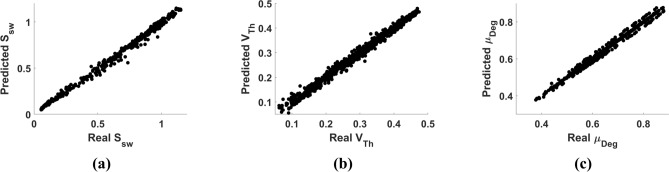
The simulation and design of electronic devices such as transistors is vital for the semiconductor industry. Conventionally, a device is intuitively designed and simulated using model equations, which is a time-consuming and expensive process. However, recent machine learning approaches provide an unprecedented opportunity to improve these tasks by training the underlying relationships between the device design and the specifications derived from the extensively accumulated simulation data. This study implements various machine learning approaches for the simulation acceleration and inverse-design problems of fin field-effect transistors. In comparison to traditional simulators, the proposed neural network model demonstrated almost equivalent results (R = 0.99) and was more than 122,000 times faster in simulation. Moreover, the proposed inverse-design model successfully generated design parameters that satisfied the desired target specifications with high accuracies (R = 0.96). Overall, the results demonstrated that the proposed machine learning models aided in achieving efficient solutions for the simulation and design problems pertaining to electronic devices. Thus, the proposed approach can be further extended to more complex devices and other vital processes in the semiconductor industry.
诸如晶体管等电子器件的模拟和设计对半导体行业至关重要。传统上,器件是通过模型方程直观地进行设计和模拟的,这是一个耗时且昂贵的过程。然而,最近的机器学习方法通过训练器件设计与从大量积累的模拟数据中得出的规格之间的潜在关系,为改进这些任务提供了前所未有的机会。本研究针对鳍式场效应晶体管的模拟加速和逆向设计问题实施了各种机器学习方法。与传统模拟器相比,所提出的神经网络模型展示了几乎等效的结果(R = 0.99),并且在模拟速度上快了超过122,000倍。此外,所提出的逆向设计模型成功生成了高精度(R = 0.96)满足所需目标规格的设计参数。总体而言,结果表明所提出的机器学习模型有助于为与电子器件相关的模拟和设计问题实现高效解决方案。因此,所提出的方法可以进一步扩展到更复杂的器件以及半导体行业中的其他重要工艺。