Department of Plastic Surgery, Hand Surgery and Burns, Faculty of Health Sciences, Linköping University, 58185, Linköping, Sweden.
Department of Biomedical and Clinical Sciences, Linköping University, Linköping, Sweden.
Arch Orthop Trauma Surg. 2023 Jan;143(1):381-387. doi: 10.1007/s00402-022-04336-1. Epub 2022 Jan 21.
Fractures of the distal ulna, excluding the styloid, are rare. The cause of injury is often a fall on an outstretched hand with an extended wrist, and in most cases there is a concomitant distal radius fracture. The aims of this retrospective study were to investigate the results of the current treatment of distal ulna fractures in adults, with or without a concomitant distal radius fracture, and if a recently presented fracture classification could predict outcome.
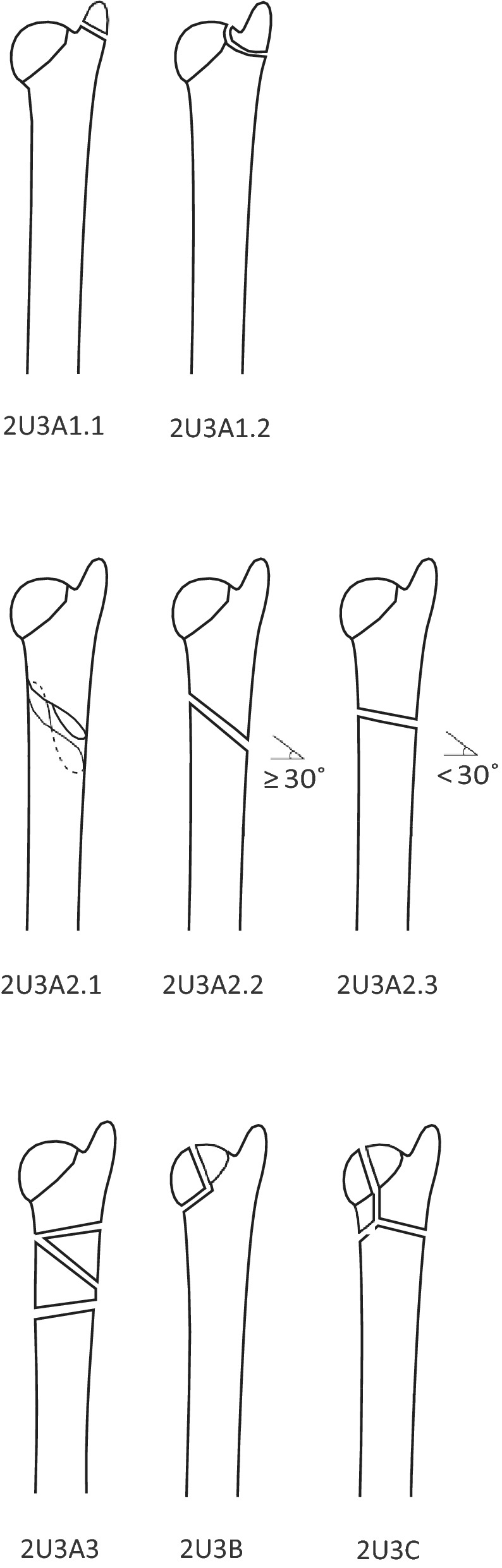
Patients, 18 years or older, treated for a fracture of the distal third of ulna in our county, were included. Fractures of the styloid tip were excluded. The radiographs of the fractures were independently classified by two specialists in radiology according to the 2018 AO/OTA classification. Follow-up was performed 5-7 years after the injury, through the questionnaire Patient-Rated Wrist Evaluation (PRWE) and new radiographs of both wrists.
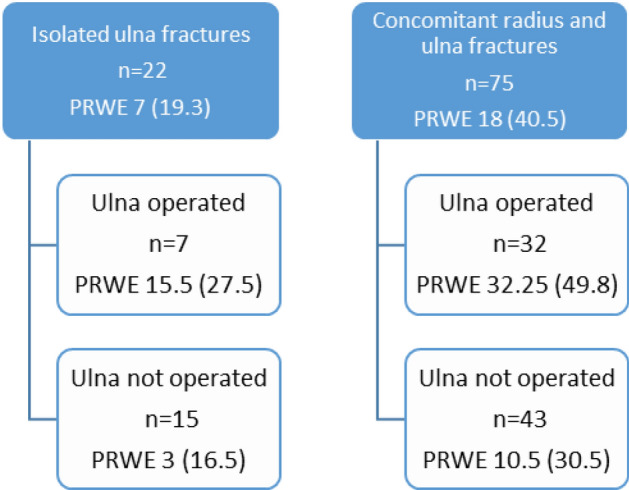
Ninety-six patients with 97 fractures were included and filled out the PRWE. 65 patients also had new radiographs taken. 79 patients were women and the mean age at the time of injury was 63 years (SD 14.5). The most common fracture class was the extra-articular transverse fracture, 2U3A2.3 (42%). We found that 40% of the fractures had been treated by internal fixation and only 2 fractures had not healed, one conservatively treated and one operated. The median PRWE was 15 (IQR 33.5). The PRWE score was significantly worse in the operated ulna fractures (p = 0.01) and this was also true for extra-articular transverse fractures 2U3A2.3 (p = 0.001). Initial displacement was more common in operated transverse fractures, but it could not be proven that this was the reason for the inferior result.
Distal ulna fractures almost always unite and the result is comparable to that of isolated distal radius fractures when measured by PRWE. Based on the opinions of the radiologists and how often a consensus discussion was needed for classification, we found the updated AO classification system difficult to use, if dependent only on standard radiographic views. In the present study, transverse extra-articular ulna fractures did not benefit from internal fixation regardless if associated with a distal radius fracture or isolated.
尺骨远端(不包括茎突)骨折较为少见。受伤的原因通常是手掌伸展摔倒,手腕伸展,大多数情况下同时伴有桡骨远端骨折。本回顾性研究旨在探讨目前成人尺骨远端骨折的治疗效果,无论是否伴有桡骨远端骨折,以及最近提出的骨折分类是否能预测结果。
纳入我院收治的尺骨远端三分之一骨折患者,年龄 18 岁及以上,排除茎突尖端骨折。骨折的 X 线片由两位放射学专家根据 2018 年 AO/OTA 分类标准独立进行分类。通过问卷调查患者腕关节评分(PRWE)和双侧腕关节的新 X 线片,在损伤后 5-7 年进行随访。
共纳入 96 例 97 处骨折患者,填写了 PRWE。65 例患者还拍摄了新的 X 线片。79 例为女性,受伤时的平均年龄为 63 岁(标准差 14.5)。最常见的骨折类型是关节外横形骨折,2U3A2.3(42%)。我们发现,40%的骨折采用内固定治疗,只有 2 例未愈合,1 例保守治疗,1 例手术治疗。PRWE 的中位数为 15(IQR 33.5)。手术治疗的尺骨骨折 PRWE 评分明显较差(p=0.01),关节外横形骨折 2U3A2.3 也是如此(p=0.001)。手术治疗的横形骨折初始移位更常见,但不能证明这是结果较差的原因。
尺骨远端骨折几乎都能愈合,用 PRWE 测量,结果与单纯桡骨远端骨折相当。根据放射科医生的意见以及分类需要多少次共识讨论,我们发现,如果仅依赖标准的 X 线片,更新后的 AO 分类系统很难使用。在本研究中,关节外横形尺骨骨折无论是否合并桡骨远端骨折,内固定均不能获益。