The Department of Clinical Medicine and Surgery, Gastroenterology and Hepatology Unit, University of Naples "Federico II," Naples, Italy.
the Hepatology Unit, AORN A. Cardarelli, Naples, Italy.
Clin Gastroenterol Hepatol. 2022 Jul;20(7):1534-1541.e4. doi: 10.1016/j.cgh.2022.01.012. Epub 2022 Jan 20.
BACKGROUND & AIMS: In the context of the Italian severe acute respiratory syndrome coronavirus 2 vaccination program, liver transplant (LT) recipients were prioritized for vaccine administration, although the lower response to vaccines is a well-known problem in this population. We aimed to evaluate immunogenicity of BNT162b2 mRNA vaccine in LT recipients and healthy controls and to identify factors associated with negative response to vaccine.
In a cohort of adult patients with LT, we prospectively evaluated the humoral response (with anti-Spike protein IgG-LIAISON SARS-CoV-2 S1/S2-IgG chemiluminescent assay) at 1 and 3 months after 2-dose vaccination. A group of 307 vaccinated health care workers, matched by age and sex, served as controls.
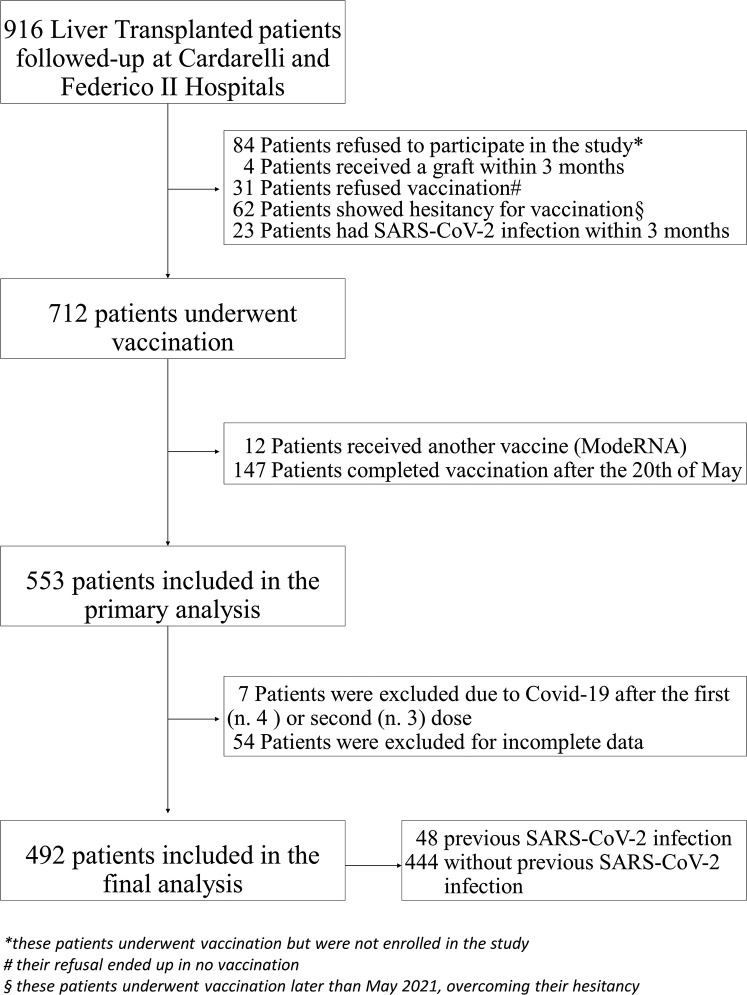
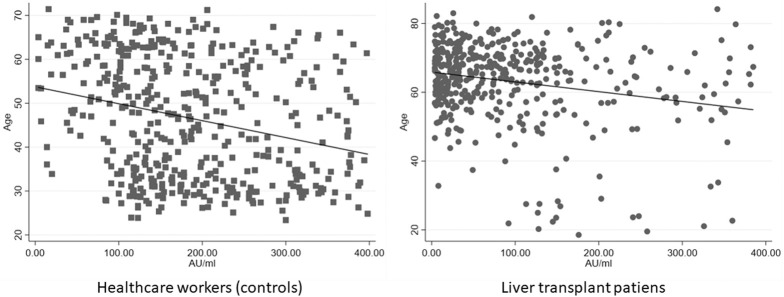
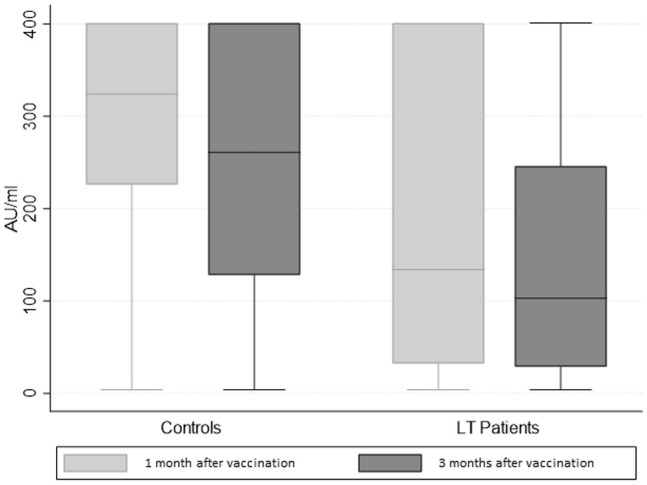
Overall, 492 LT patients were enrolled (75.41% male; median age, 64.85 years). Detectable antibodies were observed in the 75% of patients, with a median value of 73.9 AU/mL after 3 months from 2-dose vaccination. At multivariable analysis, older age (>40 years; P = .016), shorter time from liver transplantation (<5 years; P = .004), and immunosuppression with antimetabolites (P = .029) were significantly associated with non-response to vaccination. Moreover, the LT recipients showed antibody titers statistically lower than the control group (103 vs 261 AU/mL; P < .0001). Finally, in both controls and LT patients, we found a trend of inverse correlation between age and antibody titers (correlation coefficients: -0.2023 and -0.2345, respectively).
Three months after vaccination, LT recipients showed humoral response in 75% of cases. Older age, shorter time from transplantation, and use of antimetabolites were factors associated with non-response to vaccination, and LT recipients at risk of non-response to vaccination needed to be kept under close monitoring.
在意大利严重急性呼吸综合征冠状病毒 2 疫苗接种计划的背景下,肝移植(LT)受者被优先接种疫苗,尽管该人群对疫苗的反应较低是一个众所周知的问题。我们旨在评估 BNT162b2 mRNA 疫苗在 LT 受者和健康对照者中的免疫原性,并确定与疫苗反应阴性相关的因素。
在一组成年 LT 患者中,我们前瞻性评估了 2 剂疫苗接种后 1 个月和 3 个月的体液反应(采用抗刺突蛋白 IgG-LIAISON SARS-CoV-2 S1/S2-IgG 化学发光测定法)。307 名接种疫苗的医护人员按年龄和性别匹配作为对照组。
总体而言,共有 492 名 LT 患者入组(75.41%为男性;中位年龄 64.85 岁)。75%的患者可检测到抗体,2 剂疫苗接种后 3 个月时的中位数为 73.9 AU/mL。多变量分析显示,年龄较大(>40 岁;P =.016)、肝移植后时间较短(<5 年;P =.004)和使用代谢抑制剂的免疫抑制(P =.029)与疫苗接种无反应显著相关。此外,LT 受者的抗体滴度明显低于对照组(103 与 261 AU/mL;P <.0001)。最后,在对照组和 LT 患者中,我们发现年龄与抗体滴度呈负相关趋势(相关系数分别为-0.2023 和-0.2345)。
接种疫苗 3 个月后,75%的 LT 受者出现体液反应。年龄较大、肝移植后时间较短和使用代谢抑制剂是疫苗接种无反应的相关因素,需要对 LT 受者中的疫苗无反应高危人群进行密切监测。