Ablondi Michela, Sabbioni Alberto, Stocco Giorgia, Cipolat-Gotet Claudio, Dadousis Christos, van Kaam Jan-Thijs, Finocchiaro Raffaella, Summer Andrea
Dipartimento di Scienze Medico-Veterinarie, University of Parma, Parma, Italy.
Associazione Nazionale Allevatori della Razza Frisona Bruna e Jersey Italiana, Cremona, Italy.
Front Vet Sci. 2022 Jan 13;8:773985. doi: 10.3389/fvets.2021.773985. eCollection 2021.
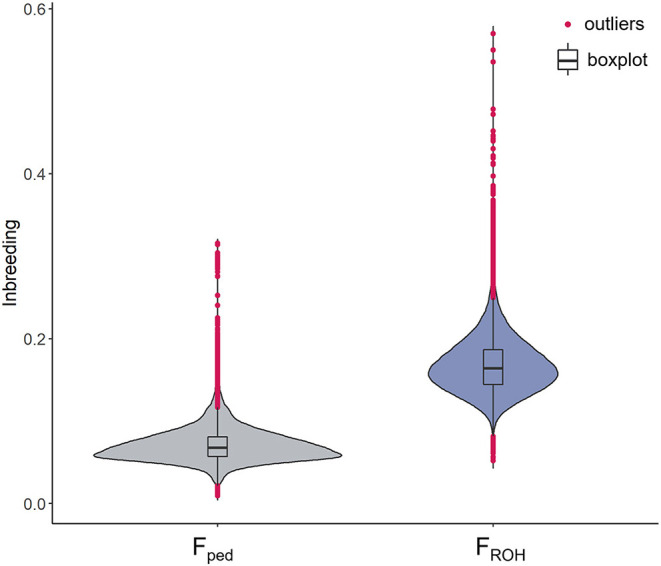
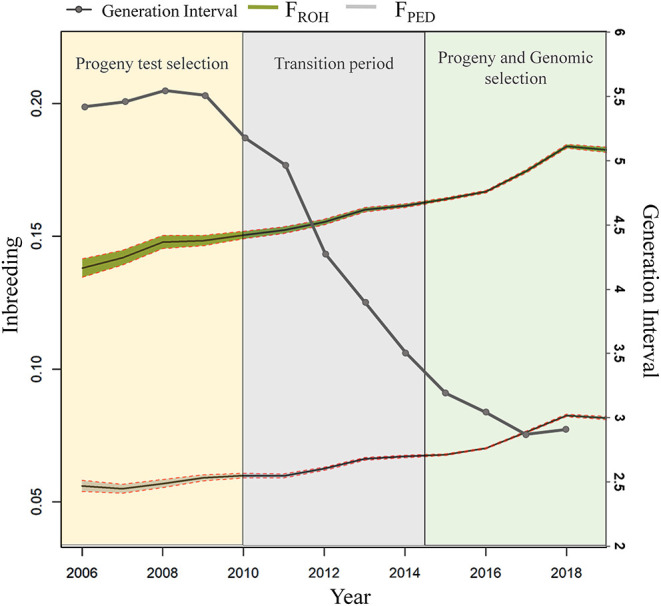
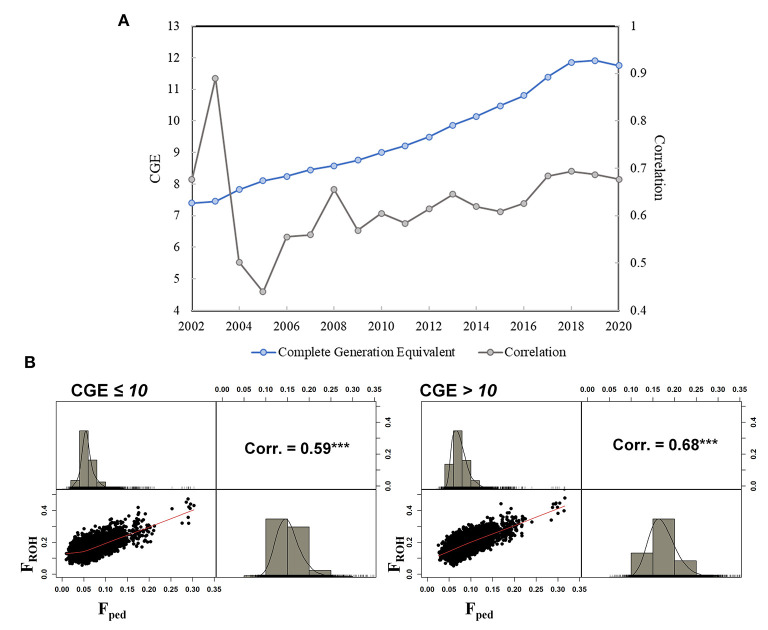
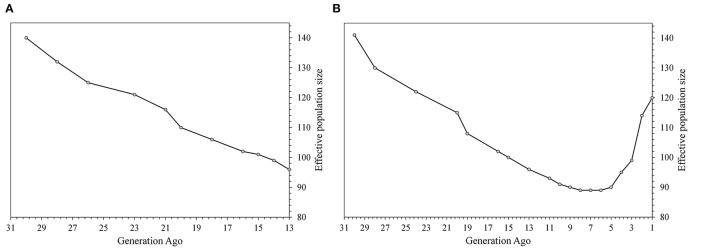
Genetic diversity has become an urgent matter not only in small local breeds but also in more specialized ones. While the use of genomic data in livestock breeding programs increased genetic gain, there is increasing evidence that this benefit may be counterbalanced by the potential loss of genetic variability. Thus, in this study, we aimed to investigate the genetic diversity in the Italian Holstein dairy cattle using pedigree and genomic data from cows born between 2002 and 2020. We estimated variation in inbreeding, effective population size, and generation interval and compared those aspects prior to and after the introduction of genomic selection in the breed. The dataset contained 84,443 single-nucleotide polymorphisms (SNPs), and 74,485 cows were analyzed. Pedigree depth based on complete generation equivalent was equal to 10.67. A run of homozygosity (ROH) analysis was adopted to estimate SNP-based inbreeding (F). The average pedigree inbreeding was 0.07, while the average F was more than double, being equal to 0.17. The pattern of the effective population size based on pedigree and SNP data was similar although different in scale, with a constant decrease within the last five generations. The overall inbreeding rate (ΔF) per year was equal to +0.27% and +0.44% for F and F throughout the studied period, which corresponded to about +1.35% and +2.2% per generation, respectively. A significant increase in the ΔF was found since the introduction of genomic selection in the breed. This study in the Italian Holstein dairy cattle showed the importance of controlling the loss of genetic diversity to ensure the long-term sustainability of this breed, as well as to guarantee future market demands.
遗传多样性不仅在小型地方品种中,而且在更具特色的品种中都已成为一个紧迫问题。虽然在畜牧育种计划中使用基因组数据提高了遗传进展,但越来越多的证据表明,这一益处可能会被遗传变异性的潜在损失所抵消。因此,在本研究中,我们旨在利用2002年至2020年间出生的奶牛的系谱和基因组数据,调查意大利荷斯坦奶牛的遗传多样性。我们估计了近亲繁殖、有效种群大小和世代间隔的变化,并比较了该品种引入基因组选择前后的这些方面。数据集包含84443个单核苷酸多态性(SNP),共分析了74485头奶牛。基于完整世代等效的系谱深度等于10.67。采用纯合性片段(ROH)分析来估计基于SNP的近亲繁殖系数(F)。平均系谱近亲繁殖系数为0.07,而平均F值则是其两倍多,等于0.17。基于系谱和SNP数据的有效种群大小模式相似,尽管规模不同,在过去五代中持续下降。在整个研究期间,F和F的每年总体近亲繁殖率(ΔF)分别等于+0.27%和+0.44%,分别对应于每代约+1.35%和+2.2%。自该品种引入基因组选择以来,ΔF显著增加。对意大利荷斯坦奶牛的这项研究表明,控制遗传多样性损失对于确保该品种的长期可持续性以及满足未来市场需求非常重要。