Younesian Hananeh, Ouellet Raphaël, Legrand Thomas, Turcot Katia
Department of Kinesiology, Laval University, Quebec City, Quebec, Canada.
Center for Interdisciplinary Research in Rehabilitation and Social Integration (CIRRIS), Quebec City, Quebec, Canada.
Foot Ankle Orthop. 2021 Oct 28;6(4):24730114211050366. doi: 10.1177/24730114211050366. eCollection 2021 Oct.
The 6-minute walk test (6MWT) is one of the common clinical tests to assess rehabilitation progress and needs in individuals with lower-limb amputation (iLLAs). However, the analysis of this test is mostly limited to the distance parameter. The first aim was to investigate effort intensity and spatiotemporal parameters of 6MWT in iLLAs using inertial measurement units (IMUs) and heart rate (HR) monitor, and second, to assess physical, physiological, and pain-related aspects of fatigue over 6MWT.
Eleven unilateral iLLAs (57.91±15.63 years old) participated in this study. To evaluate HR and spatiotemporal parameters over 6MWT, data were classified using 6 intervals of 1 minute each (I1-I6). The pain level of participants was estimated using the visual analog scale (VAS).
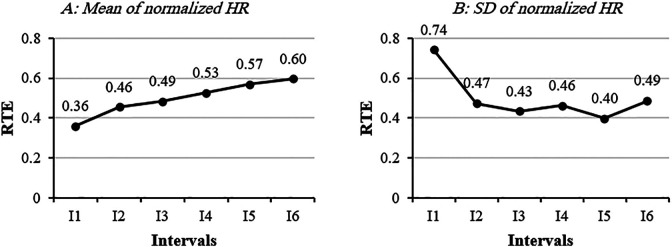
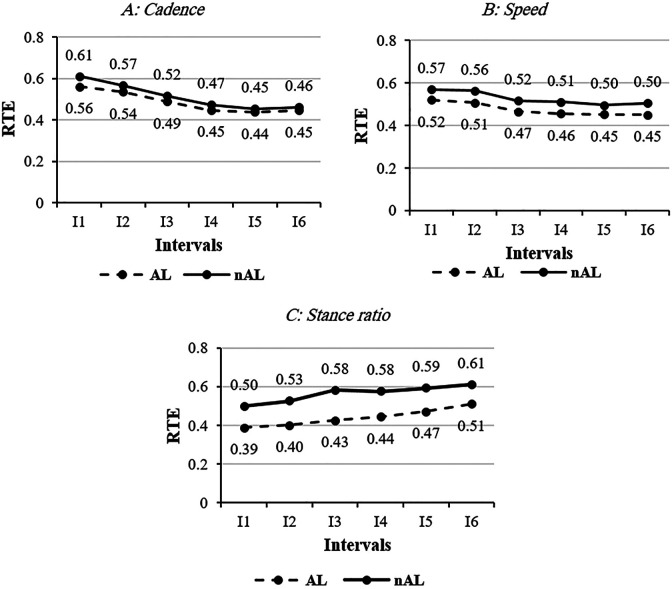
Our results showed that the means of normalized HR gradually increased over 6MWT (I1: 61.59±10.73 HR%, I6: 70.15±12.26 HR%, = .003). Variability of HR during the first interval of 6MWT was higher than the others ( < .05). The stance ratio of the gait cycle increased over 6MWT ( < .05). Cadence and speed decreased over 6MWT ( < .05). VAS score after 6MWT was significantly higher than before 6MWT ( = .016).
In this preliminary study, effort intensity over 6MWT gradually increased because of enhancement of HR. Deterioration of speed and cadence and enhancement of stance ratio over 6MWT imply potential physical aspects of fatigue and instability.
Level III, retrospective comparative study.
6分钟步行试验(6MWT)是评估下肢截肢患者(iLLAs)康复进展和需求的常见临床测试之一。然而,该测试的分析大多局限于距离参数。第一个目的是使用惯性测量单元(IMUs)和心率(HR)监测器研究iLLAs患者6MWT的运动强度和时空参数,第二个目的是评估6MWT过程中疲劳的身体、生理和疼痛相关方面。
11名单侧iLLAs患者(年龄57.91±15.63岁)参与了本研究。为了评估6MWT过程中的HR和时空参数,数据被分为6个1分钟的时间段(I1-I6)。使用视觉模拟量表(VAS)评估参与者的疼痛程度。
我们的结果显示,在6MWT过程中,标准化HR的平均值逐渐增加(I1:61.59±10.73 HR%,I6:70.15±12.26 HR%,P = .003)。6MWT第一个时间段内HR的变异性高于其他时间段(P < .05)。步态周期的站立比例在6MWT过程中增加(P < .05)。步频和速度在6MWT过程中下降(P < .05)。6MWT后的VAS评分显著高于6MWT前(P = .016)。
在这项初步研究中,由于HR升高,6MWT过程中的运动强度逐渐增加。6MWT过程中速度和步频的下降以及站立比例的增加意味着疲劳和不稳定的潜在身体方面。
III级,回顾性比较研究。