Data Science Department, Shionogi & Co, Ltd, Osaka, Japan.
Department of Respiratory Medicine, Nagasaki University Hospital, Nagasaki, Japan.
Clin Infect Dis. 2022 Sep 29;75(6):927-935. doi: 10.1093/cid/ciac068.
Influenza affects approximately a billion people globally, including > 10 million Japanese individuals every year. Baloxavir marboxil (baloxavir [BXM]; a selective cap-dependent endonuclease inhibitor) is approved for influenza treatment in Japan. We compared the incidence of intra-familial transmission of influenza between BXM and oseltamivir (OTV) treatments using a simulation model.
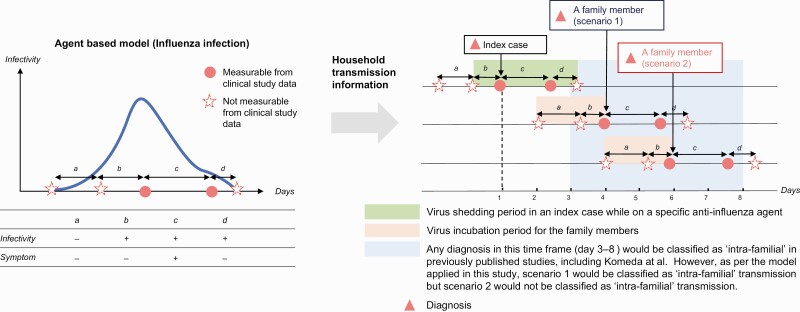
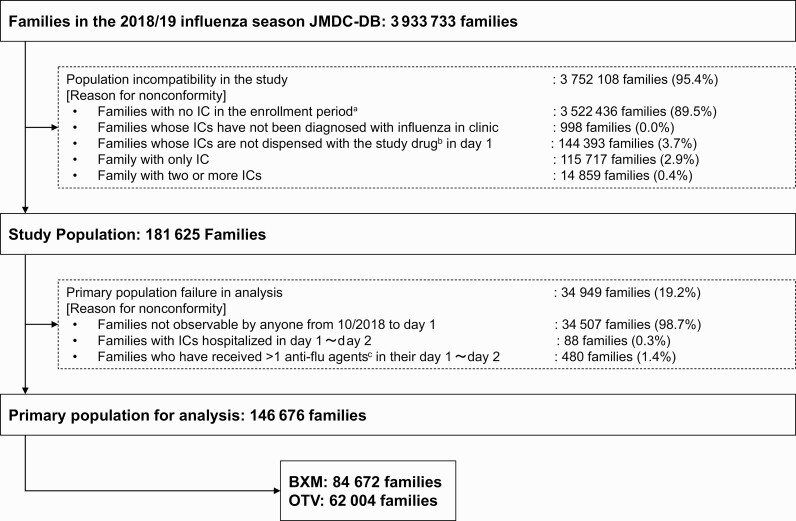
Using the JMDC Claims Database, we identified index case (IC) as the first family member diagnosed with influenza during the 2018-19 influenza season, and classified the families into BXM or OTV group per the drug dispensed to ICs. Using a novel influenza intra-familial infection model, we simulated the duration of influenza infection in ICs based on agent-specific virus shedding periods. Intra-familial infections were defined as non-IC family members infected during the agent-specific viral shedding period in ICs. The virus incubation periods in the non-IC family members were considered to exclude secondary infections from potentially external exposure. The primary endpoint was proportion of families with intra-familial infections. For between-group comparisons, we used a multivariate logistic regression model.
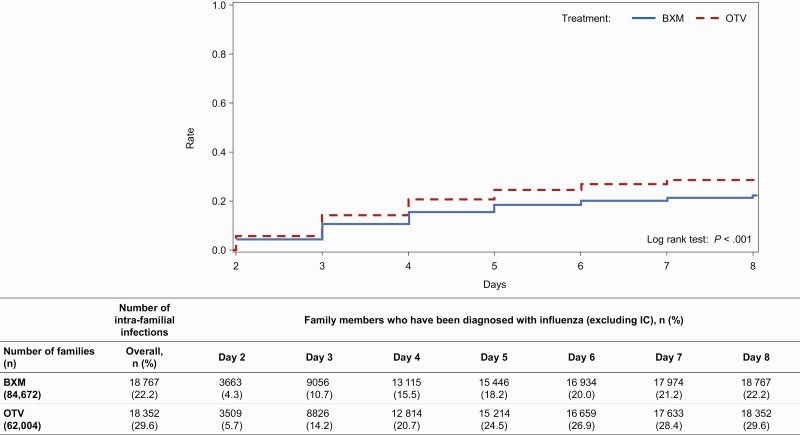
The median proportion of families with intra-familial transmission was 9.57% and 19.35% in the BXM (N = 84 672) and OTV (N = 62 004) groups, respectively. The multivariate odds ratio of 1.73 (2.5th-97.5th percentiles, 1.68-1.77) indicated a substantially higher incidence of intra-familial infections in the OTV group versus the BXM group. Subgroup analyses by ICs' age category, virus type, and month of onset revealed similar trends favoring BXM.
BXM treatment of ICs may contribute to a greater reduction in intra-familial influenza transmission than OTV treatment.
流感影响着全球约 10 亿人,包括日本每年超过 1000 万人。巴洛沙韦马波西利(巴洛沙韦[BXM];一种选择性的 cap 依赖性内切酶抑制剂)在日本被批准用于流感治疗。我们使用模拟模型比较了 BXM 和奥司他韦(OTV)治疗流感时的家庭内传播发生率。
我们使用 JMDC 理赔数据库,将索引病例(IC)定义为 2018-19 流感季中第一个被诊断出患有流感的家庭成员,并根据给 IC 开出的药物将家庭分为 BXM 或 OTV 组。使用新的流感家庭内感染模型,我们根据特定药物的病毒脱落期模拟 IC 中流感感染的持续时间。家庭内感染定义为在 IC 中特定药物的病毒脱落期内感染的非 IC 家庭成员。非 IC 家庭成员的病毒潜伏期被认为可以排除潜在的外部暴露引起的二次感染。主要终点是发生家庭内感染的家庭比例。对于组间比较,我们使用了多变量逻辑回归模型。
BXM 组(N=84672)和 OTV 组(N=62004)中家庭内传播的中位数比例分别为 9.57%和 19.35%。多变量优势比为 1.73(25%-97.5%,1.68-1.77),表明 OTV 组家庭内感染的发生率明显高于 BXM 组。按 IC 年龄、病毒类型和发病月份进行的亚组分析也显示出有利于 BXM 的相似趋势。
IC 接受 BXM 治疗可能比接受 OTV 治疗更能减少家庭内流感传播。