University of Kentucky, 740 S Limestone, Suite K401, Lexington, Kentucky, 40536-0284, USA.
Duke University, Durham, USA.
Trials. 2022 Jan 31;23(1):98. doi: 10.1186/s13063-021-05982-3.
After anterior cruciate ligament (ACL) reconstruction, patient-reported outcomes are improved 10 years post-surgery; however, cytokine concentrations remain elevated years after surgery with over 80% of those with combined ACL and meniscus injuries having posttraumatic osteoarthritis (PTOA) within 10-15 years. The purpose of this multicenter, randomized, placebo-controlled trial is to assess whether a 6-month course of oral montelukast after ACL reconstruction reduces systemic markers of inflammation and biochemical and imaging biomarkers of cartilage degradation.
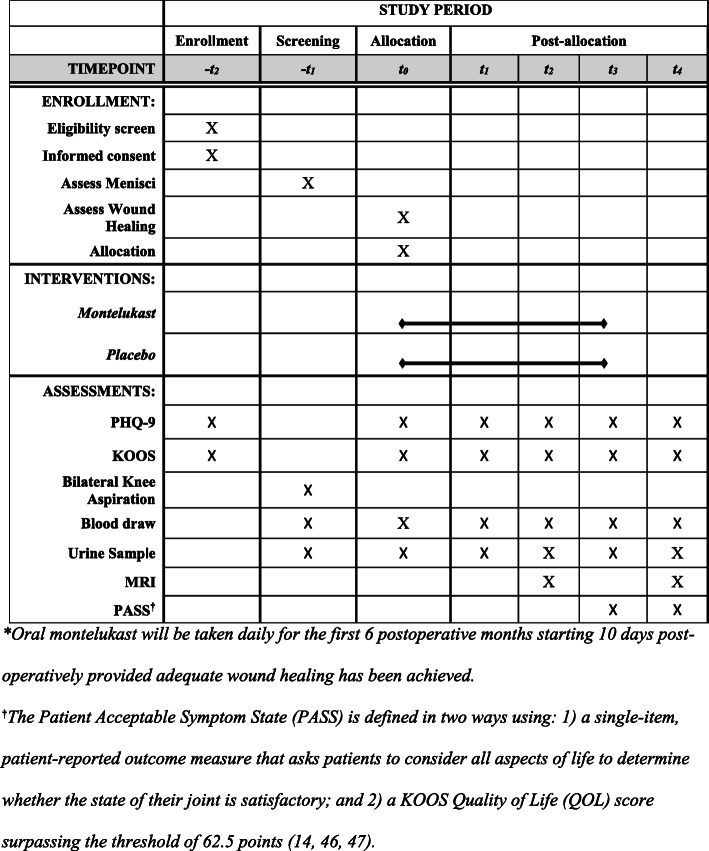
We will enroll 30 individuals undergoing primary ACL reconstruction to participate in this IRB-approved multicenter clinical trial. This trial will target those at greatest risk of a more rapid PTOA onset (age range 25-50 with concomitant meniscus injury). Patients will be randomly assigned to a group instructed to take 10 mg of montelukast daily for 6 months following ACL reconstruction or placebo. Patients will be assessed prior to surgery and 1, 6, and 12 months following surgery. To determine if montelukast alters systemic inflammation following surgery, we will compare systemic concentrations of prostaglandin E2, monocyte chemoattractant protein-1, and pro-inflammatory cytokines between groups. We will also compare degradative changes on magnetic resonance imaging (MRI) collected 1 and 12 months following surgery between groups with reductions in early biomarkers of cartilage degradation assessed with urinary biomarkers of type II collagen breakdown and bony remodeling.
There is a complex interplay between the pro-inflammatory intra-articular environment, underlying bone remodeling, and progressive cartilage degradation. PTOA affects multiple tissues and appears to be more similar to rheumatoid arthritis than osteoarthritis with respect to inflammation. There is currently no treatment to delay or prevent PTOA after ACL injury. Since there is a larger and more persistent inflammatory response after ACL reconstruction than the initial insult of injury, treatment may need to be initiated after surgery, sustained over a period of time, and target multiple mechanisms in order to successfully alter the disease process. This study will assess whether a 6-month postoperative course of oral montelukast affects multiple PTOA mechanisms. Because montelukast administration can be safely sustained for long durations and offers a low-cost treatment option, should it be proven effective in the current trial, these results can be immediately incorporated into clinical practice.
ClinicalTrials.gov NCT04572256 . Registered on October 1, 2020.
在前交叉韧带(ACL)重建后,患者报告的结果在手术后 10 年得到改善;然而,细胞因子浓度在手术后多年仍处于升高状态,超过 80%的 ACL 和半月板同时损伤的患者在 10-15 年内患有创伤后骨关节炎(PTOA)。本多中心、随机、安慰剂对照试验的目的是评估 ACL 重建后 6 个月的口服孟鲁司特是否能降低全身炎症标志物以及软骨降解的生化和影像学生物标志物。
我们将招募 30 名接受初次 ACL 重建的个体参与这项经 IRB 批准的多中心临床试验。该试验将针对那些发生 PTOA 更快的风险更高的人群(年龄在 25-50 岁,伴有半月板损伤)。患者将被随机分配到一组,指导他们在 ACL 重建后每天服用 10mg 孟鲁司特 6 个月,或安慰剂。患者将在手术前以及手术后 1、6 和 12 个月进行评估。为了确定孟鲁司特是否能改变手术后的全身炎症,我们将比较两组之间的前列腺素 E2、单核细胞趋化蛋白-1 和促炎细胞因子的全身浓度。我们还将比较两组之间手术后 1 个月和 12 个月的 MRI 收集的退化变化,通过评估 II 型胶原分解的尿生物标志物和骨重塑的早期软骨降解生物标志物来比较。
在促炎的关节内环境、潜在的骨重塑和渐进性软骨降解之间存在着复杂的相互作用。PTOA 影响多种组织,与炎症有关,与骨关节炎相比,它更类似于类风湿关节炎。目前没有治疗方法可以延迟或预防 ACL 损伤后的 PTOA。由于 ACL 重建后的炎症反应比最初的损伤更大、更持久,因此治疗可能需要在手术后开始,持续一段时间,并针对多个机制进行,以便成功改变疾病进程。本研究将评估 ACL 重建后 6 个月的口服孟鲁司特治疗是否会影响多种 PTOA 机制。由于孟鲁司特的给药可以安全地持续较长时间,并且提供了一种低成本的治疗选择,如果在当前试验中被证明有效,这些结果可以立即纳入临床实践。
ClinicalTrials.gov NCT04572256。注册于 2020 年 10 月 1 日。