Division of Neurology, Department of Medicine, Queen Mary Hospital, University of Hong Kong, Hong Kong, China.
School of Biomedical Sciences, Li Ka Shing Faculty of Medicine, University of Hong Kong, Hong Kong, China.
Transl Neurodegener. 2022 Jan 31;11(1):5. doi: 10.1186/s40035-022-00281-6.
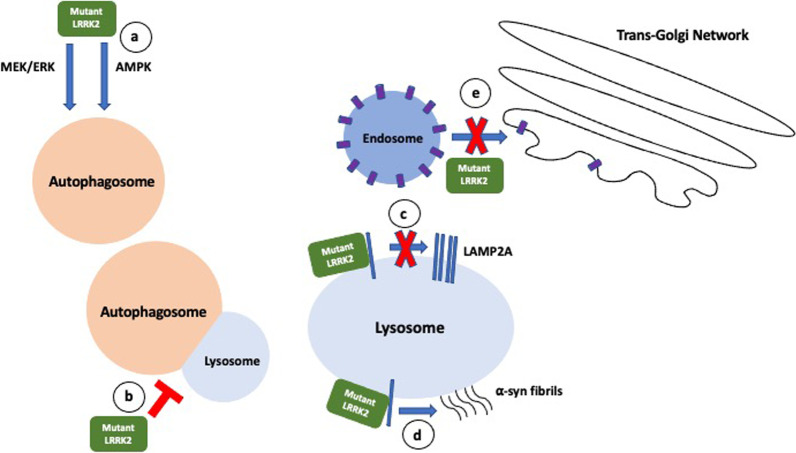
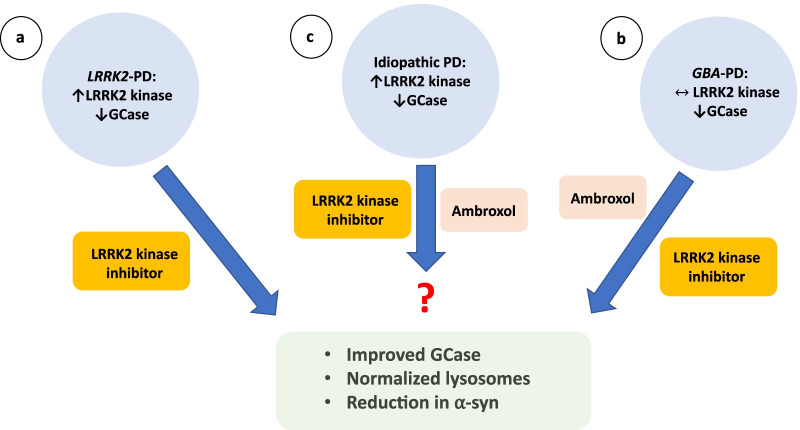
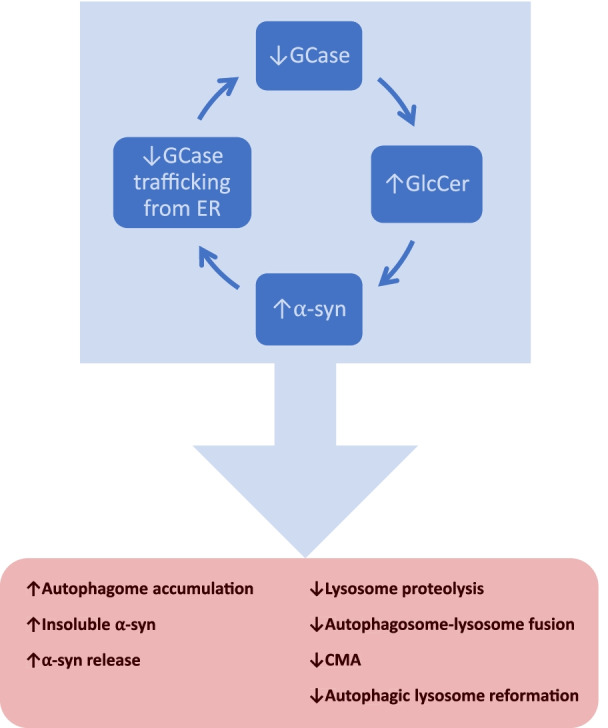
Mutations in leucine-rich repeat kinase 2 (LRRK2) and glucocerebrosidase (GBA) represent two most common genetic causes of Parkinson's disease (PD). Both genes are important in the autophagic-lysosomal pathway (ALP), defects of which are associated with α-synuclein (α-syn) accumulation. LRRK2 regulates macroautophagy via activation of the mitogen activated protein kinase/extracellular signal regulated protein kinase (MAPK/ERK) kinase (MEK) and the calcium-dependent adenosine monophosphate (AMP)-activated protein kinase (AMPK) pathways. Phosphorylation of Rab GTPases by LRRK2 regulates lysosomal homeostasis and endosomal trafficking. Mutant LRRK2 impairs chaperone-mediated autophagy, resulting in α-syn binding and oligomerization on lysosomal membranes. Mutations in GBA reduce glucocerebrosidase (GCase) activity, leading to glucosylceramide accumulation, α-syn aggregation and broad autophagic abnormalities. LRRK2 and GBA influence each other: GCase activity is reduced in LRRK2 mutant cells, and LRRK2 kinase inhibition can alter GCase activity in GBA mutant cells. Clinically, LRRK2 G2019S mutation seems to modify the effects of GBA mutation, resulting in milder symptoms than those resulting from GBA mutation alone. However, dual mutation carriers have an increased risk of PD and earlier age of onset compared with single mutation carriers, suggesting an additive deleterious effect on the initiation of PD pathogenic processes. Crosstalk between LRRK2 and GBA in PD exists, but its exact mechanism is unclear. Drugs that inhibit LRRK2 kinase or activate GCase are showing efficacy in pre-clinical models. Since LRRK2 kinase and GCase activities are also altered in idiopathic PD (iPD), it remains to be seen if these drugs will be useful in disease modification of iPD.
LRRK2(富含亮氨酸重复激酶 2)和 GBA(葡萄糖脑苷脂酶)的突变是帕金森病(PD)的两个最常见的遗传原因。这两个基因在自噬溶酶体途径(ALP)中都很重要,该途径的缺陷与α-突触核蛋白(α-syn)的积累有关。LRRK2 通过激活丝裂原活化蛋白激酶/细胞外信号调节蛋白激酶(MAPK/ERK)激酶(MEK)和钙依赖性腺苷单磷酸(AMP)激活蛋白激酶(AMPK)途径来调节巨自噬。LRRK2 通过磷酸化 Rab GTPases 来调节溶酶体稳态和内体运输。突变的 LRRK2 会损害伴侣介导的自噬,导致α-syn 与溶酶体膜结合并寡聚化。GBA 突变会降低葡萄糖脑苷脂酶(GCase)的活性,导致葡萄糖脑苷脂积累、α-syn 聚集和广泛的自噬异常。LRRK2 和 GBA 相互影响:LRRK2 突变细胞中的 GCase 活性降低,而 LRRK2 激酶抑制可以改变 GBA 突变细胞中的 GCase 活性。临床上,LRRK2 G2019S 突变似乎会改变 GBA 突变的影响,导致比 GBA 突变单独引起的症状更轻。然而,与单突变携带者相比,双突变携带者患 PD 的风险增加,发病年龄更早,这表明对 PD 发病机制的启动有累加的有害影响。LRRK2 和 GBA 之间在 PD 中存在相互作用,但确切的机制尚不清楚。抑制 LRRK2 激酶或激活 GCase 的药物在临床前模型中显示出疗效。由于 LRRK2 激酶和 GCase 活性也在特发性 PD(iPD)中发生改变,因此这些药物是否对 iPD 的疾病修饰有用仍有待观察。