Department of Artificial Intelligence, Donders Institute for Brain, Cognition and Behaviour, Radboud University, Nijmegen, the Netherlands.
Department of Biophysics, Donders Institute for Brain, Cognition and Behaviour, Radboud University, Nijmegen, the Netherlands.
J Vis. 2022 Feb 1;22(2):1. doi: 10.1167/jov.22.2.1.
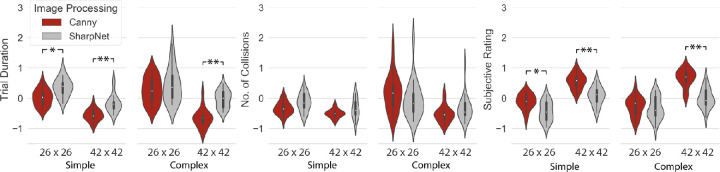
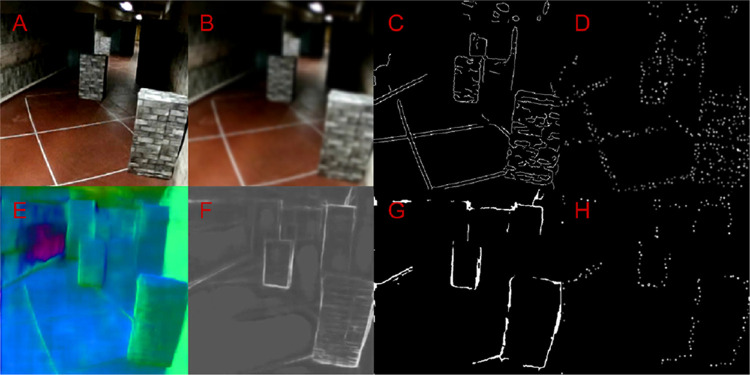
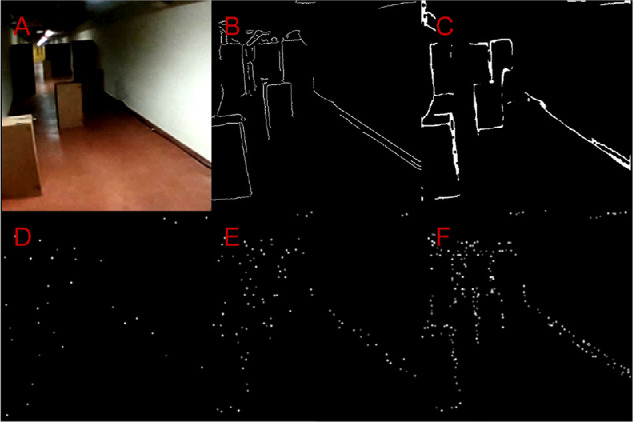
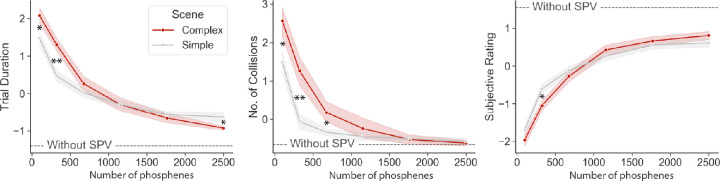
Neuroprosthetic implants are a promising technology for restoring some form of vision in people with visual impairments via electrical neurostimulation in the visual pathway. Although an artificially generated prosthetic percept is relatively limited compared with normal vision, it may provide some elementary perception of the surroundings, re-enabling daily living functionality. For mobility in particular, various studies have investigated the benefits of visual neuroprosthetics in a simulated prosthetic vision paradigm with varying outcomes. The previous literature suggests that scene simplification via image processing, and particularly contour extraction, may potentially improve the mobility performance in a virtual environment. In the current simulation study with sighted participants, we explore both the theoretically attainable benefits of strict scene simplification in an indoor environment by controlling the environmental complexity, as well as the practically achieved improvement with a deep learning-based surface boundary detection implementation compared with traditional edge detection. A simulated electrode resolution of 26 × 26 was found to provide sufficient information for mobility in a simple environment. Our results suggest that, for a lower number of implanted electrodes, the removal of background textures and within-surface gradients may be beneficial in theory. However, the deep learning-based implementation for surface boundary detection did not improve mobility performance in the current study. Furthermore, our findings indicate that, for a greater number of electrodes, the removal of within-surface gradients and background textures may deteriorate, rather than improve, mobility. Therefore, finding a balanced amount of scene simplification requires a careful tradeoff between informativity and interpretability that may depend on the number of implanted electrodes.
神经假体植入物是一种有前途的技术,可通过视觉通路中的电神经刺激为视力障碍者恢复某种形式的视力。虽然与正常视力相比,人为产生的假体感知相对有限,但它可能提供周围环境的一些基本感知,重新实现日常生活功能。特别是对于移动性,各种研究已经在具有不同结果的模拟假体视觉范式中研究了视觉神经假体的益处。先前的文献表明,通过图像处理进行场景简化,特别是轮廓提取,可能会潜在地改善虚拟环境中的移动性能。在当前具有视力的参与者的模拟研究中,我们通过控制环境复杂性来探索严格的场景简化在室内环境中的理论上可实现的益处,以及与传统边缘检测相比,基于深度学习的表面边界检测实现的实际改进。发现模拟电极分辨率为 26×26 可以为简单环境中的移动提供足够的信息。我们的研究结果表明,对于较少数量的植入电极,从理论上讲,去除背景纹理和表面内梯度可能是有益的。然而,在当前研究中,基于深度学习的表面边界检测的实现并没有提高移动性能。此外,我们的研究结果表明,对于更多数量的电极,去除表面内梯度和背景纹理可能会恶化而不是改善移动性。因此,找到平衡的场景简化量需要在信息量和可解释性之间进行仔细的权衡,这可能取决于植入电极的数量。