Rare and Neurological Diseases Therapeutic Area, Sanofi, 49 New York Avenue, Framingham, MA, 01701, USA.
Translational In Vivo Models, Sanofi, 5 Mountain Road, Framingham, MA, 01701, USA.
Alzheimers Res Ther. 2022 Feb 1;14(1):19. doi: 10.1186/s13195-022-00966-0.
Gangliosides are highly enriched in the brain and are critical for its normal development and function. However, in some rare neurometabolic diseases, a deficiency in lysosomal ganglioside hydrolysis is pathogenic and leads to early-onset neurodegeneration, neuroinflammation, demyelination, and dementia. Increasing evidence also suggests that more subtle ganglioside accumulation contributes to the pathogenesis of more common neurological disorders including Alzheimer's disease (AD). Notably, ganglioside GM3 levels are elevated in the brains of AD patients and in several mouse models of AD, and plasma GM3 levels positively correlate with disease severity in AD patients.
Tg2576 AD model mice were fed chow formulated with a small molecule inhibitor of glucosylceramide synthase (GCSi) to determine whether reducing glycosphingolipid synthesis affected aberrant GM3 accumulation, amyloid burden, and disease manifestations in cognitive impairment. GM3 was measured with LC-MS, amyloid burden with ELISA and amyloid red staining, and memory was assessed using the contextual fear chamber test.
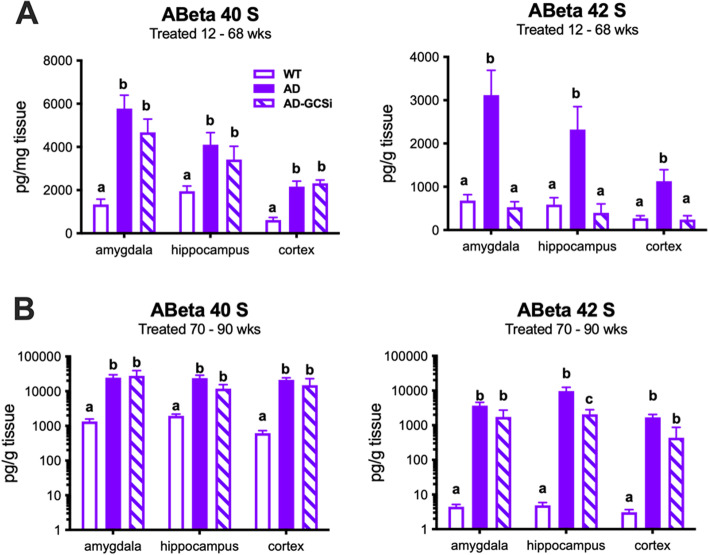
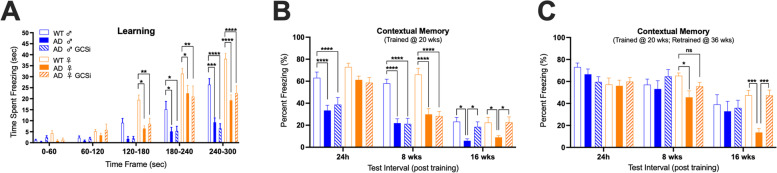
GCSi mitigated soluble Aβ42 accumulation in the brains of AD model mice when treatment was started prophylactically. Remarkably, GCSi treatment also reduced soluble Aβ42 levels and amyloid plaque burden in aged (i.e., 70 weeks old) AD mice with preexisting neuropathology. Our analysis of contextual memory in Tg2576 mice showed that impairments in remote (cortical-dependent) memory consolidation preceded deficits in short-term (hippocampal-dependent) contextual memory, which was consistent with soluble Aβ42 accumulation occurring more rapidly in the cortex of AD mice compared to the hippocampus. Notably, GCSi treatment significantly stabilized remote memory consolidation in AD mice-especially in mice with enhanced cognitive training. This finding was consistent with GCSi treatment lowering aberrant GM3 accumulation in the cortex of AD mice.
Collectively, our results indicate that glycosphingolipids regulated by GCS are important modulators of Aβ neuropathology and that glycosphingolipid homeostasis plays a critical role in the consolidation of remote memories.
神经节苷脂在大脑中高度富集,对其正常发育和功能至关重要。然而,在一些罕见的神经代谢疾病中,溶酶体神经节苷脂水解的缺陷是致病的,并导致早发性神经退行性变、神经炎症、脱髓鞘和痴呆。越来越多的证据还表明,更微妙的神经节苷脂积累有助于更常见的神经疾病的发病机制,包括阿尔茨海默病(AD)。值得注意的是,AD 患者的大脑中和几种 AD 小鼠模型中 GM3 水平升高,AD 患者的血浆 GM3 水平与疾病严重程度呈正相关。
用含有小分子葡萄糖神经酰胺合酶抑制剂(GCSi)的饲料喂养 Tg2576 AD 模型小鼠,以确定降低糖脂合成是否影响异常 GM3 积累、淀粉样蛋白负荷和认知障碍中的疾病表现。使用 LC-MS 测量 GM3,用 ELISA 和淀粉样蛋白红色染色测量淀粉样蛋白负荷,并用情境恐惧室测试评估记忆。
当预防性开始治疗时,GCSi 减轻了 AD 模型小鼠大脑中可溶性 Aβ42 的积累。值得注意的是,GCSi 治疗还降低了具有预先存在神经病理学的老年(即 70 周龄)AD 小鼠的可溶性 Aβ42 水平和淀粉样斑块负担。我们对 Tg2576 小鼠的情境记忆分析表明,远程(皮质依赖性)记忆巩固的损伤先于短期(海马依赖性)情境记忆的缺陷,这与 AD 小鼠大脑中的可溶性 Aβ42 积累比海马中更快一致。值得注意的是,GCSi 治疗显着稳定了 AD 小鼠的远程记忆巩固-尤其是在接受增强认知训练的小鼠中。这一发现与 GCSi 治疗降低 AD 小鼠大脑中异常 GM3 积累一致。
总之,我们的结果表明,GCS 调节的糖脂是 Aβ 神经病理学的重要调节剂,糖脂稳态在远程记忆的巩固中起着关键作用。