Division of Cancer Sciences, School of Medical Sciences, Faculty of Biology, Medicine and Health, University of Manchester, Manchester, UK.
NIHR Greater Manchester Patient Safety Translational Research Centre, University of Manchester, Manchester, UK.
BMC Med Inform Decis Mak. 2022 Feb 1;22(1):29. doi: 10.1186/s12911-022-01768-y.
Decisions aids (DA) can support patients to make informed decisions about screening tests. This study describes the development and initial evaluation of a lung cancer screening (LCS) DA targeted towards survivors of Hodgkin lymphoma (HL).
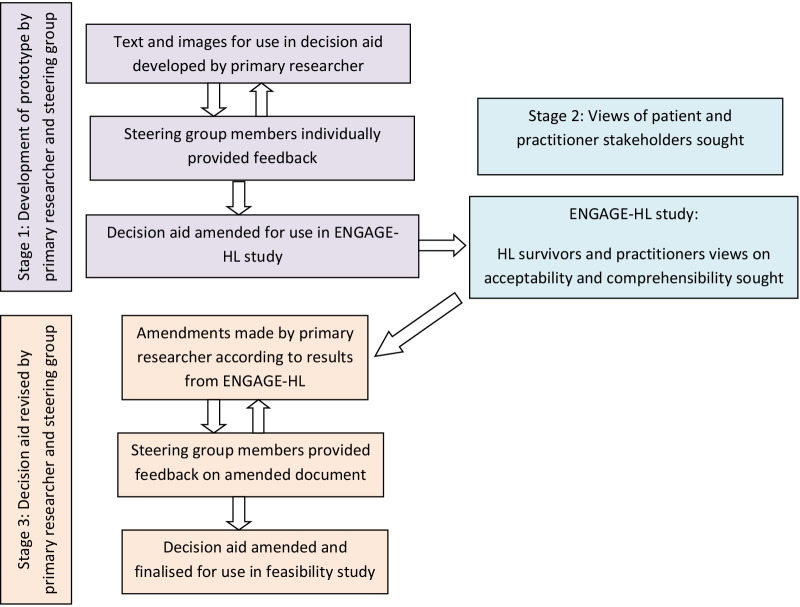
A prototype decision aid booklet was developed and subsequently reviewed by a steering group who provided feedback. Revisions were made to produce the DA tested in this study. HL survivors were recruited to an online survey and/or focus groups. Lymphoma practitioners were invited to an interview study. In the online survey, decisional conflict scales and knowledge scales were completed before and after accessing the DA. The focus groups and interviews explored acceptability and comprehensibility and the decisional needs of stakeholders. Focus groups and interviews were audio recorded. The framework method was used to analyse qualitative data.
38 HL survivors completed the online survey. Following exposure to the DA, knowledge of LCS and risk factors and decisional conflict scores (total score and subscale scores) improved significantly. 11 HL survivors took part in two focus groups (n = 5 and n = 6) and 11 practitioners were interviewed. Focus group and interview results: The language, format and length were considered acceptable. Both groups felt the DA was balanced and presented a choice. Icon arrays were felt to aid comprehension of absolute risk values and for some survivors, they reduced affective risk perceptions. Among survivors, the impact of radiation risk on decision making varied according to gender and screening interval, whilst practitioners did not anticipate it to be a major concern for patients. Both groups expressed that a screening offer could mitigate anxiety about lung cancer risk. As anticipated by practitioners, survivors expressed a desire to seek advice from their clinical team. Practitioners thought the DA would meet their informational needs regarding LCS when supporting survivors.
The DA is considered acceptable by HL survivors and practitioners. The DA reduces decisional conflict and improves knowledge in HL survivors, suggesting that it would support HL survivors to make informed decisions when considering LCS in a future clinical trial.
决策辅助工具(DA)可以帮助患者对筛查测试做出明智的决策。本研究描述了一种针对霍奇金淋巴瘤(HL)幸存者的肺癌筛查(LCS)决策辅助工具的开发和初步评估。
开发了一个原型决策辅助手册,随后由一个指导小组进行审查并提供反馈。对该手册进行了修订,以产生本研究中测试的决策辅助工具。招募 HL 幸存者参加在线调查和/或焦点小组。邀请淋巴瘤医生参加访谈研究。在在线调查中,参与者在访问决策辅助工具前后完成了决策冲突量表和知识量表。焦点小组和访谈探讨了利益相关者的可接受性和可理解性以及决策需求。焦点小组和访谈进行了录音。采用框架方法分析定性数据。
38 名 HL 幸存者完成了在线调查。在接触决策辅助工具后,LCS 和风险因素的知识以及决策冲突得分(总分和子量表得分)显著提高。11 名 HL 幸存者参加了两个焦点小组(n=5 和 n=6)和 11 名医生接受了访谈。焦点小组和访谈结果:语言、格式和长度被认为是可以接受的。两个组都认为该决策辅助工具是平衡的,并提供了选择。图标数组有助于理解绝对风险值,对于一些幸存者来说,它们降低了对情感风险的感知。在幸存者中,辐射风险对决策的影响因性别和筛查间隔而异,而医生则预计这不会成为患者的主要关注点。两个组都表示,筛查建议可以减轻对肺癌风险的焦虑。正如医生所预期的那样,幸存者表示希望向他们的临床团队寻求建议。医生认为,当支持幸存者时,该决策辅助工具将满足他们对 LCS 的信息需求。
HL 幸存者和医生认为该决策辅助工具是可以接受的。该决策辅助工具降低了 HL 幸存者的决策冲突并提高了他们的知识,这表明它将支持 HL 幸存者在未来的临床试验中对 LCS 做出明智的决策。