Center for Population Health Research, National Institute of Public Health, Cuernavaca, Mexico.
Center for Research in Evaluation and Surveys, National Institute of Public Health, Cuernavaca, Mexico.
Nat Commun. 2022 Feb 1;13(1):589. doi: 10.1038/s41467-022-28232-9.
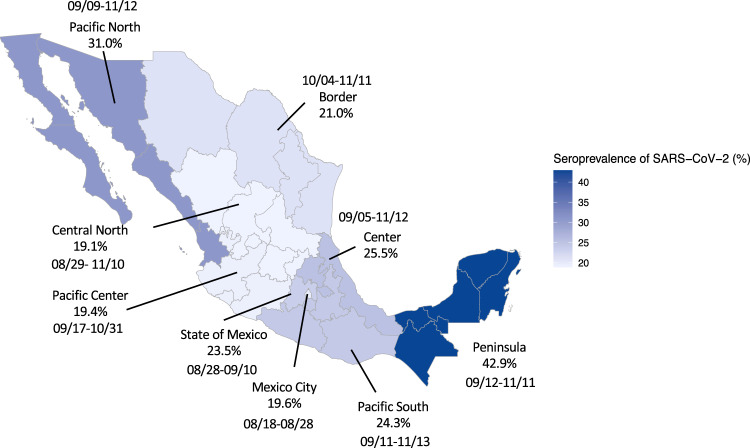
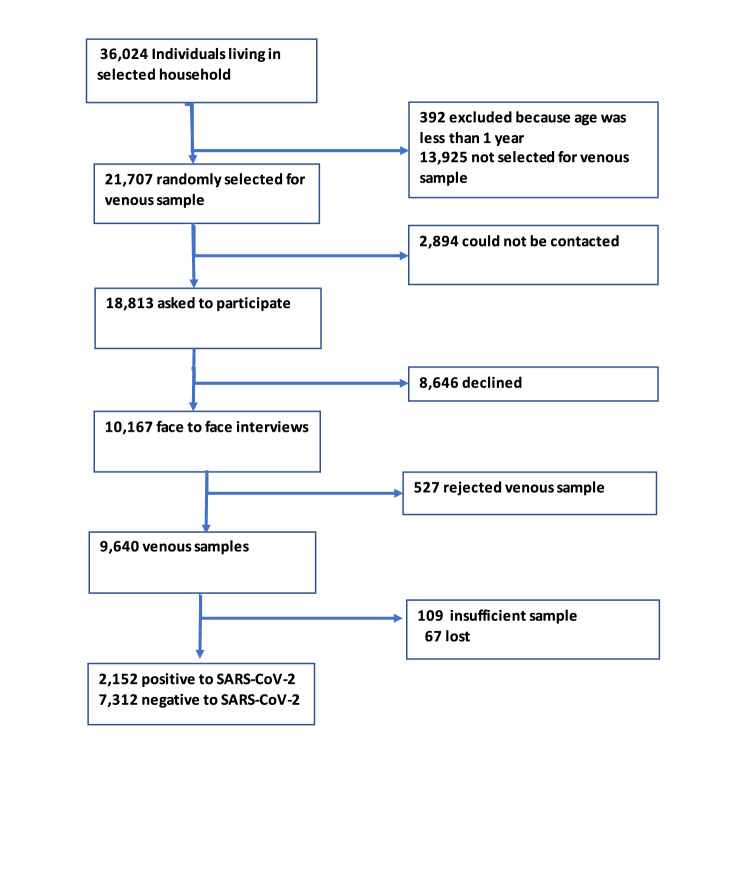
Seroprevalence surveys provide estimates of the extent of SARS-CoV-2 infections in the population, regardless of disease severity and test availability. In Mexico in 2020, COVID-19 cases reached a maximum in July and December. We aimed to estimate the national and regional seroprevalence of SARS-CoV-2 antibodies across demographic and socioeconomic groups in Mexico after the first wave, from August to November 2020. We used nationally representative survey data including 9,640 blood samples. Seroprevalence was estimated by socioeconomic and demographic characteristics, adjusting by the sensitivity and specificity of the immunoassay test. The national seroprevalence of SARS-CoV-2 antibodies was 24.9% (95%CI 22.2, 26.7), being lower for adults 60 years and older. We found higher seroprevalence among urban and metropolitan areas, low socioeconomic status, low education and workers. Among seropositive people, 67.3% were asymptomatic. Social distancing, lockdown measures and vaccination programs need to consider that vulnerable groups are more exposed to the virus and unable to comply with lockdown measures.
血清流行率调查提供了人群中 SARS-CoV-2 感染程度的估计,无论疾病严重程度和检测可用性如何。2020 年在墨西哥,COVID-19 病例在 7 月和 12 月达到峰值。我们的目的是在 2020 年 8 月至 11 月第一波疫情过后,在墨西哥全国范围内按人口统计学和社会经济群体估计 SARS-CoV-2 抗体的血清流行率。我们使用了包括 9640 份血液样本的全国代表性调查数据。血清流行率根据社会经济和人口统计学特征进行了估计,并调整了免疫测定试验的灵敏度和特异性。SARS-CoV-2 抗体的全国血清流行率为 24.9%(95%CI 22.2,26.7),60 岁及以上的成年人较低。我们发现城市和大都市区、低社会经济地位、低教育和工人的血清流行率较高。在血清阳性人群中,67.3%为无症状。社会疏远、封锁措施和疫苗接种计划需要考虑到弱势群体更容易接触到病毒,并且无法遵守封锁措施。