Blood, Stem Cells and Cancer Research Laboratory, St Vincent's Centre for Applied Medical Research, Darlinghurst, Sydney, New South Wales, Australia.
St Vincent's Clinical School, Faculty of Medicine, University of New South Wales, Sydney, New South Wales, Australia.
Ann Clin Transl Neurol. 2022 Feb;9(2):206-220. doi: 10.1002/acn3.51510. Epub 2022 Feb 1.
Autologous haematopoietic stem cell transplantation (AHSCT) has the potential to induce sustained periods of disease remission in multiple sclerosis (MS), which is an inflammatory disease of the central nervous system (CNS) characterised by demyelination and axonal degeneration. However, the mechanisms associated with durable treatment responses in MS require further elucidation.
To characterise the longer term immune reconstitution effects of AHSCT at 24 and 36 months (M) post-transplant, high-dimensional immunophenotyping of peripheral blood mononuclear cells from 22 MS patients was performed using two custom-designed 18-colour flow cytometry panels.
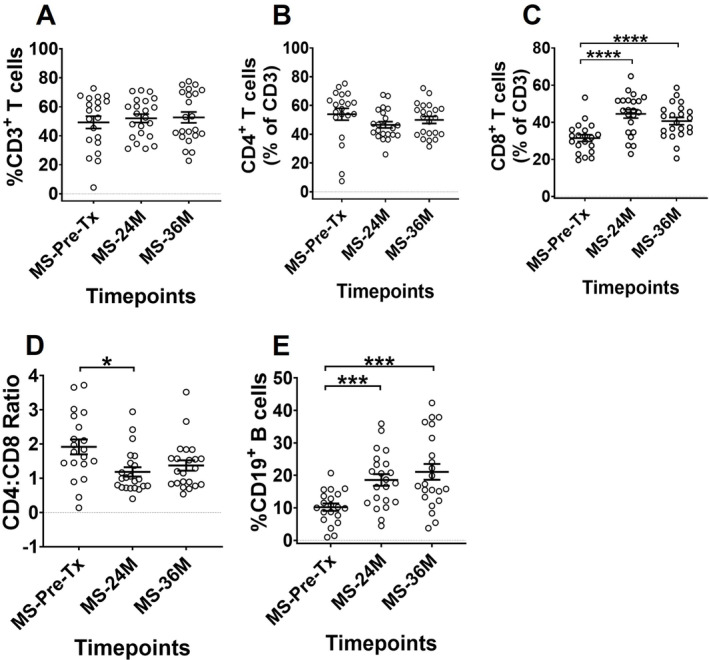
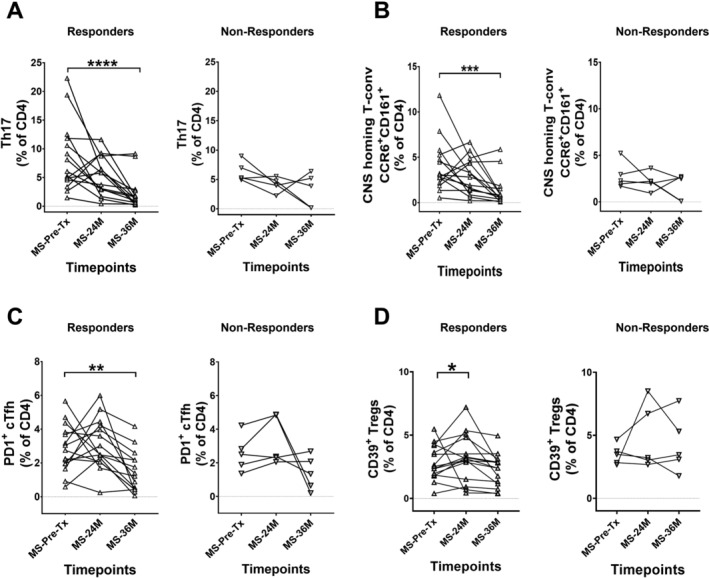
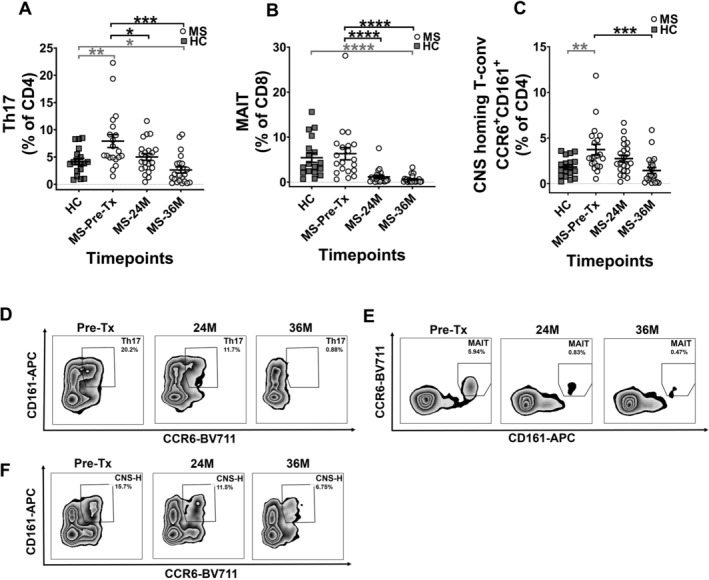
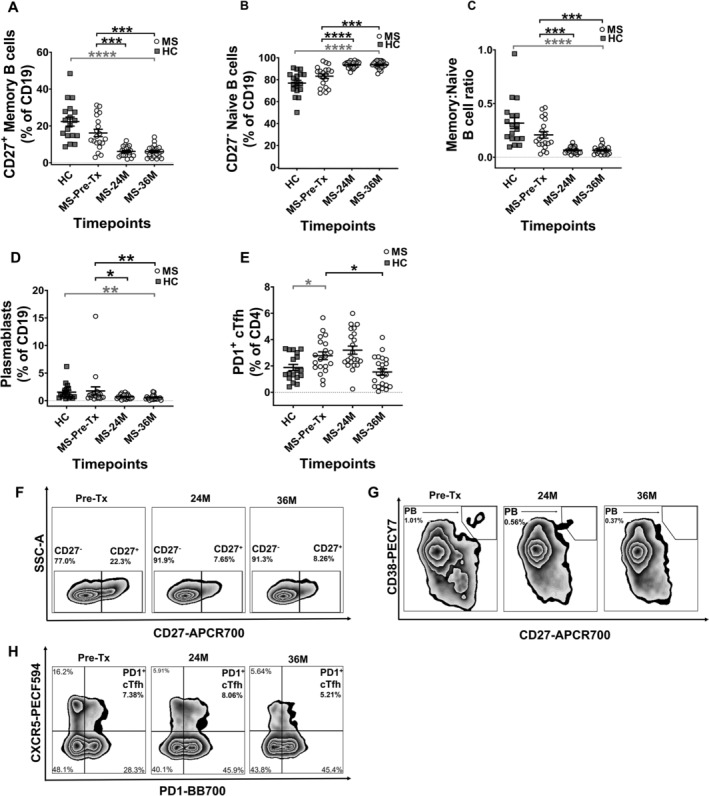
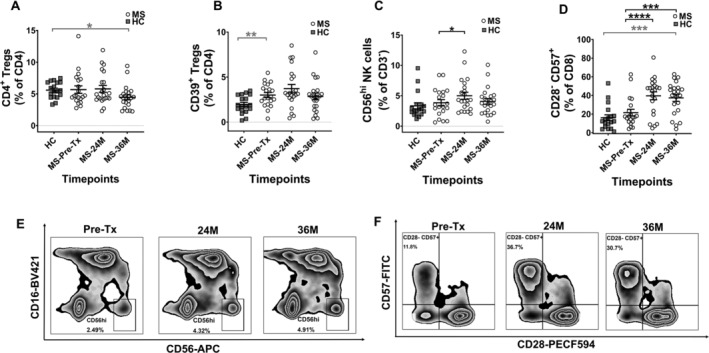
The higher baseline frequencies of specific pro-inflammatory immune cells (T-helper-17 (Th17) cells, mucosal-associated invariant T-cells and CNS-homing T-conventional (T-conv) cells observed in MS patients were decreased post-AHSCT by 36M. This was accompanied by a post-AHSCT increase in frequencies and absolute counts of immunoregulatory CD56 natural killer cells at 24M and terminally differentiated CD8 CD28 CD57 cells until 36M. A sustained increase in the proportion of naïve B-cells, with persistent depletion of memory B-cells and plasmablasts was observed until 36M. Reconstitution of the B-cell repertoire was accompanied by a reduction in the frequency of circulating T-follicular helper cells (cTfh) expressing programmed cell death-1 (PD1 ) at 36M. Associations between frequency dynamics and clinical outcomes indicated only responder patients to exhibit a decrease in Th17, CNS-homing T-conv and PD1 cTfh pro-inflammatory subsets at 36M, and an increase in CD39 T-regulatory cells at 24M.
AHSCT induces substantial recalibration of pro-inflammatory and immunoregulatory components of the immune system of MS patients for up to 36M post-transplant.
自体造血干细胞移植(AHSCT)有可能诱导多发性硬化症(MS)持续缓解,这是一种中枢神经系统(CNS)的炎症性疾病,其特征是脱髓鞘和轴突变性。然而,MS 中与持久治疗反应相关的机制仍需要进一步阐明。
为了在移植后 24 和 36 个月(M)时描述 AHSCT 的更长期免疫重建效应,对 22 名 MS 患者的外周血单个核细胞进行了二维免疫表型分析,使用了两个定制的 18 色流式细胞术面板。
MS 患者的基线频率较高的特定促炎免疫细胞(辅助性 T 细胞 17(Th17)细胞、黏膜相关不变 T 细胞和中枢神经系统归巢 T 常规(T-conv)细胞)在 AHSCT 后下降了 36M。这伴随着 AHSCT 后 24M 时免疫调节性 CD56 自然杀伤细胞的频率和绝对计数增加,以及终末分化的 CD8 CD28 CD57 细胞直到 36M。直到 36M,观察到幼稚 B 细胞的比例持续增加,而记忆 B 细胞和浆母细胞持续耗竭。B 细胞 repertoire 的重建伴随着循环滤泡辅助性 T 细胞(cTfh)中表达程序性细胞死亡-1(PD1)的频率在 36M 时降低。频率动态与临床结果之间的关联表明,只有应答者患者在 36M 时表现出 Th17、中枢神经系统归巢 T-conv 和 PD1 cTfh 促炎亚群的减少,以及 CD39 T 调节细胞的增加在 24M。
AHSCT 在移植后长达 36M 时间内诱导 MS 患者的促炎和免疫调节成分的大量重新校准。